
The Highest Rated Horsepower In An American Production Car
The United States has never had a shortage of horsepower obsessives, but the machines at the very top of the output chart have moved well beyond anything the muscle car era could have imagined. Yes, the 1960s gave us icons — the Pontiac GTO, the Chevrolet Camaro ZL1 cracking 400 hp — but today’s most extreme American production cars treat that figure as a warm-up. We’re now in an era where four-digit horsepower numbers are real, road-legal, and built right here in the USA.

Below, we’ve tracked down the most powerful production vehicles ever to emerge from American soil, ranked by pure horsepower output.
The Hennessey Venom F5 Is The Most Powerful American Production Car
Hennessey Venom F5 Specs
|
Engine |
 157 autotech 6.6-liter twin-turbo V8 |
|
Power |
1,817 HP |
|
Torque |
1,193 LB-FT |
(Source: Hennessey)
For those familiar with the work of renowned tuner Hennessey — which has produced wild vehicles like the Ram 1500-based Mammoth TRX and the Challenger Demon 1700 — it won’t come as much of a surprise that the company has created the most powerful US production car ever made. Keen to make a splash in the supercar scene as well as the tuning arena, Hennessey developed its F5 two-door coupe.
First unveiled in 2014, the F5 required seven years of development before it was finally delivered to customers in 2021. It is also one of the most exclusive performance cars ever offered, with only 24 examples of the original coupe built.
All have found owners, so any interested buyers had better keep their eyes peeled on the auction sites. Further models have been released since, however, including the open-top roadster and the track-focused F5 Revolution, both of which have been available for order.
How The Venom F5 Makes More Than 1,800 Horsepower
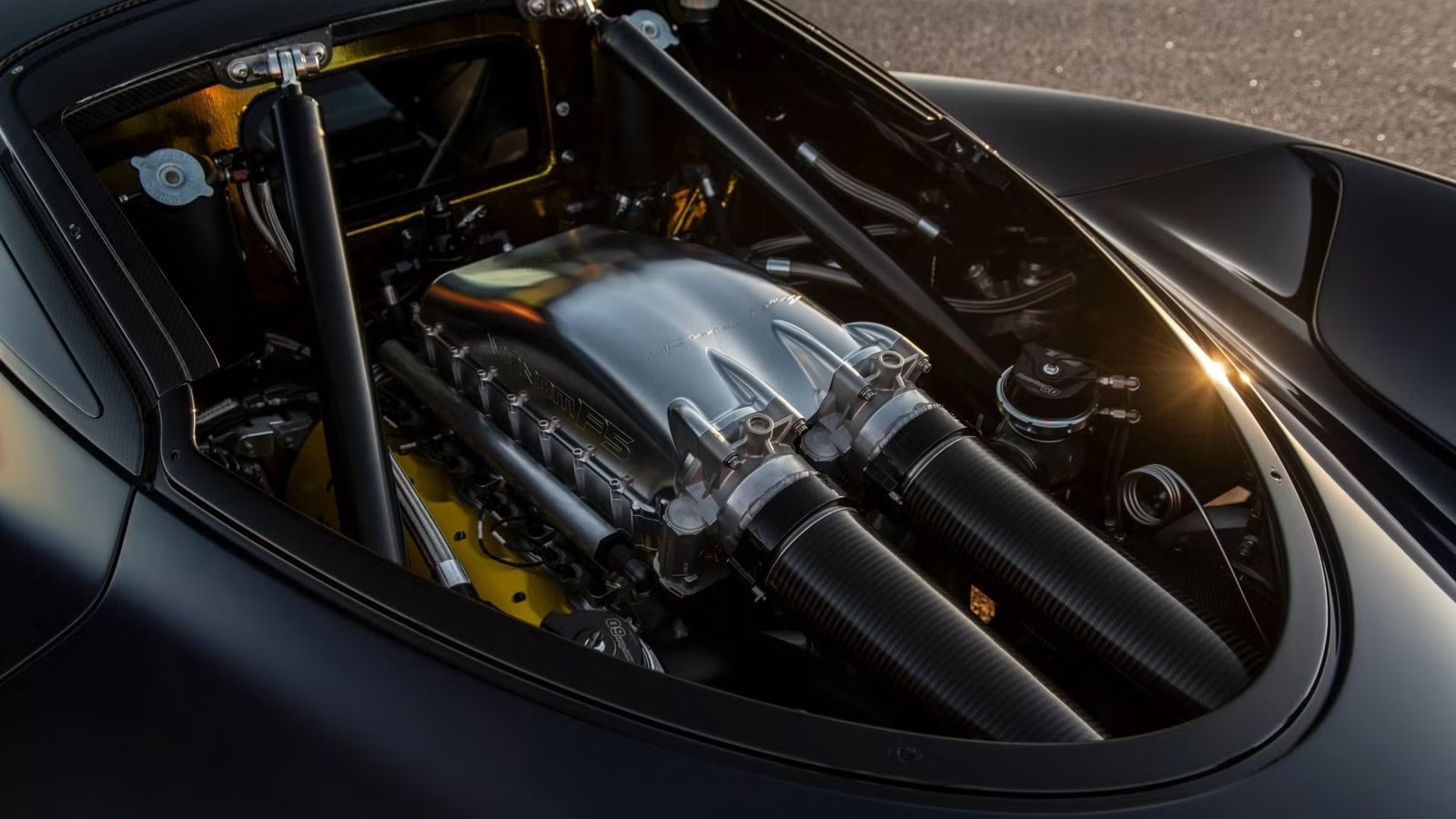
Production of the machine was undertaken by British company Delta Motorsport, which also helped develop the mighty Venom supercar. The F5 leads the power rankings thanks to a neck-snapping output of 1,817 hp, delivered by a twin-turbocharged 6.6-liter V8 that Hennessey calls the ‘Fury.’ The twin-turbo units are central to that headline figure, featuring large 76 mm aluminum compressor wheels to force-feed the engine.
Interestingly, while the Fury V8 features lightweight aluminum cylinder heads and titanium intake valves, the block itself is made from cast iron. Some high-performance engines use aluminum blocks to save weight, but cast iron offers better long-term durability and is generally easier and less expensive to repair. The connecting rods are forged steel, and the engine uses a dry-sump oiling system.
Because the oil reservoir sits alongside the engine rather than in a pan beneath it, the system can hold more oil and is far less susceptible to starvation under the extreme lateral loads generated at high speed. The absence of a conventional sump also allows the engine to sit lower in the chassis, dropping the car’s center of gravity for sharper handling.
Hennessey’s Venom F5 Is Track-Ready
Alongside the 1,817 hp engine, the F5 also produces 1,193 lb-ft of torque, which helps carry it to a top speed of over 250 mph. It isn’t simply a power merchant, either — Hennessey invested significant effort in ensuring the car could also tackle the twisty bits. A double-wishbone independent suspension system keeps the car stable under high-speed cornering, while carbon ceramic brakes allow the F5 to shed speed as impressively as it builds it.
The chassis and body are kept light through extensive use of carbon fiber, with the chassis alone tipping the scales at just 190 lbs. A front splitter and rear diffuser generate downforce to keep the car planted at speed, but the track-focused Revolution model takes aerodynamics to an entirely different level.
While it shares the same Fury engine as the standard F5, the Revolution receives an aggressive aero package featuring a large adjustable rear wing and a revised front splitter. The suspension has been retuned specifically for circuit use, and this variant is also limited to 24 units. The results speak for themselves: the car broke the production car lap record at the Circuit of the Americas in Texas.
A time of 2:10.9 put it four-tenths of a second ahead of the previous record holder, the Czinger 21C, and an astonishing seven seconds faster than the McLaren P1. While the Venom’s cornering ability is genuinely impressive, the fact that it is the most powerful vehicle ever built in the US remains its defining achievement.
The SSC Tuatara Is Another Extremely Powerful American Supercar

SSC Tuatara Specs
|
Engine |
5.9-liter twin-turbo V8 |
|
Power |
1,750 hp (On Methanol/Ethanol |
|
Torque |
1,279 lb-ft |
(Source: SSC)
They say great minds think alike, and that’s certainly true of performance heavyweights Hennessey and SSC. The latter — which previously built the Ultimate Aero that claimed the title of world’s fastest production car from the Bugatti Veyron back in 2007 — also chose a twin-turbocharged V8 layout for its Tuatara hypercar.
SSC opted for a slightly smaller 5.9-liter displacement for the Tuatara, which yields a peak output of 1,750 hp — still a staggering figure, though a step behind the Venom F5. That number requires ethanol or methanol fuel to achieve; on standard 91-octane gasoline, the Tuatara produces 1,350 hp.
Like the F5, SSC designed the Tuatara to be enjoyed on a circuit as well as a straight. An active rear wing and front splitter work together to keep the car planted under high-speed cornering loads. And while it can’t match the F5’s power output, the Tuatara does pull ahead in at least one critical area: weight.
With a dry weight of 2,750 lbs, the Tuatara is around 250 lbs lighter than the F5. It also benefits from a superior drag coefficient, the result of SSC’s meticulous attention to aerodynamic efficiency. Its 0.279 Cd is the best in its class according to the company, comfortably undercutting the F5’s 0.39 Cd rating.
EVs Are Ready To Dominate The High Horsepower Arena
While the Tuatara bests the F5 in a couple of key areas, its power deficit means it must settle for second place in the all-time most powerful American car rankings. Both vehicles offer extraordinary performance, yet the rapidly advancing EV market may soon push them both down the list. Lotus’ Evija makes 2,011 hp, while Rimac’s Nevera produces 1,914 hp — and neither requires a drop of gasoline.
Sources: Hennessey, SSC

Related posts



Latest Post


No Comments