
The Most Well-Rounded Automatic Touring Motorcycle Of 2026
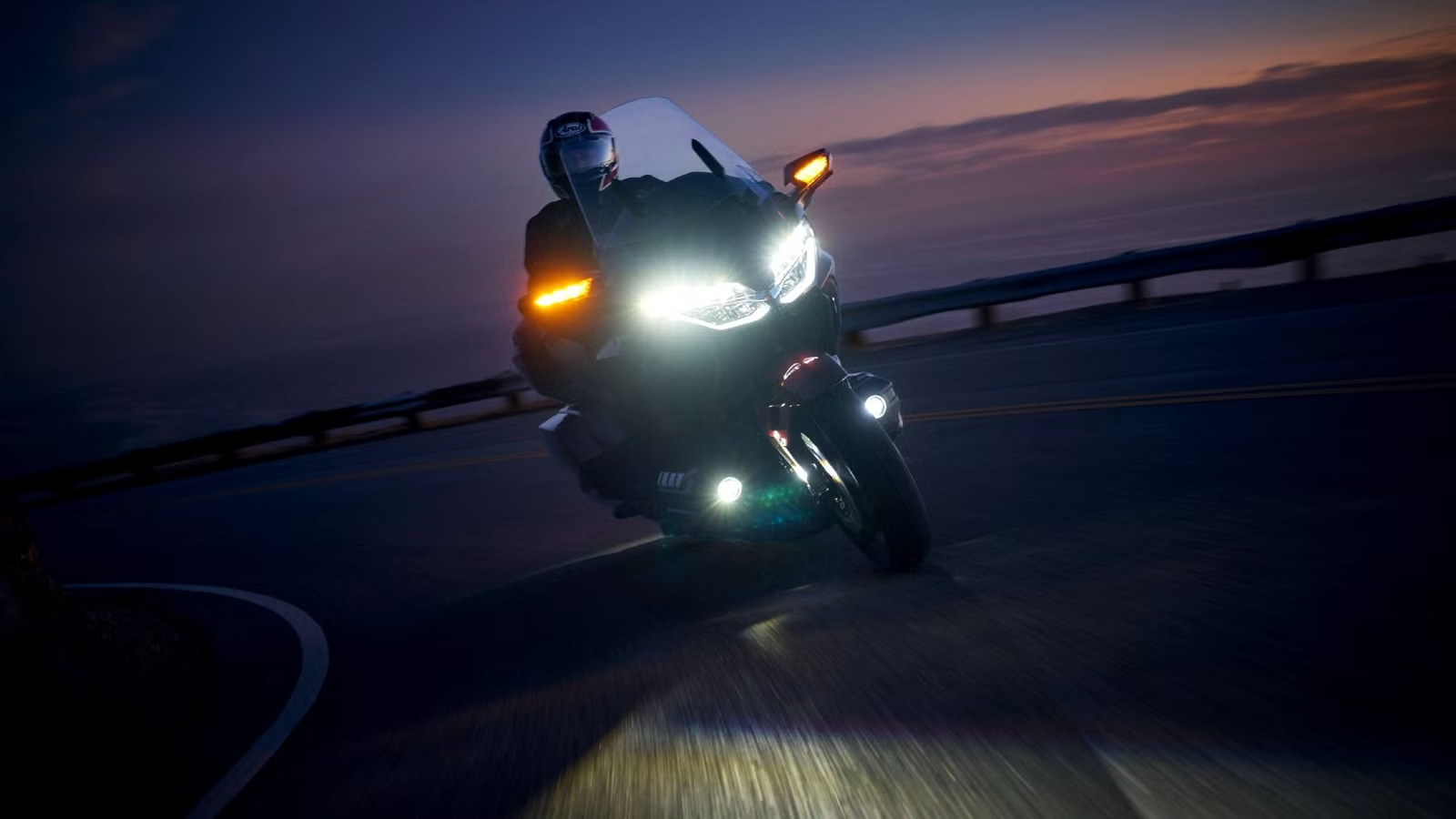
Back in 1980, about 35 percent of new cars sold in the U.S. would be equipped with a manual gearbox. According to EPA tracking data, that figure has sat under one percent for years in recent times, marking a clear, majority shift (pun intended) in transmission preference in cars. Automatic transmissions, after all, are not just convenient, but modern gearboxes shift faster and run more efficiently. Motorcycles, on the other hand, kept full manual control for the most part, with only now seeing the emergence of automated shifting tech like the AMT used by KTM.
Why Touring Bikes Are The Perfect Case For Ditching The Clutch

While offering a great deal of control, especially for dual-sport and adventure bikes on or off pavement, operating a clutch, with a purely pragmatic mindset, isn’t required everywhere. Imagine sitting on Interstate 70, a long, seemingly endless roughly 600-mile stretch between Denver and Kansas City.
Once you hit top gear, you’re only going to then use the clutch and gears when you exit into the city. By that time, you’ll be tired enough to wish that the motorcycle could handle the gear changes as you’re ready to wind down the day’s ride. And then, you hit a jam just a few miles away from your destination.

That’s the kind of inconvenience that an automatic transmission removes. For touring motorcycles, working the clutch by hand isn’t a necessity. Cruising in comfort is of the utmost importance, with throttle modulation taking up the majority of the speed control work. Operating a clutch by hand and shifting gears is just an added function in that case. Every stop in traffic, with a bulky tourer, and every parking-lot U-turn would require the left hand to modulate clutch friction and that can get tiring and even cause arm-pump for some riders.

Honda, being the pioneer that it is, first attempted this approach in the 2008 DN-01 using a hydraulic, infinitely variable transmission. The mechanism itself worked, but paired with a detuned 680cc V-twin, an extremely questionable moto-scooter-esque styling, and an eyebrow-raising ask of $14,599 for it, the combination sank the bike within two model years.

Two years later, Honda tried again with an entirely different mechanism. The 2010VFR1200F introduced a six-speed dual-clutch transmission (DCT) on a V4 sport-tourer. Now this stuck, simply because it made sense. Quicker shifting, optional manual control, and a confidence boost to Honda that kept building on it. Come 2018, Honda realized that the modern touring bike demanded this convenience, and the flagship Gold Wing added the seven-speed DCT.
No Tourer Does Automatics As Well As The Honda Gold Wing Tour DCT

Honda built the first Gold Wing in 1975 with a flat-four, while the flat-six came only after thirteen years with the GL1500. A bit over half a century on, the current Gold Wing Tour Automatic DCT continues to refine the same shaft-driven concept of the original GL1000.
Wrapped around a 1,833cc six-cylinder engine and a seven-speed automatic gearbox, the latest Gold Wing Tour Automatic DCT starts at $30,500, sitting between the top-caseless base Gold Wing Automatic DCT at $26,500 and the $33,800 Tour Airbag DCT above it. It’s undoubtedly the most relaxing bike you can buy today and not without reason.
The Dual-Clutch System That Makes 125 Horsepower Feel Effortless At Any Speed

The 1833cc flat-six is a remarkable piece of tech in itself, making 125 horsepower at 5,500 rpm and 125 pound-feet of torque at 4,500 rpm. The seven-speed DCT, however, is the real talking point. It shifts through that power with two clutches — one holding the current gear while the other pre-selects the next one — so the handoff happens almost instantaneously with no interruption in drive.
A Chassis Built To Shed The Couch-On-Wheels Reputation

Honda built the double-wishbone front end specifically to shed the Gold Wing’s old couch-on-wheels reputation. The wishbone design changes the front wheel’s path throughout its travel, which lets the engine and rider sit closer to the front axle and lowers the bike’s center of gravity compared to a telescopic fork.
Front travel is 4.3 inches, and the whole package still weighs 847 pounds with a full tank, so the chassis is doing a good amount of work to make a bike this size turn in like a much lighter bike. It’s exactly why this is the ultimate comfort tourer that beats luxury cars if you’re committed to motorcycling as a lifestyle.
The Comfort A Clutch-Free Cockpit Buys You

While the weight of the Gold Wing practically disappears on the move, it isn’t something to ignore at parking-lot pace. But the boffins at Honda think about everything. The DCT trims get Walking Mode, which uses engine power to creep the bike forward or backward at a walking pace, so you don’t look like a penguin muscling a loaded Gold Wing while paddling it with both feet. It is surprisingly easy to manage everywhere.
It’s a tourer, and luggage-carrying ability is another Gold Wing forte. The Tour trunk holds 16.1 gallons on its own, and combined with the saddlebags, the Gold Wing carries 32.0 gallons of weatherproof storage. Heated grips come standard across the whole Gold Wing range, and Tour trims add heated seats with separate temperature controls for rider and passenger as well. The electric windscreen moves through a 4.9-inch range and adjusts its angle as it rises, also remembering the last position set. A small feature you’ll appreciate while doing multiple 500-mile days.

It’s also the tech underneath the bodywork that makes the Gold Wing such a natural cross-country tourer. The four ride modes, Tour, Sport, Rain, and Econ, change more than throttle response. Rain mode also changes how the DCT shifts, limiting gear changes to lower engine speeds to keep the rear tire from breaking loose on a wet or slippery surface.
Honda Selectable Torque Control backs up the behavior by trimming torque the instant it detects rear-wheel slip. Hill Start Assist holds the bike in place on an incline for three seconds after the brake releases, giving the rider time to roll on the throttle before the bike can roll backward.
The Gold Wing Inspires An Automatic Wave In The Touring And Adventure Class

Motorcycling’s narrow focus on the manual gearbox is finally ending, as the touring and adventure category now picks up on the idea of automating the gear shifts, or at least, the clutch. The need for convenience in these genres of motorcycling has led every major manufacturer to develop its own version of the same idea Honda pioneered.
The DCT is an expensive technology and wouldn’t be fit for purpose in all applications, so an automated clutch that riders can leave alone in traffic and still override by hand when the road gets interesting, seems like a more cost-effective way forward. BMW’s Automated Shift Assistant is a brilliant workaround that already covers the R 1300 GS range, the R 1300 RS, and the RT, using electromechanical actuators to operate a conventional six-speed gearbox’s clutch.

KTM has its own Automated Manual Transmission on the 1390 Super Adventure S Evo, using a centrifugal-clutch six-speed. Yamaha’s Y-AMT, a similar automated-clutch system, reached the Tracer 9 GT and GT+ in 2025 and the smaller Tracer 7 GT for 2026, but it’s yet to reach American shores, staying limited to Europe, Canada, and Australia for now.
These systems use different mechanisms than Honda’s DCT, but the idea driving all of them traces back to what the Gold Wing proved was possible. The Gold Wing Tour DCT has spent eight years refining the automatic gearbox on a fully loaded touring platform, part of a DCT lineage Honda has been developing for sixteen years since the VFR1200F, setting a benchmark for the rest to follow.
Source: Honda

Related posts
Latest Post


No Comments