
The Forgotten Japanese Inline-Six That Chased Down A Porsche 904
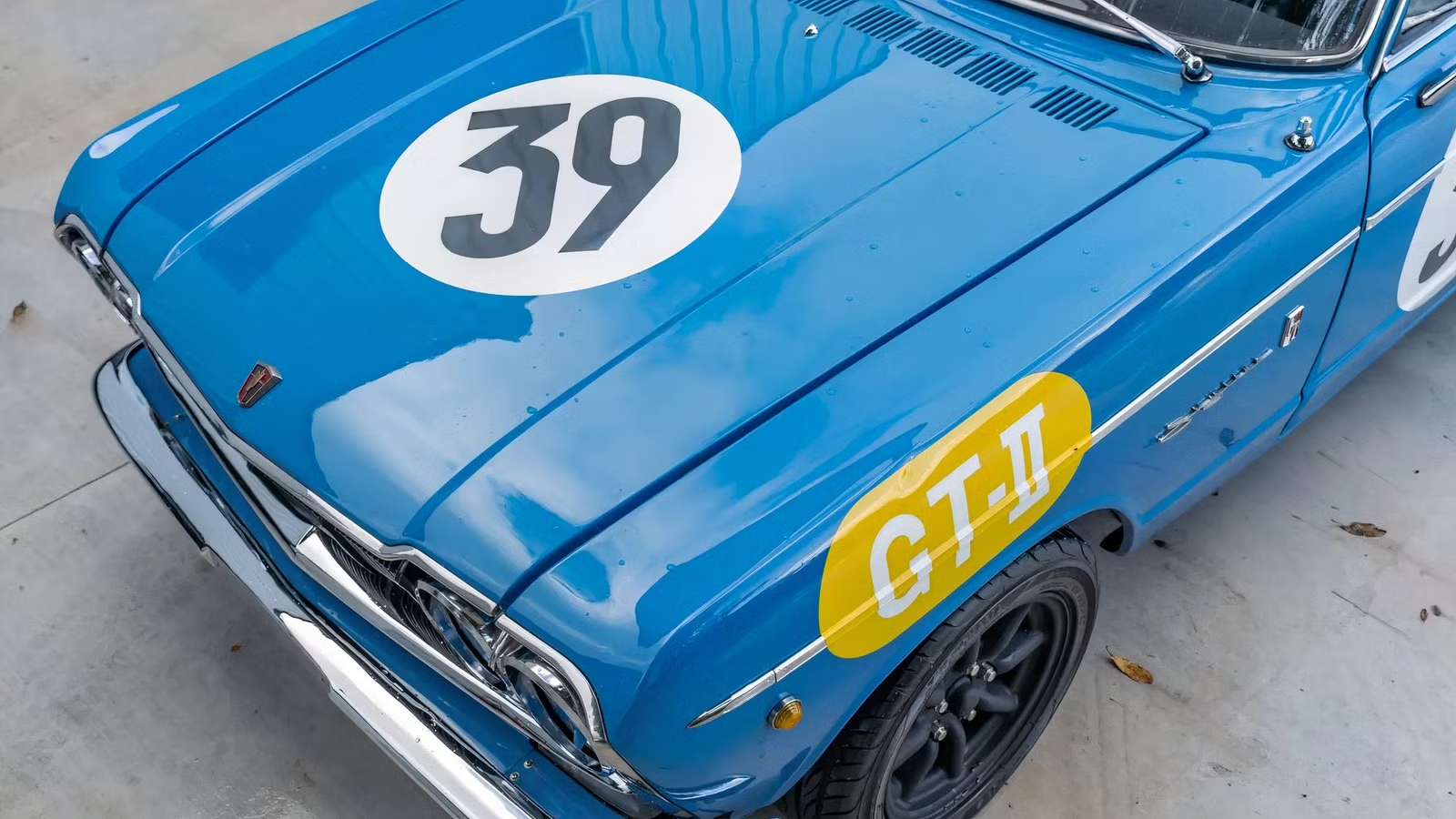
Racecar hierarchies looked pretty straightforward back in 1964. A featherweight Porsche prototype belonged at the front, while a Japanese family sedan with an oddly long hood was supposed to admire the view from behind.

For one lap at Suzuka, however, that order flipped. The sedan scurried past the Porsche, and the engine responsible had begun life hauling executives rather than gunning for speed trophies. This is where Japan’s most famous performance bloodline started.
Japan Needed A Performance Milestone Of Its Own
Japan’s auto industry was expanding rapidly in the early ’60s, but international performance credibility remained very much a work in progress. Prince Motor Company operated at the ambitious end of that market. Its cars were more sophisticated than basic transportation demanded, and the company’s roots in aircraft manufacturing encouraged its engineers to think beyond the usual small car formula.

The second-generation Prince Gloria arrived in 1962 as the company’s large luxury sedan. In 1963, the Gloria Super 6 added a new 121 cubic-inch single-overhead-cam inline-six rated at 105 PS, or roughly 104 horsepower. It became the first Japanese engine to cross the 100 PS mark. That figure looks tame beside a current economy car turbo engine, but it represented a real line in the sand at the time.
The Gloria wrapped that engine in a roomy sedan that could be ordered with factory air conditioning or power windows. Its De Dion rear suspension also showed how seriously Prince took engineering. The inline-six’s first job was delivering smooth, respectable luxury car performance, yet its compact displacement and overhead-cam layout gave it potential that a well-upholstered back seat couldn’t fully exploit.
One Racing Defeat Demanded Eight More Inches

Prince discovered that potential after a bruising result at the inaugural Japanese Grand Prix in 1963. The company’s Glorias and Skylines finished well down the order, while domestic rivals enjoyed the sort of success that sold cars on Monday. Prince had arrived at Suzuka with polished road cars. The following year, it intended to bring something that could fight.
The obvious starting point was the new S50 Skyline, introduced in September 1963. It was a compact family sedan powered by a 91ci four-cylinder engine with around 70 hp. The Skyline was light and competent, but Suzuka’s fast sections demanded more muscle than its sensible little four could provide. Prince needed a shortcut, and the Gloria’s larger six-cylinder engine was sitting in the same parts bin.
Race For Time

Shinichiro Sakurai, the engineer who would later become known as the father of the Skyline, chose the wonderfully direct solution: put the big engine in the smaller car. The Skyline’s engine bay disagreed, so the team lengthened the body ahead of the cowl by nearly eight inches. That’s major surgery for a sedan designed around a four-cylinder, and the resulting proportions looked as if the hood had ordered one size up.
Prince also had to satisfy homologation rules, which required 100 road cars. The team hand-built the extended-nose Skyline GTs under intense time pressure and completed the run in time for the second Japanese Grand Prix. The Skyline 2000GT officially launched on May 1, 1964, only two days before the race. Most new-car launches involve catering and carefully aimed spotlights, but this one involved getting enough cars finished before the rule book slammed shut.
The Prince G7 Changed The Skyline

The engine behind the rush was the Prince G7, the same 121ci SOHC inline-six that had debuted in the Gloria Super 6. In the luxury sedan, it had already broken Japan’s 100 PS barrier. Installed in the smaller S54 Skyline GT, it changed the car’s character and gave Prince a new kind of performance machine.
Prince built the first 100 extended-nose Skylines to satisfy the regulations, while the competition cars used triple Weber side-draft carbs to help the G7 breathe at racing speeds. The transplant added more than output. It gave the Skyline the smooth power delivery and long-legged feel that would become closely associated with the name.
In addition to that, the chassis had to catch up. Race-prepped versions received front disc brakes, and Prince reinforced the body after adding the longer nose. The layout remained inherently awkward because the narrow family sedan hadn’t been designed around a straight-six, yet that rough-edged engineering made the achievement more interesting.
This was Japanese muscle car thinking before the formula had a local name. A larger engine went into a smaller sedan because racing demanded it, much as Detroit was discovering with the Pontiac GTO. The Prince Skyline 2000GT was more technically ambitious than a simple stoplight bruiser, but the appeal was just as easy to understand. More engine usually makes a good car story.
The Lap That Made A Sedan Bigger Than A Porsche

Prince entered seven Skyline GTs at Suzuka in May 1964, expecting to challenge for the GT-II class. Then a privately entered Porsche 904 Carrera GTS appeared. The Porsche was a mid-engined competition car with lightweight fiberglass bodywork, built for racing from the start. The Skyline remained a stretched production sedan whose original brief involved family transport. On paper, the comparison was slightly puzzling.
During the race, however, Tetsu Ikuzawa in the No. 41 Skyline caught the Porsche and passed it. For one lap, the homegrown sedan led the purpose-built German machine, and the crowd reacted as if it had seen the established order come loose at the bolts. The Porsche eventually reclaimed the position, but the image of a Japanese car running ahead of it had already done its work.
National Performance

Unsurprisingly, the Porsche won the race. Prince filled second through sixth, with Yoshikazu Sunako finishing runner-up and Ikuzawa taking third. The official result belonged to Stuttgart, but the story belonged to the Skyline. That brief pass turned an honorable defeat into a national performance myth and gave Prince more publicity than an easy class victory probably would’ve managed.
Nissan Inherited A Legend Prince Had Already Built

Prince turned the racing lesson into a more complete road car in February 1965. The Skyline 2000GT-B used three Weber 40DCOE carburetors and raised the G7’s output to 125 PS, or about 123 hp. A close-ratio five-speed transmission and limited-slip differential strengthened its competition flavor. The single-carb, four-speed version was later identified as the 2000GT-A.
The GT-B proved that the 1964 homologation effort wasn’t a disposable special. Prince had created a Japanese sports sedan with genuine racing credibility, and people responded strongly enough that the company had to develop the car into a regular production model. The G7 had traveled from the Gloria’s luxury car engine bay to the center of a new performance identity.
Humble Start

Prince’s independence, however, didn’t last much longer. A merger with Nissan was announced in 1965 and completed in August 1966. Existing Skylines and Glorias briefly carried both identities before later generations appeared under Nissan branding. The engineers and the cars survived, but the company name that created them faded from dealership signs.
Nissan would build the Skyline legend into something far larger, beginning with the first GT-R in 1969 and extending through the celebrated generations that followed. Those cars tend to dominate the history books, while the Prince G7 sits several chapters behind the famous Nissan L-series and RB inline-sixes. Its achievement, though, is undeniable. This was where the Godzilla family tree started, with a Gloria engine and eight extra inches of nose.
Sources: ClassicCars, CurbsideClassic, JapaneseNostalgicCar, Nissan

Related posts
Latest Post


No Comments