
How Much It Costs To Replace A Toyota Highlander Hybrid Battery In 2026
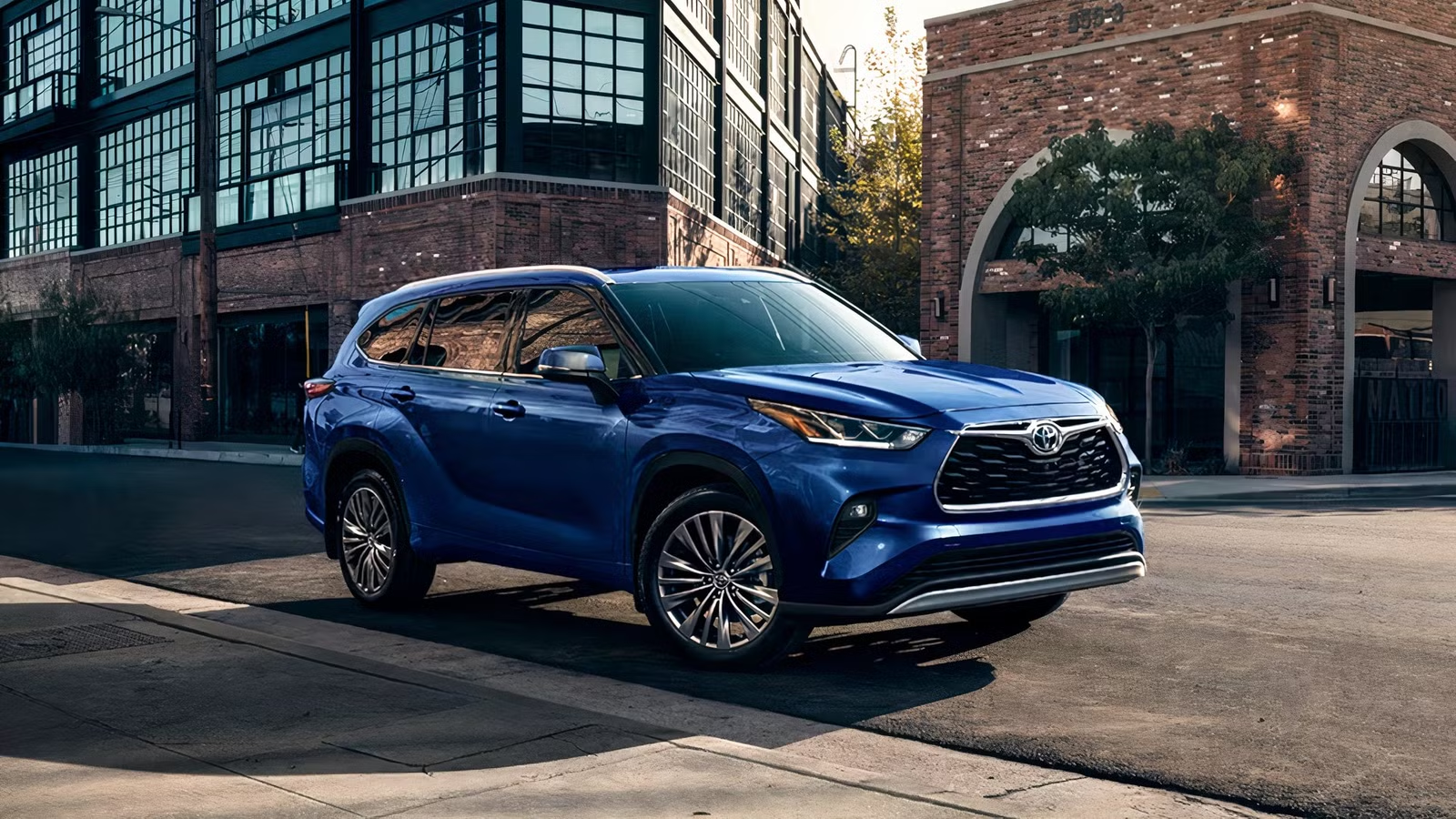
The Toyota Highlander Hybrid holds a top spot among family-friendly crossover options, but as older models exit factory coverage, buyers face potential repair obligations. High-voltage traction battery replacements represent one of the primary ownership expenditures for aging hybrid vehicles. Replacing this critical component requires evaluating specific vehicle model years, component supply options, and warranty boundaries before committing to a purchase or repair quote.
Why Hybrid Battery Replacement Matters Now

Early generations of the Toyota Highlander Hybrid continue operating on public roads, with first-generation models entering two decades of continuous use. Second-generation and third-generation models manufactured between 2008 and 2019 are also transitioning to independent maintenance care. Factory battery warranties eventually expire across all vehicle cohorts, shifting full financial responsibility onto vehicle owners.
The Toyota Highlander Hybrid remains a popular option on the used vehicle market thanks to its practical interior dimensions and good fuel efficiency. Potential buyers and long-term owners must account for high-voltage battery service when calculating total operational expenses. Understanding component prices helps owners evaluate whether a battery refresh makes economic sense relative to total vehicle valuation.
OEM, Remanufactured, And Independent Options

High-voltage battery service costs depend directly on the production year and the parts distribution channel selected for the repair. Official dealership service centers utilize new factory components sourced directly from Toyota logistics networks. Independent repair facilities offer alternative options through third-party remanufactured units or recycled salvage assemblies.

Owners of current-generation Highlander Hybrids face OEM replacement costs between $7,558 and $7,752 at franchised dealerships. Parts account for roughly $7,142 of this total outlay, while technician labor, adding $416 to $610, covers the physical installation and system initialization. Independent installation options for post-2020 models remain constrained due to specialized parts and scarce market supply of newer battery architectures.

Owners of 2006 to 2016 model-year vehicles access more cost-effective alternatives through remanufactured hybrid battery suppliers. Specialist providers such as Greentec offer remanufactured units priced between $1,999 and $2,999, depending on cell specifications and warranty terms. Brand-new aftermarket replacement packs for 2006 to 2016 models sell for around $4,650 to $5,199 before core deposit refunds and local shop installation fees.
Independent service facilities generally charge lower shop labor rates than franchised dealerships. Swapping a high-voltage traction pack typically requires two to four hours of billable shop time. Sourcing a tested, low-mileage salvage battery from an auto recycler can lower parts costs to $1,200, though this route carries higher risks regarding remaining component lifespan.
How Long Toyota’s Hybrid Battery Lasts

Toyota high-voltage nickel-metal hydride and lithium-ion batteries demonstrate notable long-term durability under standard driving conditions. Most original factory traction packs achieve 150,000 to 200,000 operational miles before experiencing significant internal cell degradation. Fleet vehicles and highway-driven models frequently exceed 220,000 miles on original battery equipment.
Battery degradation occurs gradually rather than through system failures. Internal resistance increases over time, reducing the total electrical energy stored and discharged during operation. Drivers usually notice progressive drops in fuel efficiency alongside more frequent combustion engine cycling. Diagnostic trouble codes, dashboard warning indicators, and disabled electric-only drive modes mark final battery failure stages.
Extreme ambient temperatures accelerate battery wear over long periods. Prolonged operation in hot climates increases internal cell heat, while extended freezing conditions temporarily reduce immediate electrical output. Regular inspection of the rear passenger seat cooling vents prevents thermal buildup, helping protect high-voltage components from premature failure.
Evaluating The Worth Of Replacing The Highlander Hybrid’s Battery

An illuminated master warning light or a failing traction battery reduces a vehicle’s trade-in value significantly. Dealership appraisers deduct the full retail cost of an OEM replacement pack from their wholesale offers. A vehicle worth $8,000 in operational condition may only receive trade-in offers of $1,500 to $2,000 when presenting active hybrid system fault codes.
Installing a remanufactured battery pack for $2,500 often restores full vehicle operation and preserves market resale value. Investing in a new high-voltage pack makes financial sense if the vehicle’s engine, transmission, body, and suspension remain in good condition. Spending $3,000 on battery repairs is generally more economical than taking on a new vehicle loan or accepting a low trade-in offer.
Long-Term Hybrid Issues You Should Be On The Lookout For

Used hybrid vehicle shoppers must review factory warranty terms during pre-purchase inspections. Toyota provides a 10-year or 150,000-mile factory hybrid battery warranty on all 2020 and newer models. Older 2006 to 2019 Highlander Hybrids carry an eight-year or 100,000-mile factory warranty window, which has expired for most vehicles from those model years.
Contextualizing repair expenses against related Toyota hybrid models highlights cost differences across platform sizes. A smaller Toyota RAV4 Hybrid battery replacement costs roughly $5,500 to $6,200 at dealership service departments, whereas a Toyota Camry Hybrid battery replacement averages $6,006 to $6,205. The larger battery pack capacity and higher electrical output demands of the Toyota Highlander Hybrid result in higher baseline parts costs.
Consumers evaluating used Highlander Hybrids should request a full diagnostic scan of the hybrid control module. Monitoring individual block voltages and internal resistance levels reveals battery health before warning lights trigger on the display. Verifying service history records ensures past cooling maintenance was completed properly, protecting the hybrid investment over years of future ownership.
The Toyota Highlander’s Effective Powertrain

The 2026 Toyota Highlander Hybrid variant features Toyota’s Atkinson-cycle 2.5-liter naturally aspirated four-cylinder engine with two integrated permanent-magnet synchronous electric motor-generators. This system utilizes an electronically controlled continuously variable transmission, paired exclusively with Toyota’s Electronic On-Demand all-wheel-drive system.
The system activates a dedicated rear electric motor when extra traction is required. Together, the hybrid powertrain produces a net combined system output of 243 hp, with the gasoline engine itself delivering 175 lb-ft of torque. The hybrid models manage a respectable 0-to-60 mph acceleration time of 8.2 seconds with a 113 mph limited top speed. The maximum towing capacity is reduced to 3,500 pounds.
The Highlander Hybrid’s Trusted Reputation

The Toyota Highlander Hybrid shines in its reliability and value retention abilities. iSeeCars gives the model an 8.3/10 overall score, which includes 7.7/10 for reliability, 9/10 for safety, and 8.3/10 for retained value. The publication indicates that the model will last for 12.9 years or 172,763 miles before you encounter any noteworthy issues, with a 32.9-percent probability of surpassing 200,000 miles. It also indicates that it will lose 36.3 percent or $16,531 of its value after five years of regular usage.
J.D. Power backs this with an 82/100 consumer-verified overall score, which includes 82/100 for quality and reliability, 82/100 for the driving experience, and 90/100 for resale. In terms of ownership costs, the Edmunds True Cost To Own calculator reveals that you can expect to spend $49,274 over the first five years when owning an XLE derivative.
How To Keep The Highlander Hybrid In Check

To preserve the vehicle’s long-term reliability and maintain valid warranty coverage, you must strictly adhere to mandated factory maintenance requirements. The standard service intervals occur every six months or 5,000 miles, whichever milestone is reached first. A minor service at 5,000 miles requires a tire rotation, fluid level check, wiper blade inspection, and brake system visual check.
Major mechanical service intervals are required every 12 months or 10,000 miles, at which point the factory technician will perform a full engine oil and oil filter replacement and swap out the cabin air filter. Extended intermediate and major checkups occur at 15,000-mile and 30,000-mile thresholds, expanding the checklist to include critical hardware inspections of the steering gear, ball joints, brake lines, and driveshaft boots.

Despite its strong reputation for build quality, the 2026 Highlander has been affected by a few active National Highway Traffic Safety Administration safety recalls. These target specific passenger restraint and safety systems. Among the most noteworthy recalls is an airbag ECU software defect where the front passenger seat-belt force limiter may default to settings intended for smaller occupants. This fails to properly restrain larger passengers and significantly increases their risk of injury in a collision.
Another prominent safety campaign involves an assembly error regarding the seat-mounted side airbag trim covers, where incorrect trim components can physically impede the proper deployment of the side airbags during a side-impact crash. Dealerships resolve these critical safety issues, along with minor regional recalls for loose accessory roof-rail fasteners and incorrectly inflated spare tires, free of charge.
Fuel Efficiency Yields Additional Savings

The Highlander Hybrid isn’t the most fuel-efficient Toyota HEV that you can consider, but it’s not bad for the segment that it operates in, especially when you consider the fact that it is a fully functional three-row SUV. The XLE models benefit from a 35/35/35 MPG fuel consumption estimate on the city/highway/combined cycle, while the Limited and Platinum trims fractionally worsen it to 35/34/35 MPG. Beyond this, their estimates are identical.
With a 17.1-gallon tank and 1.9 kWh battery pack, this Japanese SUV will cover 598 miles. On average, you can expect to save $2,500 on your fuel bill over five years compared to the average new vehicle sold in the U.S. You’ll also spend $1,900 on fuel every year. Driving 25 miles will cost around $3.19, while a full tank of gas may set you back by around $76.
Sources: Toyota, the EPA, Edmunds, iSeeCars, and J.D. Power.

Related posts





Latest Post


No Comments