
Nissan Just Brought Back The Value Deal That Made Rogues Famous
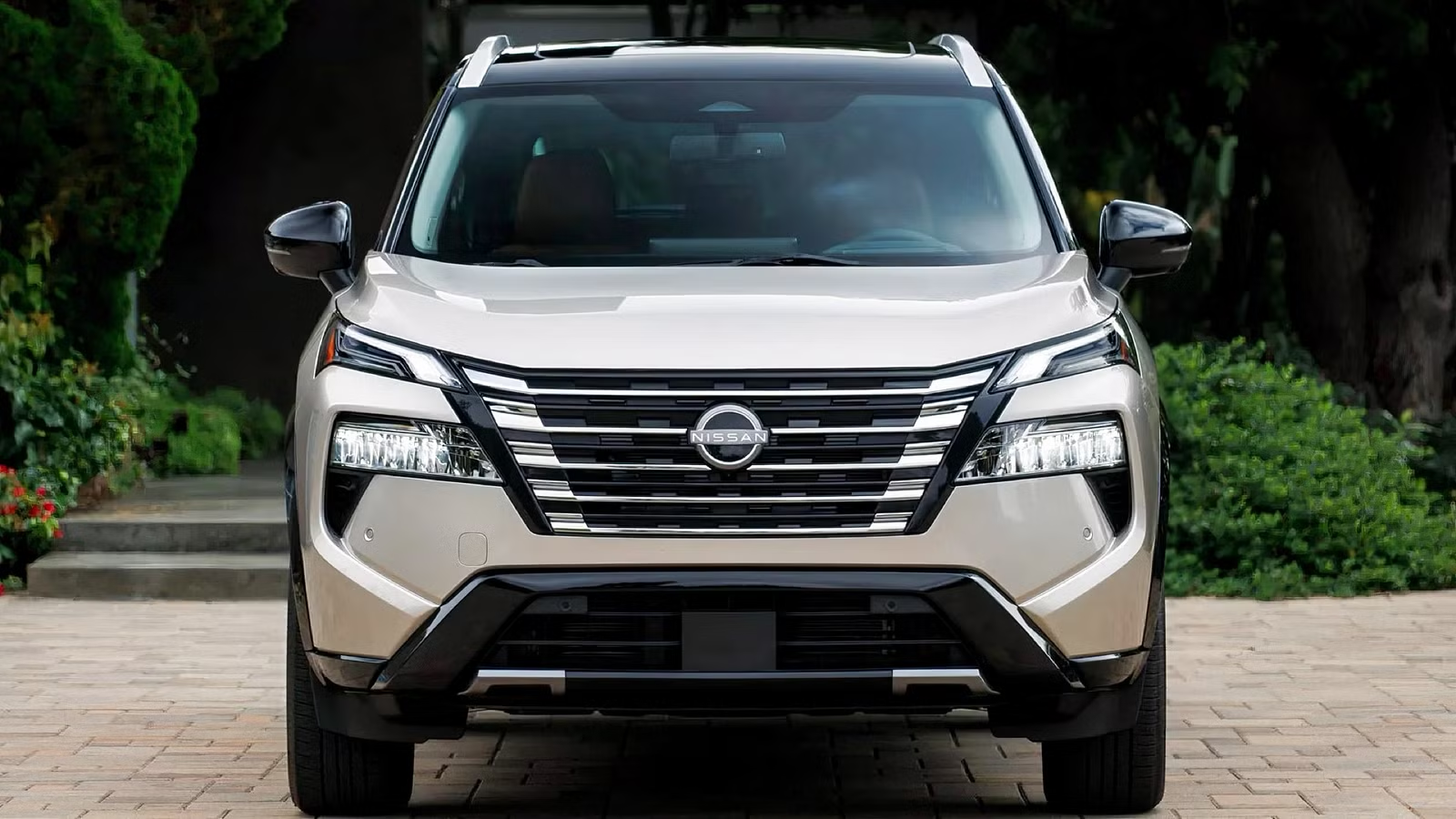
A 2026 Nissan Rogue Platinum with $4,500 off the hood used to mean Nissan needed to move metal. Now it means something else. A compact SUV that, out-the-door, can undercut a Toyota RAV4 or Honda CR-V by thousands of dollars. Nissan’s average incentive per vehicle climbed 14% in July while the industry average fell roughly 10%, a gap wide enough to flip the usual “buy the Toyota, it holds value” calculus on its head — at least for buyers who don’t plan to keep the car past its likely resale peak.
Nissan’s $4,000-Plus Incentive Push Is Turning the Rogue Into a Compact-SUV Bargain

Nissan’s average incentive spend per vehicle crossed $4,000 in July 2026, up 14% year over year, even as competitors pulled back their own discounts by about 10% on average. That divergence is the story here, not a verdict on Nissan’s health; it’s simply a signal that Rogue pricing has detached from the rest of the segment at a moment when rivals are getting stingier.
On the ground, that translates into rebates as high as $4,500 nationwide on Rogue Platinum trims, with real transaction prices running up to 18% below MSRP on leftover 2025 units and around 9% off fresh 2026 stock. Regional fleet and loyalty programs are stacking further cash on top; some dealer groups are advertising up to $5,000 in combined incentives through early August. None of that requires a trade-in, a loyalty badge, or a finance qualification most shoppers can’t hit; it’s showing up as sticker-level cash that any buyer can claim.

For context, an 18% cut on a Rogue Platinum stickered near $39,000 works out to roughly $7,000 off, before any additional dealer negotiation. That’s not a rounding error against a segment where list prices between Nissan, Toyota, and Honda are normally separated by a few hundred dollars.

A 2026 Rogue Discount Can Erase the Price Gap With a CR-V or RAV4

Compare list prices and the Rogue, CR-V, and RAV4 look nearly interchangeable, all land within a few percentage points of each other trim-for-trim. That parity is exactly why incentives matter more than sticker price in this segment: whichever manufacturer is discounting hardest effectively wins the spec-for-spec comparison, because the badge premium buyers assume for Toyota and Honda evaporates once real transaction prices are on the table.
Run the numbers on a mid-trim Rogue SV against a similarly equipped RAV4 XLE or CR-V EX. Before incentives, the three are close enough that most shoppers would default to whichever brand they trust more for resale. After a Rogue-specific discount of $4,000 to $7,000, the Rogue can land $3,000 to $5,000 below the out-the-door price of either competitor.

The trade-off is that RAV4 and CR-V still carry stronger long-term resale value and hold their prices better at trade-in time. But that advantage is realized years down the road, and only if the ownership period is long enough for it to matter. For someone financing a new vehicle every four to five years, a guaranteed $4,000 today is worth more than a theoretical resale edge that may or may not survive market conditions at trade-in.
The Incoming 40-MPG e-Power Rogue Makes Waiting A More Complicated Bet

The wrinkle is that Nissan isn’t just discounting the current Rogue to clear space, it’s preparing a genuinely different next-generation model. The redesigned Rogue is expected to adopt Nissan’s e-Power hybrid system, in which the gas engine never directly drives the wheels; it exists purely as a generator, charging a battery that powers electric motors at all times. Nissan is targeting roughly 40 mpg combined, which would put it ahead of the CR-V Hybrid’s 37 mpg and well clear of the current gas Rogue’s low-30s rating.
Timing here isn’t fully settled; some reporting suggests the e-Power Rogue could arrive as early as October 2026, while other sources point to a 2027 model-year launch that could stretch into next year. Nissan hasn’t confirmed an exact date, and buyers weighing “wait for the hybrid” against “buy the discounted gas model now” should treat any launch date as a moving target rather than a lock.
That uncertainty matters because the current gas Rogue isn’t going away immediately; Nissan plans to sell it alongside the new hybrid at a lower price point for at least part of the overlap period, meaning today’s discounts may persist even after the e-Power model reaches showrooms. Waiting, in other words, doesn’t guarantee a cleaner comparison; it mostly guarantees a longer wait.
Here’s How Many Miles You Need To Drive Before Better MPG Beats A Bigger Discount

This is the number competitors covering this incentive story are skipping, and it’s the one that actually answers whether waiting makes financial sense. Start with the fuel-economy gap. The current gas Rogue averages around 30 mpg combined; the incoming e-Power model is targeting 40 mpg. At a national average gas price near $3.50 a gallon, an average driver covering 12,000 miles a year burns about 400 gallons annually in the current Rogue versus roughly 300 gallons in the e-Power version, a difference of 100 gallons, or about $350 a year in fuel savings.
Now set that against a $4,000 real-world discount available on the current model today. At $350 a year in savings, it would take roughly 11 years of average-mileage driving just to recoup the money left on the table by waiting, far beyond a typical ownership cycle.

Stretch the ownership window to six years, a more realistic hold period, and the math still favors buying now unless annual mileage climbs substantially. Solving for the mileage that closes a $4,000 gap over six years puts the breakeven point at roughly 23,000 miles a year, nearly double what the average American driver logs. Below that threshold, the discount on the current Rogue outweighs the hybrid’s fuel savings for the entire time most people will own the vehicle. Above it, genuine high-mileage drivers — rideshare use, long commutes — the e-Power model’s efficiency starts to close the gap meaningfully, and waiting becomes defensible.
The practical takeaway is that unless annual mileage is unusually high, or the buyer plans to own the vehicle well past a decade, the discounted gas Rogue’s upfront savings are difficult for the hybrid’s mpg advantage to overcome, even accounting for further gas price increases.
The Rogue PHEV Adds Another Wild Card With Thousands In Cash Incentives

A separate vehicle is muddying this decision further, and it’s worth untangling from the e-Power story. The 2026 Rogue Plug-In Hybrid isn’t a preview of the upcoming series-hybrid Rogue, it’s a rebadged version of the Mitsubishi Outlander PHEV, built on shared platform engineering rather than Nissan’s own e-Power tech. It went on sale only recently, and Nissan is already discounting it aggressively. Nissan is offering $5,000 in customer cash or 0% APR financing for 60 months in some markets, with certain deals reportedly reaching $6,500 in combined incentives.

For a shopper cross-shopping plug-in hybrids specifically, that’s a meaningful data point: a PHEV offering real EV-only range for short trips, discounted almost as heavily as the outgoing gas model, sitting alongside a next-generation e-Power model that operates on entirely different technology and won’t offer a plug at all. Buyers should be careful not to conflate the two: the PHEV is available now with aggressive cash on the hood, while the e-Power Rogue is a future gas-only hybrid with no plug and an unconfirmed launch date.

Taken together, the picture for shoppers is less about which Rogue is “best” and more about matching a specific vehicle to a specific driving pattern. The discounted current Rogue suits typical-mileage buyers who want savings today; the PHEV suits those who can charge and want incentive-heavy plug-in range right now; and the upcoming e-Power model, whenever it actually arrives, suits genuine high-mileage drivers willing to wait for the mpg math to work in their favor.
Sources: Nissan U.S., KelleyBlueBook

Related posts




Latest Post


No Comments