
1967 Dodge Coronet R/T Convertible: Why Nobody Bought It
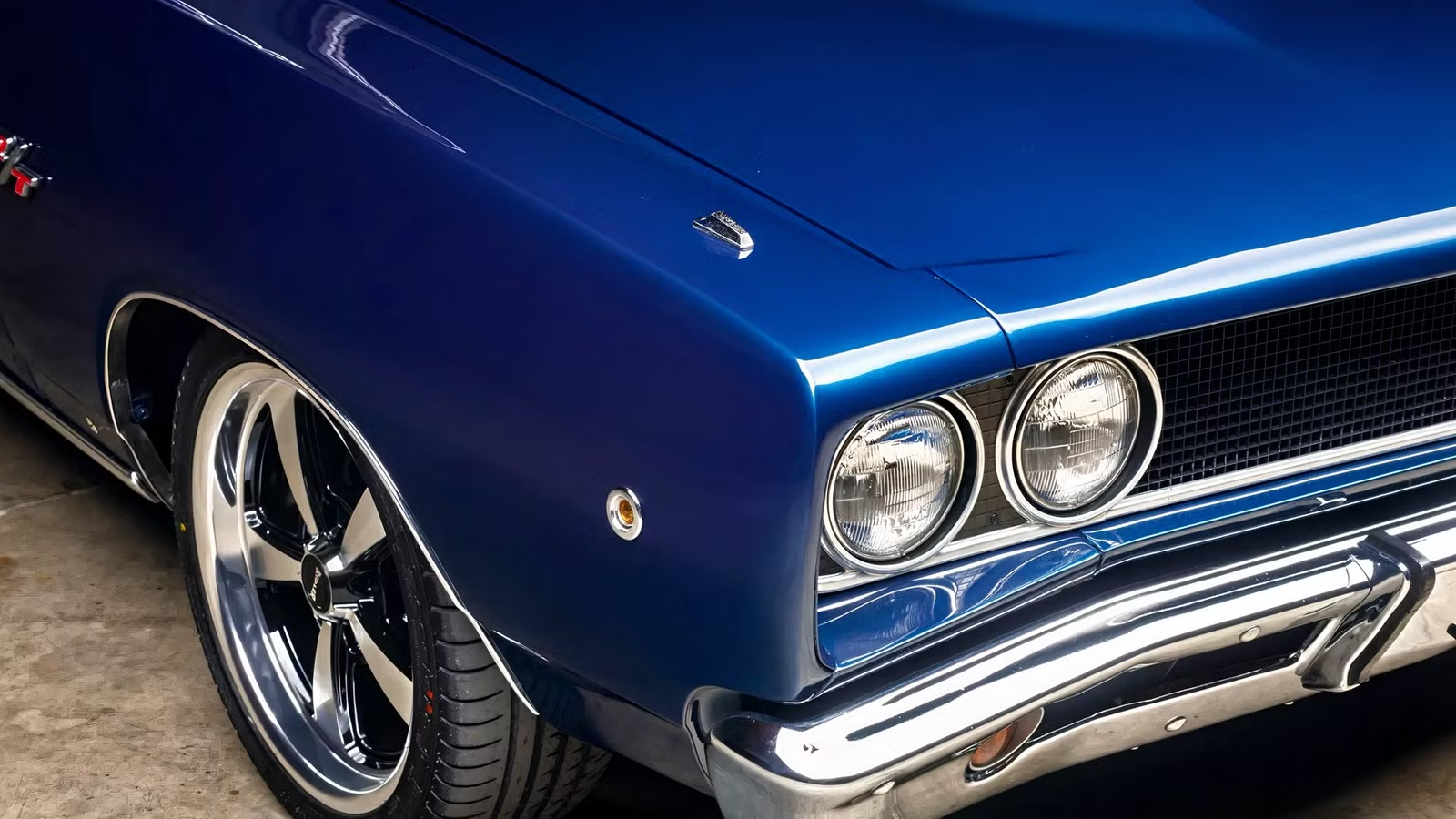
The muscle-car era was supposed to be about excess. Bigger engines, louder exhausts, more horsepower and, wherever possible, fewer reasons to behave sensibly. So when Dodge introduced a new performance model with a big-block V8 as standard equipment, offering it as a convertible seemed almost too obvious. Take a serious muscle car, fold the roof away, and let everybody see what you’ve got. Except that’s not what happened. Only about six percent of 1967 Coronet R/T production was made up of convertibles. Dodge had put big-block power, heavy-duty hardware, and open-air motoring into one package, and most buyers still wanted a roof.
Dodge Was Building A Different Kind Of Muscle Car

By 1967, the muscle-car formula was no longer some strange experiment happening at the fringes of Detroit. Pontiac had already proved that an intermediate could become a genuine performance machine, and virtually every major American manufacturer was scrambling to get its own version into showrooms. The GTO, Chevelle SS 396 and Fairlane GT were all fighting for the same stoplight bragging rights.
Dodge’s answer arrived that year as a new performance flagship for its mid-size lineup. It wasn’t merely a regular family car with a bigger engine and some stickers, and it launched alongside Plymouth’s GTX, its corporate cousin on the same B-body platform. Most importantly, a four-barrel big-block V8 was standard, with the 426 Hemi as the only engine above it on the order form.

That standard big-block wasn’t the consolation prize for people who couldn’t afford the Hemi. It was the engine Dodge considered good enough to put in every example. The rest of the package backed it up with heavy-duty suspension, heavy-duty brakes, performance tires and bucket seats, while the TorqueFlite automatic was standard and a four-speed manual sat on the options list.

And this is where Dodge’s strategy gets interesting. The new car wasn’t trying to be the cheapest way into a giant engine. Think of it as a gentleman’s hot rod, a big-block brute that could still work as a comfortable street machine. That gave it a slightly different personality from the stripped-down performance cars that would soon become central to Chrysler’s muscle-car strategy. It was a muscle car, certainly. It just happened to wear a little nicer shirt.
Why Muscle Buyers Were Starting To Favor Hardtops

The convertible should have fit that personality perfectly. A big-block V8, bucket seats, aggressive styling and the ability to drop the roof on a warm evening sounds like a recipe Detroit would have struggled to keep in stock. Yet buyers kept signing for the hardtop. In 1960s Detroit, a two-door hardtop meant no B-pillar, so rolling down every side window delivered a decent slice of the open-air look without giving up the roof. A fixed roof also has inherent advantages for a performance car.

Removing it from a unibody vehicle requires structural reinforcement, and a convertible has to carry the extra hardware of its folding top. That makes the body-style choice more complicated than simply deciding whether you like sunshine. For a buyer focused on performance, those compromises could matter. For a buyer looking for a stylish cruiser, they might not matter at all. The timing is important, too. Dodge’s muscle lineup was about to get much more aggressive. The Super Bee would arrive for 1968, while Plymouth would introduce the Road Runner with an entirely different interpretation of the muscle-car formula.
Those cars emphasized affordable performance and a more stripped-back attitude. Dodge’s new flagship occupied a more upscale position, which made the convertible a logical fit on paper. It also made the drop-top’s dismal take rate a genuine head-scratcher. Because the Mopar caught in the middle of this shift was no soft-edged boulevard queen.
The 1967 Dodge Coronet R/T Convertible Was The Odd One Out

Meet the 1967 Dodge Coronet R/T convertible. The initials stood for Road and Track, and 1967 was the year the R/T badge made its debut. Under the hood of the drop-top sat the same 440 Magnum that made the R/T hardtop such a serious proposition. 375 hp. 480 lb-ft. A four-barrel carburetor. Dual exhaust. In other words, Dodge wasn’t asking convertible buyers to accept a watered-down version of its muscle car. They got the real thing.

Period testing backs up the engine’s reputation. Magazine testers clocked a 440 R/T at 7.2 seconds from 0 to 60 mph and 15.4 seconds through the quarter-mile on street tires, with a passenger aboard. In a head-to-head against an identically equipped Hemi car, the 440 leaped into the lead off the line, and the Hemi only caught it just after the quarter-mile mark. Drag racer Dick Landy went further to set an AHRA B/Stock Automatic national record in 1967 with a Coronet R/T 440 at 12.61 seconds and 110.02 mph.
That makes the standard 440 even more significant. You didn’t need to spend extra for the Hemi to get a genuinely potent R/T. And you didn’t need to buy the hardtop to get that performance, either. The convertible listed at $3,438, against $3,199 for the hardtop. Drop-top buyers were paying roughly $240 extra for the open-air experience, with essentially the same R/T formula underneath. Yet Dodge built more than 10,000 Coronet R/Ts for 1967, and only 628 were convertibles. That’s more than 15 hardtops for every drop-top. Suddenly, the car’s rarity isn’t the most interesting thing about it. The preference is.
Six Percent Told Dodge Everything It Needed To Know

Looking backward, 628 cars sounds like a collector’s dream, especially since Dodge restyled the Coronet for 1968, making the ’67 a one-year design. Looking at the production sheet in 1967, it told Dodge something much more useful. R/T customers overwhelmingly preferred the hardtop.
That distinction matters because the R/T itself was hardly a failure. Its debut-year volume turned the R/T into a badge that genuinely mattered in Dodge showrooms. The buyers were there, and they wanted the big engine and the heavy-duty hardware. They just didn’t want to give up the roof to get them. The temptation is to explain that with one neat sentence. Performance buyers didn’t want convertibles because they were heavier and less rigid.

There’s a problem with that. The engineering logic makes sense, but production figures don’t reveal why an individual buyer chose one body style over another. No factory survey shows that every hardtop buyer made the decision after pondering chassis stiffness, and history is annoyingly resistant to being that convenient.
What the numbers do show is a market making a remarkably consistent choice. Six percent is too small to dismiss as a fluke, but it isn’t enough evidence to declare that one specific factor killed the convertible. The $239 price premium made the convertible more of a lifestyle choice on paper, even though it retained the same fundamental R/T mechanical package. That’s the contradiction at the heart of the car. The R/T was civilized enough to play boulevard cruiser, yet the 440 Magnum made sure nobody mistook it for a softie. The convertible leaned hardest into the cruiser side, and it was the version most buyers passed over.
The Muscle Convertible Was Already Running Out Of Road

The 1967 Coronet R/T convertible didn’t kill the muscle-car drop-top. Its tiny production run doesn’t prove that buyers suddenly decided convertibles were useless, either. What it does offer is an early glimpse of a market that was getting increasingly complicated for high-performance open cars. As the decade wore on, insurance costs, changing regulations, emissions requirements and shifting consumer tastes all put pressure on the formula that had produced Detroit’s wildest performance cars. The days when manufacturers could simply keep adding bigger engines and more aggressive options were numbered.
The convertible became an especially strange proposition when combined with the most extreme versions of those cars. And the contrast with 1971 is almost ridiculous. That year, Plymouth built just 12 Hemi ‘Cuda convertibles, and five of them were shipped overseas. It was also the 426 Hemi’s final model year, and one factory four-speed example sold for $3.5 million at Mecum’s 2014 Seattle auction. The ‘Cuda was an E-body pony car rather than an intermediate like the Coronet, but by the end of the classic muscle-car period, the pairing of that engine and a folding top had become almost mythical.

That doesn’t mean the 1967 Coronet R/T somehow predicted those exact cars. Four years is a long time in the muscle-car world, and the market changed dramatically between 1967 and 1971. Even the Coronet’s own drop-top kept shrinking. By 1970, with the Super Bee and Charger R/T competing for the same buyers, Dodge built just 296 Coronet R/T convertibles. But the trajectory is hard to miss. In 1967, Dodge could put a standard 440 Magnum in a convertible and find 628 takers. Four years later, Plymouth’s ultimate Hemi drop-top barely made it into double digits.
That’s what makes the 1967 Coronet R/T convertible worth looking at again. It wasn’t an unpopular muscle car, and it wasn’t a failed experiment. It certainly wasn’t lacking in performance, either. Dodge gave buyers a 375-hp 440 Magnum, serious chassis hardware, an upscale interior and the option of driving with the sky overhead. On paper, it was almost the perfect expression of the muscle-car era. The buyers simply had other ideas. They wanted the 440 Magnum and they wanted the R/T. And, overwhelmingly, they wanted to keep the roof.
Sources: Bring A Trailer, Mecum, Classic.com

Related posts


Latest Post


No Comments