
The Honda Motorcycle That Secretly Birthed The Superbike Era
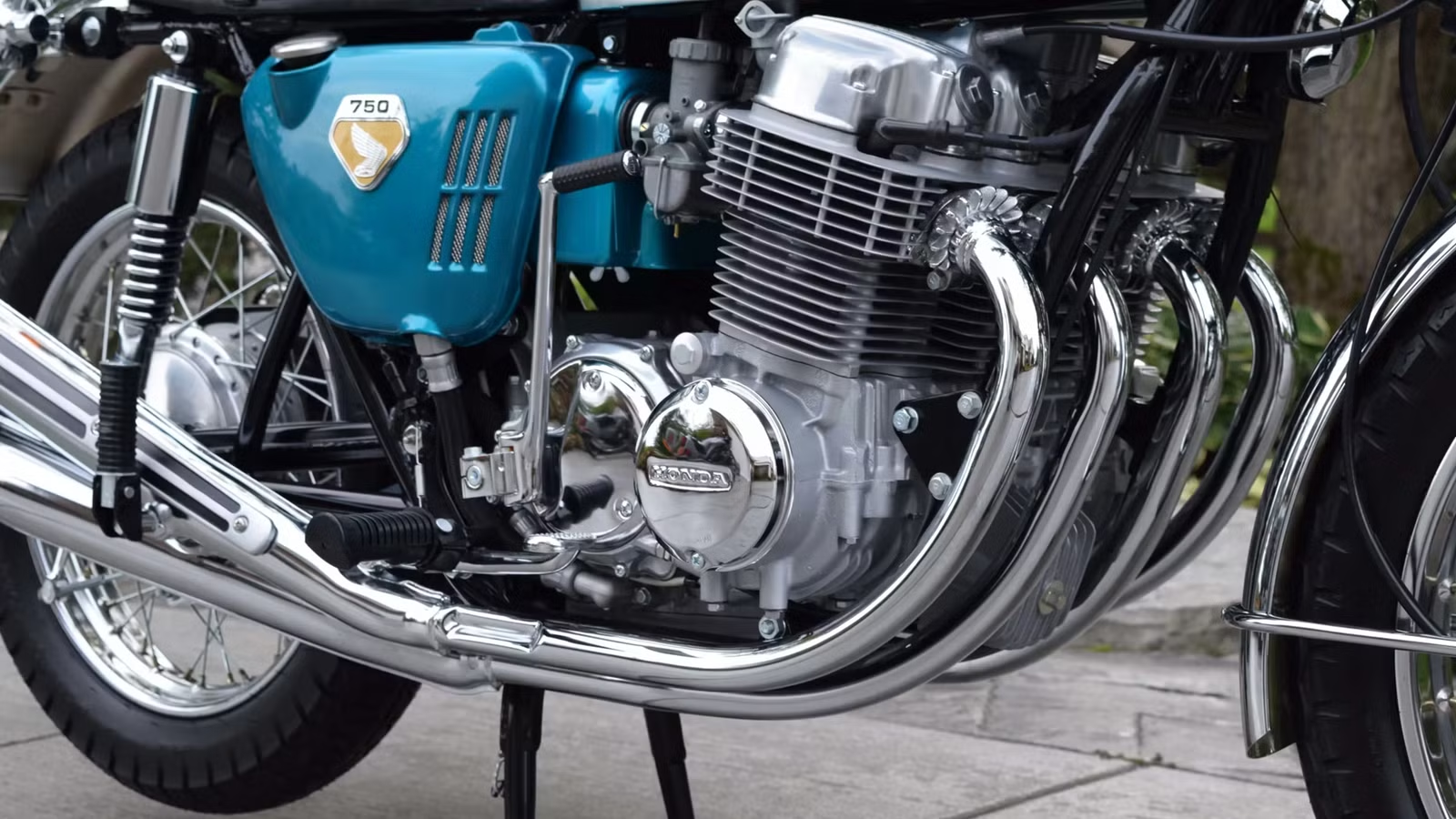
Today we are truly spoiled for choice in terms of performance motorcycles. Enthusiasts have access to small, medium and large capacity superbikes. There are two, three and four-cylinder engines to pick from and reliability is rarely an issue. In the 1960s this was not the case. Large capacity American motorcycles from the likes of Harley-Davidson was not aimed at performance, while the mainly twin- and triple-cylinder engines from the United Kingdom in the shape of the Nortons, BSA and Triumph was not perfectly reliable and needed more maintenance than their owners would admit.
The Four Cylinder Engine That Changed Everything

Honda had a different approach and it’s love for high-revving motorcycle engines can be traced back to a few years before the unveiling of the CB750. At the 1965 Italian Grand Prix at Monza, it made its debut. This 250 cc six-cylinder (DOHC) screamed all the way to 18,000 rpm! If that sounds exciting, so did its results – it secured all 10 victories in the World Championship Series that year. This success, as well as a further six years of racing four-cylinder motorcycles all contributed to the birth of the new CB. At the time, Honda was known for producing small-capacity motorcycles such as the Super Cub C100, Benly models, as well as road and scrambler motorcycles in the shape of the CB160, CB77, CB450 and CL77 to name a few.

However, in Japan, they were secretly working on a motorcycle that would change the motorcycle scene, not only in Japan, but globally. Imagine the shock when Honda then unveiled a large-capacity motorcycle for the first time with the CB750 at the 15th Tokyo Motor Show in October 1969.
Reading Cycle World magazine’s review of August 1969, you can sense how impressed the testers were in at the time. Even the front page of the magazine read “Is it really the world’s finest road machine?”

Honda Built A Motorcycle Nobody Saw Coming

It was the combination of all the various mechanical (and electrical) highlights that made the CB750 such a rounded and standout package in the late-60s. Apart from the five-speed gearbox, the CB750 featured a hydraulically-operated single-caliper disc on the front wheel. Cycle World even reported that “it is reasonably fade-free for a 120-plus-mph machine…”
The suspension setup was firm, but comfortable while the rear spring-damper units were De Carbon units. There were even two settings to make the springs stiffer. The large dials were easy to read, even at night as they were illuminated. Note also the electric starter, which arguably was a very attractive addition at the time.

This new engine used plain bearings, versus the use of rolling bearings before. The result was that these were lighter, a little smaller and were quieter. This means Honda achieved a number of objectives, including an engine that runs quieter. The clutch was also positioned inboard, which limits engine width. As the engine was tuned for daily use, tractability and good mpg figures were the results. This was achieved with only a mild overlap of the intake and exhaust valve.
How Honda’s Manufacturing Cost Discipline Helped The CB750

Similar to Enzo Ferrari’s approach to the importance of racing to improve its products, Soichiro Honda viewed Honda’s racing program as an engineering laboratory. Back in the factories, Honda’s approach to manufacturing, economies of scale, and conducting as much research, design, and manufacturing in house, led to the point where they could unveil an advanced motorcycle such as the CB750 at a competitive price. By 1968 Honda had, for example, already produced more than 6.5 million Super Cabs. There was a clear mass production mindset at Honda as they invested in automated machine tools, die-casting and production lines that were capable of producing consistent quality at high volumes.
12 Japanese Motorcycles That Practically Last Forever
These ten Japanese motorcycles have one thing in common: with basic maintenance, they just keep going. Some owners have even seen six-figure mileage.
It Delivered Superbike Performance At A Mass Market Price

Because Honda focused heavily on engineering as well as high-volume manufacturing, it reached the market lower than its main competitors. The launch price of the CB750 was $1,495. This is an impressive introductory price at the time. The Triumph Bonneville traded for $1,800 and higher, while the BSA Rocket 3 slotted into the same segment as the Triumph. The Norton Commando 750 was closer in price to that of Honda at around $1500 – $1600. If readers have noticed what is happening with the Chinese automotive industry on a global scale, you could say that history is to an extent, repeating itself.
The Motorcycle That Created A New Performance Benchmark

Only months after being launched, the CB750 was entered, in a near-stock form, into the Suzuka 10-hour endurance race in Japan. Riders Morio Sumiya and Tetsuya Hishiki were victorious and took the overall win. This was a notable and important feather in the CB750’s cap. As if this race wasn’t long enough, it won the 24-hours of Bordeaux race, also in 1969. Expectedly, this had a positive market effect in Europe. Most notably, in the USA with rider Dick Mann, a CB750-based Honda CR750 factory motorcycle was the overall winner at the AMA Daytona 200 in March 1970. Here the crowds could see how the new Honda beat the likes of Triumph, their own Harley-Davidsons as well as Japanese manufacturers such as Yamaha and Suzuki.
|
Model |
Engine |
Power |
Torque |
0-60 mph |
Top Speed |
|---|---|---|---|---|---|
|
1969 Honda CB750 Four |
736cc SOHC Inline-4 |
67 hp @ 8,000 rpm |
45 lb-ft |
7.5 sec |
125 mph |
|
1969 BSA Rocket 3 |
740cc OHV Triple |
58 hp @ 7,250 rpm |
40 lb-ft |
5.6 sec |
117 mph |
|
1969 Triumph Trident T150 |
740cc OHV Triple |
58 hp @ 7,250 rpm |
40 lb-ft |
5.6 sec |
117 mph |
|
1969 Norton Commando 750 |
745cc OHV Parallel Twin |
58 hp @ 6,800 rpm |
43 lb-ft |
13.4 sec |
115 mph |
|
1969 Triumph Bonneville T120 |
649cc OHV Parallel Twin |
46 hp @ 6,700 rpm |
38 lb-ft |
~10.5 sec |
110 mph |
|
1969 Harley-Davidson Sportster |
900cc OHV V-Twin |
48 hp @ 5,500 rpm |
55 lb-ft |
~12 sec |
110 mph |
The Birth Of The Universal Japanese Motorcycle

It is fair to say that the CB750 laid the foundation for the other motorcycle manufacturers to follow suit. Soon companies like Kawasaki, Suzuki and Yamaha were also developing high-revving, reliable, fast, efficient and low-maintenance motorcycles. Honda confidently continued with the CB750 after launching the first model. In 1970, the K1 followed, leading to an updated model each consecutive year until the K8 in 1978. To this day, there is a CB750 in the Honda range, called the Hornet.
The Rare Forgotten Motorcycle That Still Looks The Business
In the 1980s turbo-bike boom, one short-lived Honda mixed wild tech, sharp styling, and a forgotten story that still feels ahead of its time.
The CB750’s Legacy Is Driving Collector Interest

Apart from its mechanical and technological highlights and racing successes, it has to be said that the pure look of the CB750 and especially the exhaust manifold, with those four exhaust pipes, are some of the notable visual delights for any petrolhead.
The very early sandcast (cases) models remain the most sought after and achieve the highest prices, but for usability, everyday enjoyment and affordability, consider the models higher up the range. Covering a price range from as low as $2,000 for a poor-quality late-70s example to over $40,000 for a concours K0 sandcast model, the range offers models for all types of enthusiasts.

Related posts


Latest Post


No Comments