
10 Mercedes-Benz Models You Should Buy Used
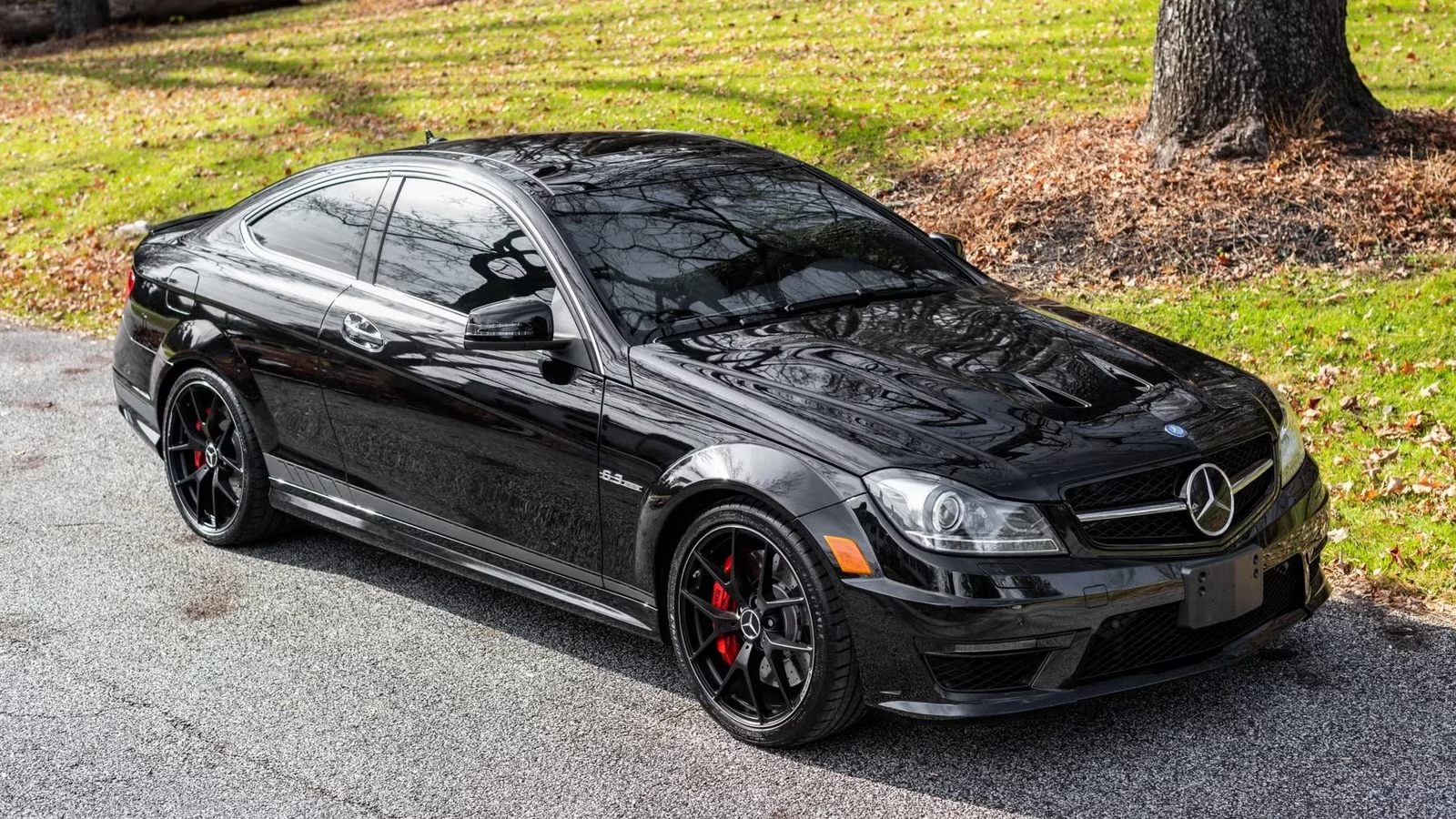
Owning a Mercedes-Benz doesn’t have to mean paying new-car prices. Thanks to steep depreciation during the first few years of ownership, many Mercedes models become surprisingly attainable on the used market while still delivering the premium comfort, refined performance, and cutting-edge technology the brand is known for. The key is knowing which models have stood the test of time, offering a balance of reliability, manageable maintenance costs, and lasting appeal.

A well-maintained example can provide a genuinely luxurious driving experience for a fraction of its original MSRP, but choosing the wrong model can quickly erase those savings through expensive repairs. Whether you’re shopping for a sporty sedan or a comfortable SUV, these used Mercedes-Benz models represent some of the smartest buys for enthusiasts and everyday drivers alike.
2021 Mercedes-Benz GLE-Class
Reliability Verdict: 3/5
Kicking off our list is the latest redesign of Mercedes’ mid-sized SUV, the GLE. The fourth generation introduced a new family of powertrains, including the turbocharged 2.0-liter inline-four found in 350 models and the mild-hybrid turbocharged 3.0-liter inline-six found in 450 models.

The 2020 model year was the first of this current generation and, like most first-year models, did not post the best reliability score. The following 2021 model year, however, earned a 3/5 Reliability Verdict — the highest mark of any GLE model year within this generation.
Pros
- The most efficient powertrain options offered in a GLE body
- Ride comfort and quality
- A 600+ horsepower AMG model is still offered, because why not?
Cons
- Poor driving dynamics
- Annoying infotainment system and user controls
- The complex mild-hybrid system will be expensive to fix down the road
2021 Mercedes-Benz GLC-Class
Reliability Verdict: 3/5

Next comes the first-generation Mercedes GLC crossover SUV, which enjoyed a long production run from 2016 to 2022. In 2020, the GLC received a significant mid-cycle refresh; the most consequential change was the adoption of Mercedes’ next-generation powertrain lineup.
The 2021 model year earned the highest Reliability Verdict score of the three-year refresh period. The turbocharged 2.0-liter inline-four used in this refresh would be the last iteration of the platform before Mercedes paired it with the more complex 48-volt mild-hybrid system found on current-generation models.
Pros
- Great ride comfort
- Quality interior
- Solid handling for its size
Cons
- Complex infotainment
- Deserves better MPG
- Needs more power
2021 Mercedes-Benz C-Class
Reliability Verdict: 3/5

Our first C-Class sedan on the list is the fourth generation, which was available from 2015 to 2021. For the 2019 model year, Mercedes gave this compact sedan a significant refresh — including updated powertrain options that moved to the 48V mild-hybrid combination now standard across the modern Mercedes lineup.
Of every Mercedes C-Class model year between 2015 and 2021, the final 2021 model year received the highest Reliability Verdict score of 3/5. If you’re shopping this generation, we recommend sticking to 2019 and later — post-refresh years averaged higher reliability scores than their pre-refresh counterparts.
Pros
- Quiet and comfortable
- The refreshed interior is great
- Expensive LED headlights are standard on refreshed models
Cons
- The infotainment system and user controls are still far from perfect
- The complex mild-hybrid system might be expensive to fix in the future
2014 Mercedes-Benz C-Class
Reliability Verdict: 3/5

Our next entry is the third-generation C-Class, produced from 2008 to 2014. During its heyday, this sedan was Mercedes’ best-selling model — and it came in an era when the C 300 still carried a naturally aspirated 3.5-liter V-6 under the hood.
The 2012 model year brought a welcome mid-cycle refresh, delivering a much-needed interior overhaul and global powertrain updates. The 2014 model year — the last of this generation — also earned the highest Reliability Verdict of any third-generation C-Class year, scoring 3/5.
Pros
- Comfortable front seats
- The standard manual transmission in RWD C 300 models, but only pre-refresh
- The C 63 AMG model is still a legend today
Cons
- The pre-refresh interior is lackluster
- Lower-trim models lacked overall performance
- Pre-refresh models look and feel outdated
2013 Mercedes-Benz GLK-Class
Reliability Verdict: 4/5

Before there was a GLC-Class, there was its predecessor, the GLK-Class SUV — essentially a C-Class in SUV form. The GLK first went on sale in 2010, and a thorough mid-cycle refresh for the 2013 model year proved to be a smart move for the brand.
That first refresh year, 2013, scored an impressive 4/5 Reliability Verdict, placing it among the most dependable modern Mercedes models. By this point, the GLK 350’s 3.5-liter V-6 was in one of its most refined and well-developed states. Interestingly, the final model year of 2015 posted a starkly contrasting score of 2/5, despite no changes to the powertrain or major design elements.
Pros
- Refresh models offer the best version of the smooth and solid V-6 engine
- Solid MPG for its size
- Refresh models’ interior quality is improved
Cons
- Low-speed handling characteristics
- Could be more spacious in general
- Infotainment will leave you disappointed
2014 Mercedes-Benz M-Class
Reliability Verdict: 4/5

The predecessor to the current GLE-Class is the M-Class, Mercedes’ full-sized SUV, which was renamed after the 2015 model year as part of its mid-cycle refresh. It was the penultimate year of the pre-refresh third-generation German SUV, the 2014 model year, that stands out above the rest.
The 2014 model year earned an impressive 4/5 Reliability Verdict — a sharp contrast to the 2015 model year’s 2/5 score. The proven 3.5-liter V-6 in the ML 350 was undoubtedly the most dependable powertrain in the lineup, though the ML 500/550’s twin-turbo V-8 delivers serious performance for those willing to accept a higher maintenance cost.
Pros
- Diverse engine offerings across trims
- Quiet and comfortable
- Impressive off-road capability that rarely gets used
Cons
- Vague driving dynamics
- Confusing infotainment system
- Fuel economy above 20 mpg is a pleasant surprise
2016 Mercedes-Benz GLC-Class
Reliability Verdict: 4/5

When the GLK-Class was discontinued after 2015, the first-generation GLC-Class stepped in as its replacement for the 2016 model year. First-year models rarely top their generation’s reliability charts — they tend to serve as the proving ground for improvements that follow.
Despite that general rule, the 2016 GLC bucked the trend and earned the highest Reliability Verdict of any year in its generation — a 4/5 — across a production run that stretched all the way to the 2022 model year. Much of that success can be credited to the more efficient and better-sorted powertrain options the GLC offered compared to the GLK it replaced.
Pros
- Comfortable and quiet
- Interior quality is great
- Great value at its price point
Cons
- Frustrating infotainment
- Rear seats could be more spacious
- Fuel economy is acceptable at best
2017 Mercedes-Benz E-Class
Reliability Verdict: 4/5

What is the most consistently reliable Mercedes model of the last decade? The fifth-generation E-Class takes the crown, posting three separate 4/5 Reliability Verdict scores within a single generation — a feat no other Mercedes model can match. Even more remarkable, the first model year of this generation, 2017, is one of those three top-rated years despite representing a substantial departure from its predecessor.
The powertrain lineup of the fifth-generation E-Class is nothing short of sprawling. Base E 300 models received a turbocharged four-cylinder, the E 400 stepped up to a twin-turbo V-6, and the E 63 AMG brought a twin-turbo V-8. Add the mild-hybrid turbocharged inline-six in the E 53 AMG, mild-hybrid variants of the turbo-four, plus available hybrid and diesel options, and the engine menu becomes genuinely overwhelming.
Pros
- Improved fuel economy across trims
- Gorgeous interior quality
- An E-Class for every tax bracket
Cons
- Not as plush as the previous generation
- Infotainment and user controls still a mess
- Less interior space than in the previous generation
2019 Mercedes-Benz E-Class
Reliability Verdict: 4/5

Despite the sheer breadth of body styles and powertrain options in the pre-facelift fifth-generation E-Class, the turbocharged four-cylinder in the entry-level E 300 and E 350 proved to be the most reliable of the bunch. The twin-turbo V-6 in the E 450 made its final appearance in an E-Class here, subsequently replaced by the mild-hybrid turbocharged inline-six that now powers current 400- and 450-badged Mercedes models.
For all its complexity, the fifth-generation E-Class succeeded because of its strong underpinnings. This generation was the first E-Class built on Mercedes’ modern modular rear-wheel-drive architecture, known as MRA — a platform that proved to be a hit across multiple segments and one that underpins many of the models discussed throughout this list.
Pros
- Better dynamics than its predecessor
- Gorgeous interior quality
- An E-Class for every tax bracket
Cons
- Not as plush as the previous generation
- Infotainment and user controls still a mess
- Jack of all trades, master of none?
2022 Mercedes-Benz E-Class
Reliability Verdict: 4/5

Rounding out our list is the 2022 Mercedes E-Class, part of the facelifted fifth generation that debuted for the 2021 model year. No aspect of that refresh was more significant than the overhaul of the powertrain lineup, which had grown unwieldy and far too complex.
The 2021 facelift brought a welcome simplification to Mercedes’ engine roster. The updated E 300 adopts the current mild-hybrid turbo-four combination, while E 450 models use the mild-hybrid turbocharged inline-six. The legendary E 63 twin-turbo V-8 also bowed out with this generation, as Mercedes continues its push toward engine downsizing — for better or for worse.
Pros
- Modernized and simplified powertrain options
- Gorgeous interior quality
- An E-Class for every tax bracket
Cons
- End of the E 63 lineage
- Mercedes still can’t figure out infotainment
- Mild-hybrid technology is still unproven long-term and expensive
Sources: Mercedes-Benz, Consumer Reports

Related posts



Latest Post




No Comments