
The Kawasaki That Owners Keep Coming Back To
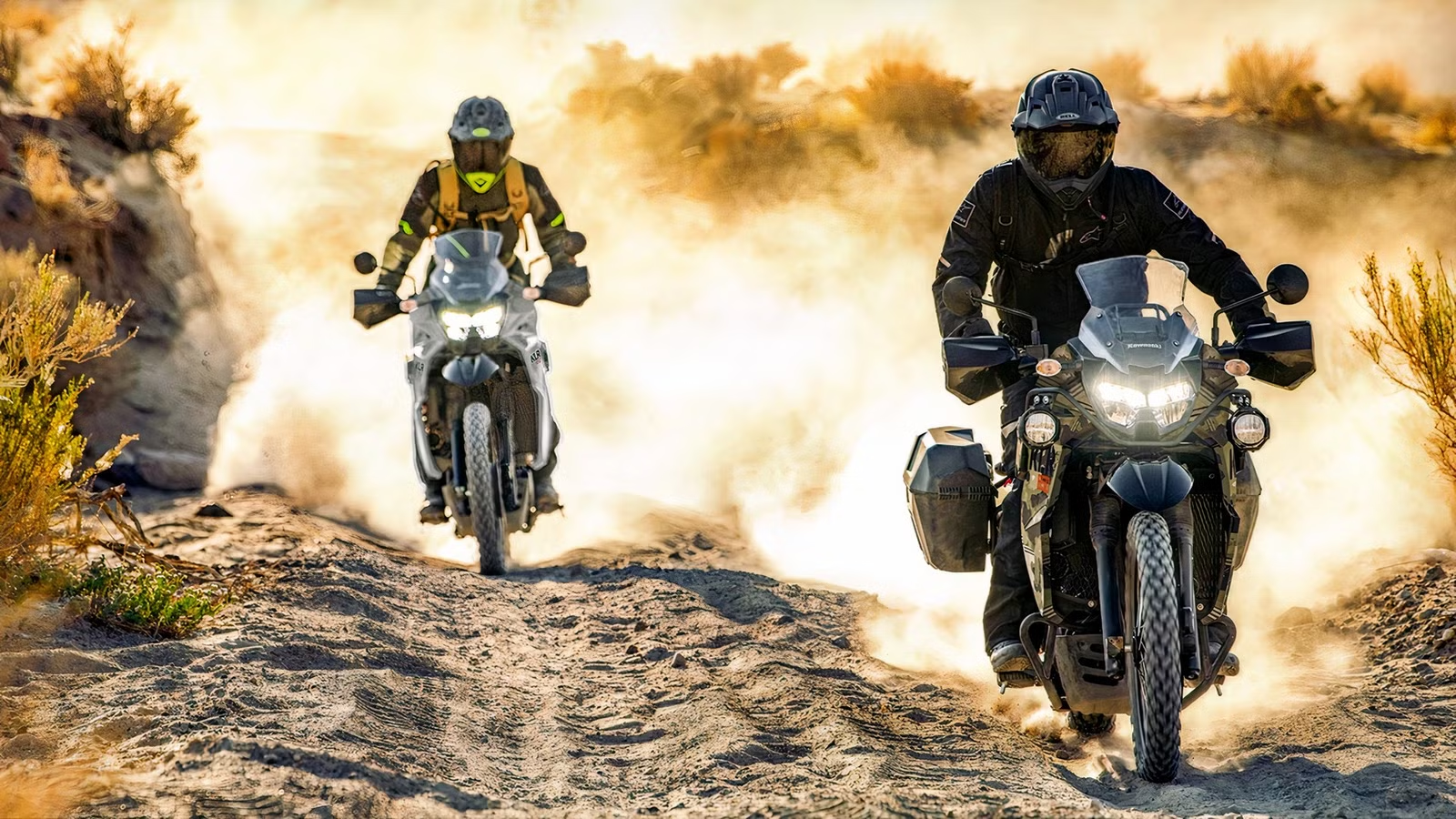
Most motorcycles get judged on numbers — horsepower, weight, and the price on the window sticker. However, a few earn something a spec sheet can’t capture: riders who sell them, then quietly buy another one. Kawasaki has built its name on tough, forgiving machines, the kind that shrug off neglect, bad weather, and the occasional tip-over in a gravel driveway. One of them, though, seems to hold on to people in a way the flashier models rarely do. It’s not the quickest, definitely not the newest and yet owners just keep finding their way back to it, sometimes more than once.
The Kawasaki Riders Sell, Then Buy Again
The Loyalty Kawasaki’s Spec Sheets Miss
Ask most Americans what Kawasaki is known for, and you’ll hear Ninja, maybe Z. Sport bikes and nakeds, fast and a little aggressive. That reputation is earned. However, owner attachment doesn’t track horsepower, lap times or price, so the bike riders return to isn’t necessarily the quickest one in the showroom. Plenty of them churn through Kawasakis, always chasing something newer and faster, and still circle back to one familiar machine. It happens in the used market, too, and owner discussions on public forums are a testament.
The Unglamorous Traits That High-End Bikes Trade Away

The traits repeatedly praised by Kawasaki owners in these forums are not exotic. They include simplicity, predictable behavior, straightforward maintenance, versatility, and a relatively low cost of entry. That’s a very different pitch from the flagship end of the lineup, where high output and heavy electronics buy performance at the cost of simplicity.
It’s a fine trade if speed is the point. There is nothing wrong with that progress. It simply leaves room for a different kind of motorcycle. One that can commute during the week, disappear onto dirt roads on Saturday, and spend Sunday morning carrying camping gear without making either job feel unnatural. And one Kawasaki in particular sits firmly in that second camp.

The Kawasaki KLR 650 Is The Unkillable Swiss Army Knife Of American Dual-Sports
At $6,999, The KLR 650 Undercuts Most Adventure Rivals By Thousands

The Kawasaki KLR 650 remains one of the least intimidating ways to get into a large dual-sport. For 2026, the base model starts at $6,999 without ABS or $7,299 with it, plus a $685 destination charge that dealers can adjust. Colors are Pearl Solar Yellow and Metallic Spark Black.
The KLR650 S carries the same pricing but cuts the seat height from 34.3 to 32.1 inches, a real help if you are short on inseam. Then there’s the Adventure ABS at $8,199, or $8,299 for the Cypher Camo Beige paint. It adds factory side cases, auxiliary lights, engine guards, a tank pad, and both DC and USB outlets. The bike has been dubbed the Swiss army knife of motorcycles.
A Design That Barely Changed For Two Decades

Kawasaki introduced the KLR 650 in 1987 to replace the 564cc KLR 600, then left it almost unchanged through the 2007 model. While rivals kept reworking their bikes, Kawasaki stuck with the same basic design, and when the mid-’90s dual-sport boom hit, buyers ended up on waiting lists.
The 2008 model brought the first significant redesign, and it wasn’t flawless. Early bikes had a thirst for oil, and Kawasaki fitted thinner, higher-tension piston rings in 2009 to fix it. Production then paused after 2018, and a revised model arrived in 2022 with fuel injection and ABS. That’s the bike on dealer floors today: old soul, newer plumbing.
Bulletproof Mechanicals: Simple Engineering Built For Endurance
The 652cc Liquid-Cooled Single: Torque Over Top Speed

The currentKLR650 uses a 652cc liquid-cooled, four-stroke, DOHC single-cylinder engine with a 40mm throttle body, five-speed transmission, and sealed-chain final drive. Kawasaki rates it at 40 horsepower at 6,000 rpm and 39.1 pound-feet of torque at 4,500 rpm. There is an important footnote to that horsepower figure. Kawasaki measures its motorcycle output using the ISO 4106 standard, which means the published number can be higher than a figure measured using SAE methodology.
Either way, 40 horsepower is not the reason somebody buys a KLR650. The engine’s appeal is more about how little it needs to do. A large single with a relatively modest state of tune delivers enough torque for trails, back roads, and everyday riding without trying to turn every straightaway into a top-speed contest.
Practicality Wins Over High Horsepower

The KLR650’s real party trick is how many jobs it can handle. Owner discussions regularly describe these motorcycles being used as daily commuters, weekend trail bikes and long-distance touring machines. One owner of an older model reported exceeding 100,000 miles, while another rider described a machine with roughly 100,000 miles that was still running well, although it had reached the point of needing an overhaul. These are individual owner accounts, not laboratory reliability data, but they illustrate the mileage this motorcycle can accumulate if maintained properly.
That doesn’t mean the KLR 650 can carry out everything that a rider desires. Plenty of these riders keep something faster in the garage, too. In one KLR Forum thread, a member said he owns two bikes and grabs the KLR when he just wants to go somewhere under 200 miles round trip. Even its hardcore admirers admit that it doesn’t have strong enough horsepower to back its case as the primary machine in a garage, and yet they are unwilling to part ways with their KLR. That’s the point.
Built For The Long Haul: Ergonomics, Range, And Customization
A 6.1-Gallon Tank And 8 Inches Of Travel Built For Remote Roads

Everything about the chassis says distance. Suspension travel is 7.9 inches up front and 8.0 inches at the rear, where the shock offers adjustable rebound damping and spring preload. It rolls on a 21-inch front wheel and a 17-inch rear, with 8.3 inches of ground clearance. Curb weight is 460.6 pounds with ABS, and the tank holds 6.1 gallons. Kawasaki’s spec sheet lists ABS as the only electronic rider aid, and the cockpit is modest, comprising a dash with a slim LCD showing speed, fuel level, and the clock. It’s also one with very little to go wrong on a remote trail.
The Massive Aftermarket Ecosystem

Out of the box, the KLR is a blank canvas, and owners treat it like one, adding skid plates, panniers, upgraded suspension, and custom seats. Kawasaki itself sells factory extras like a more accessible seat, LED auxiliary lights, frame sliders, and a grip heater set. Some owners build lightweight trail machines out of the stock KLR. Others fit panniers, crash protection, GPS units, and windscreens, and turn the bike into a budget adventure tourer.
The important thing is that none of this feels like fixing a motorcycle’s identity. The KLR was practically designed to be modified. That creates another reason owners have trouble leaving the platform. Once a rider has spent years setting up a motorcycle exactly how they want it, switching to a completely different platform means starting over.
Why KLR650 Owners Always Buy Another One
Cheap To Buy, Easy To Live With

At $6,999 before destination and other fees, the non-ABS trim of the KLR 650 is accessible enough to serve as a first adventure motorcycle, a second bike or a long-term project. The ABS version remains below $7,300 before those additional costs, while the Adventure ABS trim adds factory touring equipment for $8,199. For reference, Yamaha’s Ténéré 700 is listed at $10,999, while Suzuki’s V-Strom 800DE is listed at $11,799.
Then the owner decides what the motorcycle needs. A commuter might need only a rack and hand guards. A traveler may add luggage, a GPS, heated grips and a larger windscreen. Someone heading deep into the back country might prioritize a skid plate, suspension upgrades, and stronger protection. The motorcycle grows with the rider instead of demanding that the rider buy a more expensive motorcycle to unlock its potential.
Trailside Maintenance And DIY-Friendly Design

There is also an important psychological advantage to owning something you are comfortable working on. The KLR 650’s conventional mechanical layout has made owner maintenance a major part of its culture. Routine service does not require the kind of diagnostic equipment associated with increasingly complex motorcycles, and the large owner community has produced an enormous library of guides, parts and practical advice.
The KLR’s history is filled with motorcycles carrying luggage through remote areas, across long stretches of pavement and onto rough trails. It is not flawless, and calling any motorcycle literally indestructible would be misleading. It succeeds because it does not try to win every category. It simply remains useful across an unusually wide range of situations. It can be the commuter that takes the rough road home, the camping bike that ventures beyond the pavement or the old favorite that gets pulled out when the expensive motorcycle starts feeling like too much machinery. That is why the most revealing KLR stories are often not about buying one. They are about buying another.
Source: Kawasaki

Related posts


Latest Post


No Comments