
The Tiny Audi That Came With Lamborghini DNA Under the Hood
Few things in the automotive world grab attention like a big, thirsty engine. A V8, a V10, or, better yet, a great, lusty V12 have long been the preserve of supercars, but they’re gradually fading away as manufacturers have to aim for double-digit MPG figures. But for all the loss of these fantastically large engines, there’s one unusual configuration that has persevered from 1980s motorsport all the way to today. And Audi has arguably perfected it.
When More Cylinders Meant More Prestige

For decades, more cylinders meant more status. A four-cylinder was your standard fare, but things got more exciting as you rose up through six and eight cylinders to cars like the V10-powered Audi R8, Lexus LFA, and Lamborghini Gallardo. Anything more was reserved for the truly exotic and unique, covering cars like the V12-engined Ferrari 812 Superfast and Aston Martin DBS, or the ludicrous 16-cylinder Bugatti W16 engine. It was a simple formula — more cylinders generally equaled more power, smoother application, and more esteem. But somewhere along the way, more cylinders became more of a burden.
Turbocharging, supercharging, and electrification negated much of the power advantage once offered by additional cylinders, allowing manufacturers to squeeze increasingly impressive outputs from smaller engines. This was partly precipitated by tightening emissions regulations and efficiency concerns, forcing manufacturers to rethink the old bigger-is-better mantra, but in the constant quest to extract more from less, it has impacted every facet of motoring.
Lamborghini’s V10 run ended with the Huracán, its replacement using a 4.0-liter twin-turbo V8 hybrid powertrain. Audi’s R8 is no longer produced, and the V10-powered Lexus LFA was a one-off. The Bugatti Tourbillon does have a V16 engine but, in a car costing $4 million, it’s not exactly common. Yet while larger-cylinder engines die out, there’s one format that continues to live.

The Five-Cylinder Formula That Refused To Die

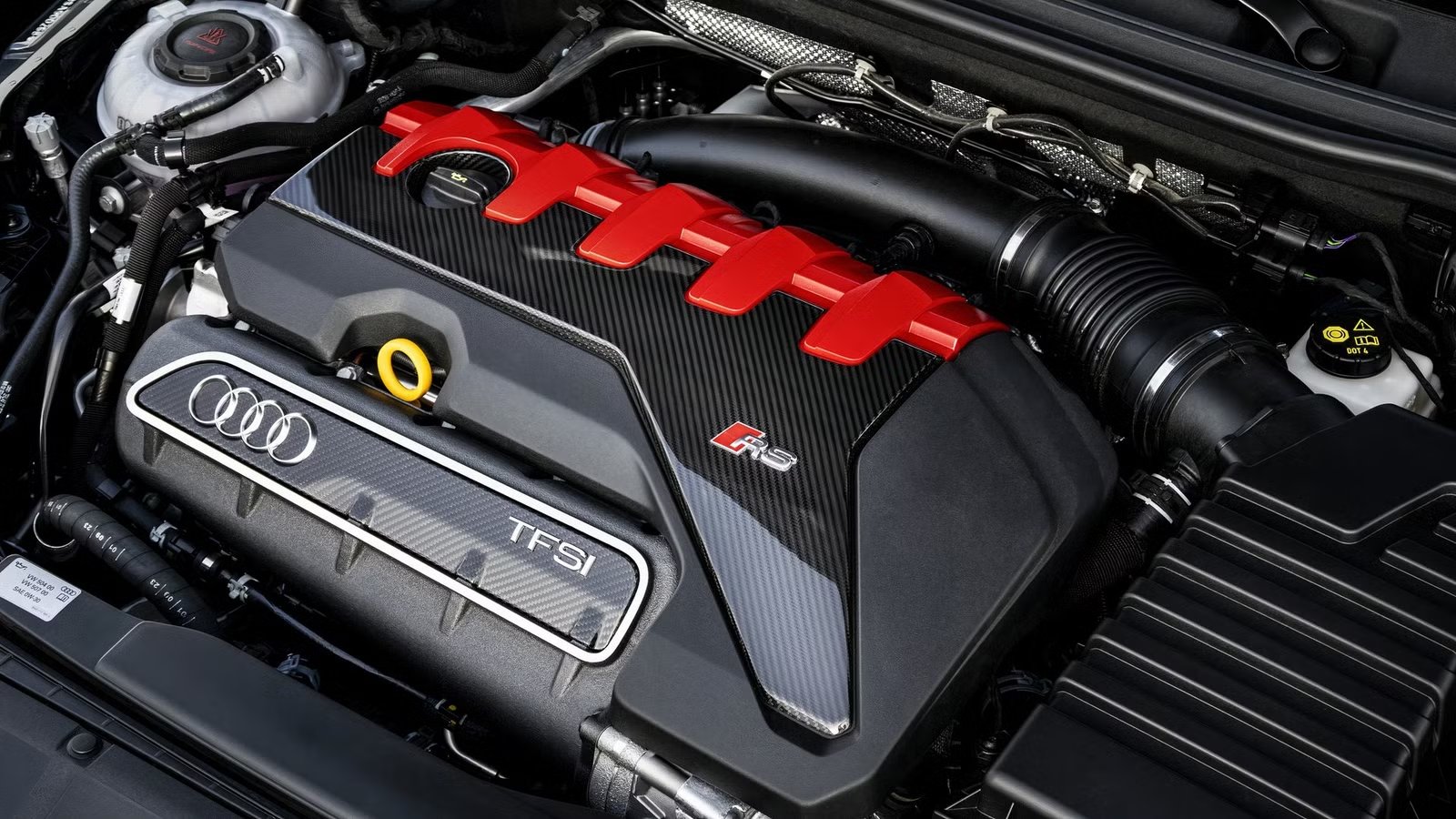
The inline-five engine occupies a niche spot in the automotive world. Slightly bigger than the generic four, yet not as complicated as the larger six, the uneven 1-2-4-5-3 firing order gives it a distinctive, characterful sound that simply can’t be imitated. Being an odd number also means that it has a more unusual interval, firing every 144 degrees rather than the 180 degrees of a four, or 120 of a six.
What this means in practice is a warbling, off-beat exhaust note that is as much a part of its charm as its performance. And, for Audi in particular, it has a certain heritage. The five-cylinder engine was synonymous with Audi’s rallying program in the 1980s, with its legendary Quattro cars using the engines to devastating effect, taking two manufacturers’ titles and two drivers’ championships.
But heritage alone isn’t enough to justify a format. The five-cylinder was yet another casualty of tightening emissions and efficiency demands, as forced induction in a four-cylinder arguably just made more sense. That’s not to say that it died altogether, though, as one modern car still carries the format to this day.
Meet The 2025 Audi RS3: A Miniature Supercar In Sedan Clothing

There are plenty of ways to make a fast sedan. Some, like Lexus, opt for a big V8 engine underneath an unassuming body. BMW’s M department puts an inline-six or a V8 under the hood. Mercedes-Benz sometimes goes as far as turbocharging an inline four. But for the RS3, Audi opted to go back to its roots, powering it with a 2.5-liter inline five.
Sitting at the lower end of Audi’s performance sedans, you’d be forgiven for thinking that it isn’t that exciting. It is the entry-level Audi RS, after all, starting at $63,400 for the 2025 model. But what that money gets you is not just a car; it’s half a Lamborghini. Or at least it would be, had Lambo not abandoned its V10s. But, cylinders don’t tell the entire story of a car, and the way that the RS3 uses its cylinders is just as exciting.

The 2025 RS3’s 2.5-liter turbocharged inline-five makes 394 horsepower and 369 lb-ft of torque in US specification, pushing it to 60 mph in a rapid 3.6 seconds en route to its electronically limited 155 mph top speed. So, not exactly slow. It’s actually only 0.4 seconds slower than a Huracán LP580-2 despite having half the cylinders — an impressive demonstration of just how far modern turbocharging and technology have come. But outright performance isn’t the overall goal of the RS3 — at the end of the day, it’s still a sedan. And to that end, it’s a very capable one.
But the RS3’s five-cylinder engine isn’t the only link it has to its rallying heritage, as it also benefits from Audi’s quattro all-wheel-drive system, alongside a seven-speed S-tronic automatic gearbox and all the technology Audi could bring to bear. And this is what makes the RS3 such an intriguing car: supercar-troubling performance in a far more compact package.
Why A Tiny Five-Cylinder Can Still Feel This Special

The RS3’s appeal goes far beyond headline numbers. Numbers are cold and sterile, and do little to convey the visceral, emotional heart of a car that makes automotive enthusiasts excited. And, in more ways than one, the characterful five-cylinder is the beating heart of the car.
A great engine can be ruined by the car that surrounds it, but thankfully that isn’t the case for the RS3. Unlike larger performance sedans that impose their size on the roads and parking bays of the world, the RS3 retains the maneuverability of a smaller car while still providing the pace drivers want. It is big enough to be comfortable, but not so big that driving becomes a chore when the streets get narrow. At 78.1” wide including mirrors, it’s 1.8” narrower than the RS5, and some 5.3” narrower than the RS7. That’s a lot more room to play with when you’re trying to open it up on back roads, giving you the room to exploit that glorious engine when you have the chance.
Of course, a smaller size makes agility easier to achieve, and it’s something that Audi has paid particular attention to. Its torque-splitting rear differential allows the car to distribute power between the rear wheels, allowing greater cornering precision and giving the driver both more control and more confidence in what the car’s actually doing. It helps the car feel alive through corners, going faster by working with, not against, its driver. It makes it more than the sum of its numbers: a snarling, responsive beast beneath your right foot.
The RS3’s Legacy May Be Bigger Than Its Size

The RS3’s legacy may have little to do with its admittedly impressive performance figures. After all, are you really going to feel the difference of a couple of tenths of a second to 60 mph? No, the real impact of the RS3 is in its continuation of the five-cylinder power plant during what could be the final era of the internal combustion engine. As manufacturers move away from gasoline alone and toward smaller engines, hybridization, and even full electrification, a turbocharged five-cylinder stands out as a remarkably deliberate choice, both for the maker and the buyer.
This choice matters, because the RS3 is more than just its engine. It’s a mixture of modern performance car technology and historic motorsport success, linking the two in an entirely cohesive way that few contemporaries can match. But the five-cylinder’s future is looking increasingly uncertain. Euro 7’s tighter emissions requirements begin applying to new vehicle types from November 2026, and to new vehicles from November 2027. This adds yet another hurdle for engines that prioritize character over efficiency. Audi has already announced a new RS3 model in the RS3 Competition Limited, which is limited to just 750 units and feels like a tacit acceptance of the final days of the glorious power plant.
Regardless of your thoughts on the future and, indeed, the present, of automotive manufacturing, the RS3 will be remembered as one of the most exciting performance sedans on the market. And a big part of that is in its unusual, but immensely effective, five-cylinder engine.
Sources: Audi

Related posts



Latest Post


No Comments