
Korean And Japanese Luxury Cars That Have Depreciated Into Affordable Bargains
Used luxury cars have never made more sense than they do right now. New vehicle prices have climbed steeply over the past several years, pushing even mainstream models like the Toyota Camry into territory that once belonged exclusively to premium brands. If you’re shopping smart, a well-depreciated Asian luxury sedan can deliver genuine refinement, strong reliability, and serious bang for your dollar — without the new-car payment.

Of course, not every used luxury bargain is actually a bargain. As tempting as it is to pick up a used Mercedes S-Class at a steep discount, the ownership costs can quickly erase those savings. If you want luxury and reliability in the same package, the Asian brands remain your safest bet. That’s why we’ve put together this list of the best Korean and Japanese luxury cars that have hit peak depreciation and now offer outstanding value per dollar.
2016 Hyundai Equus
KBB Fair Purchase Price: $9,600
One may not think of a Hyundai as luxury, but the Genesis and Equus will prove that notion wrong. The 2016 Hyundai Equus originally started around $60,000 when new, though without the luxury clout that BMW, Mercedes, and Audi enjoy, the large premium sedan was destined to fall into obscurity. Despite this, it packs a slew of features and a powerful engine that rewards informed buyers with an experience that is only matched by European luxury names. Standard features include a 9.2-inch screen, a 17-speaker Lexicon sound system, tri-zone climate control, leather seating, and more. The standard engine is a 5.0-liter V8 that pumps out 429 horsepower, providing a 0-60 MPG sprint of around 5.6 seconds — rivaling the Mercedes S550 of the same time on power, speed, and luxury.

2018 Acura ILX
KBB Fair Purchase Price: $13,090

The Acura ILX was designed to slot one rung below the TLX, and as such it comes exclusively with the 2.4-liter inline-four. Even so, the facelifted ILX (2016–2019) carries over many of the TLX’s premium touches, including the striking “jewel eye” headlights. You may miss the low-end pull of a turbocharged engine, but performance is competitive within the entry-level luxury segment. If you appreciate the practicality of a Honda Civic but want a step up in refinement, the ILX delivers a well-rounded blend of comfort, quality, and reliability.
2017 Acura TLX
KBB Fair Purchase Price: $14,000 – $15,100

The Acura TLX is the Japanese brand’s direct competitor to BMW’s 3 Series, and when equipped with the optional V-6 engine, it holds its own admirably. The BMW may have the edge in outright sportiness, but the TLX’s V-6 delivers more than enough power to keep things entertaining. Both the 2.4-liter inline-four and the 3.5-liter V-6 are also considerably easier and cheaper to maintain than their German counterparts. One caveat: Apple CarPlay and Android Auto are absent on the 2017 TLX. We’d also steer clear of SH-AWD models unless you’re prepared for the added repair costs that come with the more complex all-wheel-drive system.
2017 Infiniti Q60
KBB Fair Purchase Price: $15,200 – $18,650

The Q60 is the only coupe on this list — essentially the sportier, better-looking sibling of the Q50 sedan. The twin-turbo V-6 is naturally the star of the Red Sport 400, but this trim is a complete performance package rather than just an engine upgrade. It remains the only Japanese offering that genuinely challenges BMW’s B58 inline-six in the rear-wheel-drive luxury sports car segment. The Red Sport package includes: improved brakes at both the front and rear, sport-tuned suspension, updated gearing ratios, an additional water pump and oil cooler, and semi-aniline leather sport seats.
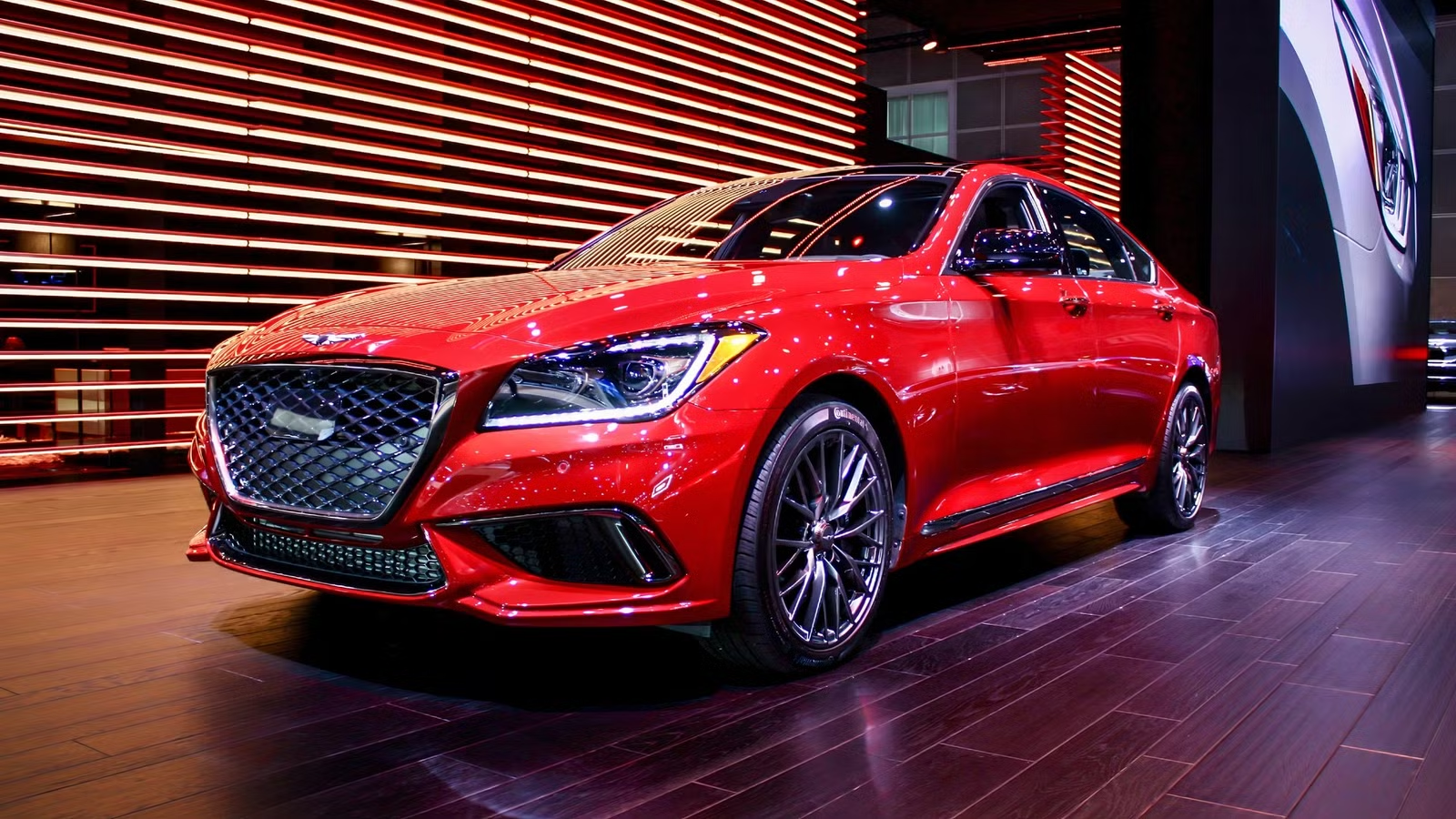
2017 Genesis G80 5.0
KBB Fair Purchase Price: $16,450

The V-8-powered G80 brings a whole new dimension of performance and presence to Hyundai’s mid-size luxury sedan. In terms of perceived quality, this variant feels every bit as European as its direct rivals. The equivalent Mercedes E-Class of this era had already moved to a twin-turbo V-6, so the G80 5.0’s naturally aspirated V-8 trades some low-end torque for a smoothness that’s genuinely hard to fault. The V-8 doesn’t turn the heavy G80 into a sports car — instead, it makes the chassis feel responsive without ever feeling rushed. If your priorities are comfort and refinement over outright performance, there’s a great deal to appreciate about the mature character of the 5.0-liter G80.
2017 Infiniti Q50 Red Sport 400
KBB Fair Purchase Price: $17,500

So you want a practical Japanese sedan, but you’re not willing to sacrifice performance? The 2017 Infiniti Q50 Red Sport 400 is one of the best options that ticks all the right boxes. In Red Sport trim, the twin-turbo V-6 unleashes its full 400 horsepower while still returning a respectable 26 MPG combined — though if you use that power freely, expect to see less. You won’t feel guilty about the fuel economy, though, because the engine is genuinely enjoyable and responsive. The RWD model lacks a limited-slip differential, but the Q50 still delivers engaging and adaptable driving dynamics whether you’re pushing hard or cruising comfortably.
2017 Lexus ES 350
KBB Fair Purchase Price: $19,200

If you want the definition of reliability wrapped in top-quality comfort, few cars fit the bill as well as the sixth-generation Lexus ES. Both the hybrid and non-hybrid variants have their merits, but for the most refined luxury experience, the V-6-powered ES 350 is the clear choice. This sedan is built to eat up miles effortlessly — it’s as practical and pleasant a daily cruiser as you’ll find, with class-leading ride quality to boot. Is it exciting? Not particularly. But sometimes predictability is exactly what you want, and there’s real comfort in being “just another Lexus.”
2015 Lexus LS 460
KBB Fair Purchase Price: $21,400 – $23,500

Yes, the 2015 Lexus LS originally stickered at over $75,000, and that figure can give pause when maintenance comes up. However, the naturally aspirated V-8 found in the LS is one of the most reliable V-8 engines available — a reputation that holds to this day, given that the same engine architecture still powers current Lexus models like the gorgeous LC 500. The fourth-generation LS simply offers extraordinary value at its current price point. Search as long as you like, but it’s hard to argue there’s a more complete sedan available for under $25,000.
2017 Lexus IS 350
KBB Fair Purchase Price: $23,350

Think of the Lexus ES with a smaller footprint and rear-wheel drive, and you have the IS sedan. But you might wonder why the smaller, entry-level IS commands higher used prices than an ES or LS of the same vintage. The answer is simple: supply. Despite being the most affordable sedan in the current Lexus lineup, the ES has outsold the IS by a wide margin year after year. Why? Because most Lexus buyers aren’t chasing driving dynamics — they want comfort, refinement, and dependability. That makes the IS a bit of an oddity in the lineup: it’s sporty, but not as sporty as its European rivals.
2020 Lexus GS 350
KBB Fair Purchase Price: $28,200

The final year of the Lexus GS sedan offered a handful of trims, including the legendary GS F, though the real bargain is the base 350, which originally started at $52,420. The 2020 GS 350 delivers Lexus’s signature refinement, quiet cabin, and easy-going ownership, though it’s also very reliable. The 2GR-FKS under the hood is one of the most reliable engines ever, and it pumps out 311 horsepower with the option of AWD. According to iSeeCars, the GS 350 has an average lifespan of 167,761 miles, though many 2GR-powered models cross 250,000 with little to no fuss. For a little extra cash, buyers can find an F Sport model with added performance parts that give the big GS 350 sharper reflxes.
Sources: OEMs, Kelley Blue Book

Related posts


Latest Post


No Comments