
The First Turbocharged Car Sold In America
Turbocharging feels like modern car magic. Say the word today, and most people picture Porsche 911 Turbos, old Saab weirdness, BMW straight-sixes, spicy hot hatches, and tiny engines that act like they drank three espressos before breakfast. It feels high-tech, digital, and very much not old Detroit.

That is what makes the first turbocharged car sold in America such a great twist. The answer came from an unlikely fight inside General Motors, where two divisions raced for the same idea at nearly the same time. One got there first, but only by a fender-length.
 107 autotech
America Made The First Turbocharged Flat-Six Sports Car A Decade Before The 911 Turbo
Before Porsche even thought about turbocharging the 911, Chevrolet quietly built a turbo flat-six sports car that broke new ground.
Putting A Turbo In A Production Car Was A Huge Gamble

Turbochargers were not new in 1962. Engineers already knew they worked in aircraft, where thin air robbed engines of power, and in large diesel and industrial uses, where steady loads made boost easier to manage. The problem was the passenger car – a family driver wanted to turn a key, run errands, and maybe show off a little on the highway ramp.
That made a turbocharged production car a serious bet. Boost could pull more power from a small engine, but it also brought extra heat, higher cylinder pressure, more plumbing, and a greater chance of detonation. Detonation is the nasty rattle that happens when combustion stops acting like a controlled burn and starts acting like tiny hammers inside the engine.
The era made the gamble even bigger. Early-1960s cars still used carburetors, drum brakes, simple ignition systems, and dashboards that treated gauges as optional decoration. Electronic knock sensors did not exist at that time, nor did computerized fuel injection. The engineers had to make boost behave with jets, springs, diaphragms, ignition timing tricks, and a lot of hope. It was clever, brave, and just a little unhinged, which is usually where interesting car history starts.
Detroit’s Quiet Race To Make Boost Mainstream

Inside General Motors, two divisions moved toward turbocharging at almost the same moment. This was not a corporate moonshot with one clean plan, but more like two smart kids in the same school building rockets in separate classrooms. Both wanted more power without simply adding displacement. Both saw a turbo as a way to make a compact car feel special.
One route was simple, sporty, and strange in a very charming way. It used a compact rear-engine car with an air-cooled flat-six hanging out behind the cabin. That layout already made the car different from anything else in Detroit. Add boost, a four-speed, extra gauges, and a sportier attitude, and suddenly the odd little compact started acting like it had been sneaking into European night school.
The other route sounded like something from a lab coat fever dream. It used a small aluminum V8, high compression, a turbocharger, and a special fluid-injection system that sprayed a water-and-methanol mix to control knock. One idea leaned on reduced compression and a simpler turbo setup. The other kept compression high and asked owners to keep a second tank filled with what sounded like rocket juice. Guess which one gave service departments more gray hair.
The First Turbocharged Pontiac Muscle Car Is Cheap And Forgotten
Although you won’t often see Pontiac’s first turbo muscle car at auction or your local car show, this historic model had a major impact on later cars.
The Spyder Beat The Jetfire To Showrooms — Barely

1962 Chevrolet Corvair Monza Spyder Key Specs
|
Engine |
Power |
Torque |
0-60 MPH |
Top Speed |
|
2.4-liter turbocharged flat-six |
150 hp |
210 lb/ft |
10.8 seconds |
110 mph |
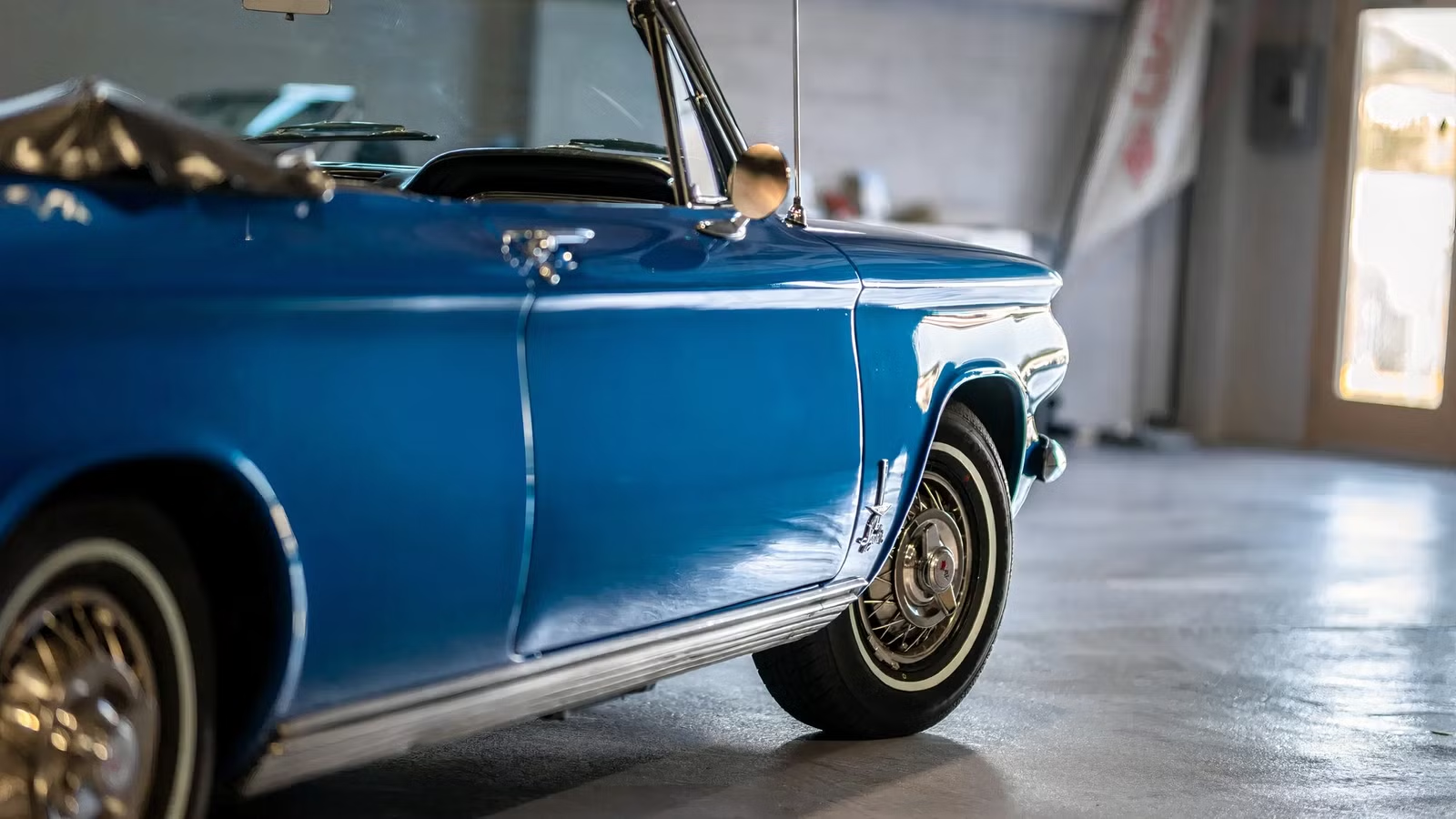
The best answer, when “first turbocharged car sold in America” means market timing and dealership availability, is the 1962 Chevrolet Corvair Monza Spyder. Chevrolet launched the turbo Spyder at the 1962 Chicago Auto Show, which ran from February 17 to 25. Oldsmobile introduced the F-85 Jetfire at the New York Auto Show on April 20, just before that show opened to the public from April 21 to 29. In car-history terms, this is a photo finish.
The Corvair Monza Spyder was not a separate model at first. It was a performance package for the Corvair Monza coupe and convertible. Simply put, Chevy didn’t create a whole new car to make history, and instead took its already unusual rear-engine compact and gave it the one thing every underdog loves – a way to punch above its weight. The package brought a turbocharged version of the 145-cubic-inch air-cooled flat-six, a four-speed manual, special instruments, chassis upgrades, badges, and the attitude adjustment Detroit compacts rarely received.

The numbers made the case. The standard Monza engine made 102 horsepower, while the turbocharged Spyder jumped to 150 horsepower. Torque rose to 210 lb-ft, which gave the little Chevy a much stronger midrange shove. The turbo setup used a TRW turbocharger and a Carter YH sidedraft carburetor. It did not have the smooth polish of modern boost, but it had the important part – it made the Corvair feel quicker, louder, and more alive.

1962 Oldsmobile Jetfire Key Specs
|
Engine |
Power |
Torque |
0-60 MPH |
Top Speed |
|
3.5-liter turbocharged V8 |
215 hp |
300 lb/ft |
8.5 seconds |
107 mph |
The Oldsmobile Jetfire deserves almost as much credit, and in some ways, it looked more advanced on paper. Its Turbo-Rocket V8 used Oldsmobile’s 215-cubic-inch aluminum V8 and made 215 horsepower, hitting the brag-worthy mark of one horsepower per cubic inch. It also made 300 lb-ft of torque and used only about 5 psi of boost. But Oldsmobile had to tame that power with its Turbo-Rocket Fluid system, which added cost, owner attention, and a new way for things to go wrong. The Jetfire was brilliant. The Spyder was earlier, simpler, and easier to explain to a person holding a checkbook.
Two GM Divisions Raced Each Other To The Same Finish Line

The Corvair and Jetfire rivalry looks even better when it is placed in GM’s early-1960s mood. The company was not acting shy in that era – Chevrolet had the rear-engine Corvair, while Buick, Oldsmobile, and Pontiac had the senior compact Y-body cars. Buick’s Special, Oldsmobile’s F-85, and Pontiac’s Tempest all showed how far GM would go to avoid building three boring compact sedans and calling it a day.
Buick played a key background role because its 215-cubic-inch aluminum V8 became one of GM’s most interesting small engines of the period. It weighed a claimed 318 pounds, which was shockingly light for an American V8. Buick used it in the Special, Oldsmobile adapted it for the F-85 and Jetfire, and Pontiac offered it in the Tempest. The engine later became famous again after Rover acquired it and turned it into a long-running British V8. Not bad for a motor that Detroit treated like an expensive side quest.

Pontiac also added to the anything-goes atmosphere. The Tempest used a front engine, a rear transaxle, and a curved “rope” driveshaft. Pontiac even built a shortened Tempest Monte Carlo show car with a supercharged four-cylinder engine, which sounds like a rejected science-fair entry until someone remembers it was real. That was the same GM world that produced the turbo Corvair and Jetfire – bold ideas, odd layouts, and engineers who apparently answered “why not?” before anyone asked “should we?”
Still, the turbo fight belonged to Chevrolet and Oldsmobile. Chevrolet gave enthusiasts the cleaner driver’s car – rear-engine balance, a four-speed, a full set of gauges, and enough boost lag to remind the driver that physics had clocked in for work. Oldsmobile gave buyers the more dramatic machine – a pillarless hardtop, bucket seats, brushed aluminum trim, a turbo gauge, and a fluid tank under the hood. One felt like an American answer to a small European sports coupe. The other felt like a luxury compact trying to qualify for the space program. Both were peak GM.
The Wagon That Quietly Hid A 400-Horsepower Muscle V8
A humble ’60s family wagon hid a 400-hp V8 secret under its long hood, turning grocery runs into muscle-era mischief.
The Turbo Era Started With A Forgotten Fight Inside GM

The real importance of the 1962 Corvair Monza Spyder and Oldsmobile Jetfire is bigger than a trivia-night answer. These cars showed that turbocharging could leave aircraft, trucks, and race-shop theory and enter a showroom. They also showed why the idea would take time – a turbo could make a small engine feel bigger, but the early hardware asked too much from ordinary buyers, mechanics, oil, fuel, and patience.
That is why the Corvair looks smarter with distance. Chevrolet lowered compression, accepted some lag, and used boost to sharpen a car that already appealed to people who liked unusual machinery. The Spyder was still not perfect, of course – it could feel soft before the turbo woke up, and the Corvair’s reputation later took a beating for reasons that stretched beyond the Spyder itself.

The irony is thick enough to need a scraper. America reached the turbocharged production-car milestone early, then mostly walked away from the idea for years. The Corvair Monza Spyder and Oldsmobile Jetfire were too early, too odd, and too misunderstood to start an instant revolution. Later, Porsche, Saab, Buick, Ford, Chrysler, Mitsubishi, Subaru, BMW, and the rest would make boost familiar. But the first American showroom battle happened back in 1962, when two GM compacts proved the turbo future was possible. The future just needed a few more decades to stop coughing, pinging, and asking where the special fluid went.
Source: Chevrolet, Oldsmobile, The Autopian, HotRod

Related posts




Latest Post


No Comments