The Chevrolet SUV That’s Surprisingly Cheap To Own
10 minutes reading
Monday, 3 Aug 2026 20:00 0 67 autotech
From truck-based models that haul trailers across the continent to crossovers that haul families across the subdivision, Chevrolet SUVs consistently emphasize utility and value. Buyers associate Chevrolet SUVs with rugged capability, straightforward engineering, and affordable pricing, and they willingly accept the cost compromises that usually accompany those attributes.
Older Chevrolet SUVs were generally inexpensive to service thanks to proven mechanical components and an extensive dealer network. As Chevrolet shifted toward more efficient SUVs, fuel costs came down but were offset by more complex powertrains, enhanced technology, and more-involved maintenance. The reality is that costs always rise.
The Evolution Of Chevrolet SUVs And The Costs Of Owning Them
Fifth-generation 1966 Chevy Suburban, front 3/4Gateway Classic Cars
Front 3/4 shot of a 2024 Chevrolet Equinox EVChevrolet
The Chevrolet SUV lineup has evolved dramatically over the past century. What began as a single “Carryall” model based off a 1935 truck has become one of the more extensive SUV portfolios in the industry, reflecting changing customer priorities and engineering advancements. Without impacting the brand’s revered capabilities, Chevrolet has improved its SUVs’ efficiency, comfort, and operating costs to align with customers’ expectations and needs.
From the Suburban, which was the only family SUV on the market through the SUV’s 30-year infancy, Chevrolet models served customers that were willing to trade high fuel usage for the mechanical simplicity that allowed shade-tree mechanics to avoid dealer visits. The 1960s brought a host of smaller SUVs, and with wider acceptance and increased competition, engineers started thinking more about efficiency and lower fuel costs, while maintenance costs started to rise as dealerships acquired more business.
The Downsizing Of Chevrolet Body-On-Frame SUVs
High-angle front 3/4 shot of 1994 Chevrolet S-10 Blazer Tahoe in blue parked on grassBring A Trailer
The evolution of the Chevrolet SUV gained momentum through the 1960s, starting with the increase in competition from Ford, International Harvester and Jeep. Rivaled by smaller, lighter, and more efficient competitors, General Motors shortened the Suburban into the Chevrolet K5 Blazer and GMC Jimmy, improving the overall ownership experience with a more fuel-efficient “truck,” while maintaining the cost-effectiveness of DIY maintenance.
The next evolutionary step came in the 1980s, as families began to appreciate SUVs for their people-moving skills … if only they were more fuel efficient and easier to drive. Enter the Chevrolet S-10 Blazer and its GMC S-15 Jimmy counterpart, welcoming challenges from a host of similar body-on-frame compact SUVs from Ford, Jeep, Toyota, and Nissan, powered by smaller engines to save fuel but requiring more complex maintenance. The 1980s also saw the advent of the crossover utility vehicle (CUV).
How Crossovers Changed Ownership Realities
2026 Chevrolet Trax front side driving viewChevrolet
Big powerful engines, bigger tires, heavier-duty components and larger fluid capacities all contributed to higher operating expenses, and though reducing the size of SUVs grounded those a bit better, the real change came when SUVs became more like passenger cars around the turn of the century. Unibody construction, front-wheel drivetrains, smaller engines, and more efficient transmissions delivered competitive performance with significant fuel economy gains.
Chevrolet responded with SUVs that focused on refinement, efficiency and family-friendly practicality. The overall improvements resulted in reduced ownership costs, relatively speaking, though the increased complexity meant a rise in financing costs—because SUVs became more expensive to build—and in maintenance costs, due to increasingly complex maintenance and repairs. It’s tough to find savings anywhere in the ownership cycle, but this Chevrolet SUV manages to keep the brand’s spirit and value focus.
The 2026 Chevrolet Blazer Surprises Owners With Relatively Low Ownership Costs
Moderate Fuel Costs Enhanced By Surprisingly Low Maintenance Estimates
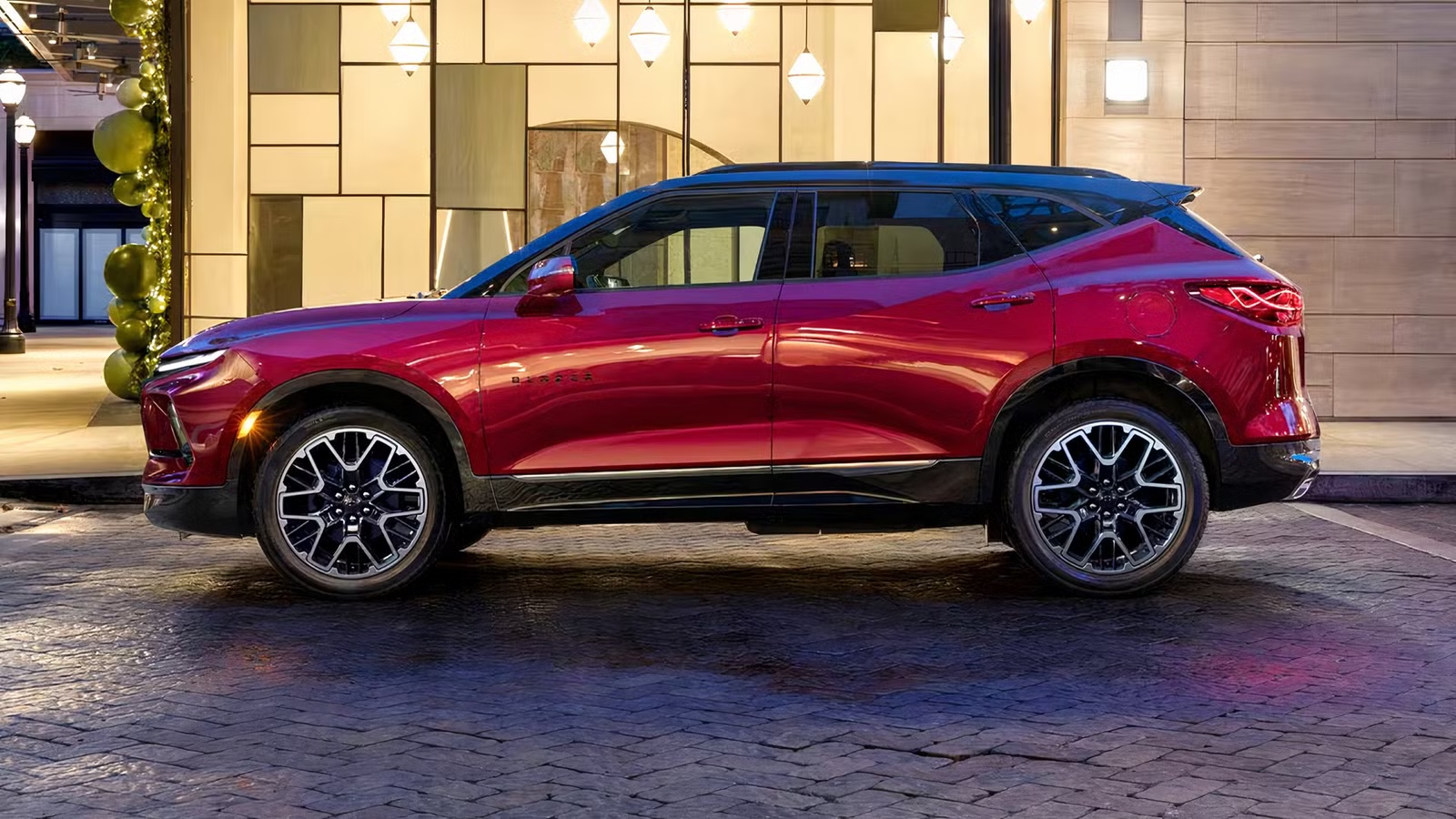
Front 3/4 shot of 2026 Chevrolet Blazer in red parked on roadChevrolet
Few Chevrolet nameplates have changed as dramatically as the Blazer. Once synonymous with rugged ladder frames, solid axles and V-8 power, Blazer has evolved into a refined two-row midsize crossover designed primarily for families seeking comfort without abandoning Chevrolet’s traditional values of toughness and affordability. There is also a current EV version, though that’s a completely different story for another time.
The 2026 Chevrolet Blazer bears little size, design and mechanical resemblance to its roots or its predecessors, now using a unibody platform that promotes pavement efficiency, ride comfort and responsive handling, rather than trail performance and back-40 ruggedness. It targets midsize efficiency, space sensibility, and cost control, adding up to long-term sustainability as one of Chevrolet’s most surprisingly easy-to-live-with vehicles.
How The 2026 Chevrolet Blazer Compares To Its 2005 Namesake
2025 Chevrolet Blazer front 3/4 shotChevrolet
Introduced in 2019, the current FWD/AWD unibody Chevrolet Blazer is not a replacement for the previous Blazer, the RWD/4WD body-on-frame S-10 Blazer (1983–2005). It can’t even be called a spiritual successor. It’s just a namesake. Although heavier and more complex in all its iterations, the current Blazer is far more efficient and cost-effective than the S-10 Blazer, which addressed different needs.
The Chevrolet S-10 Blazer was basically a smaller SUV that kept the full-size (K5) Blazer’s appeal and ability. Its mandate was to be easier to drive and cheaper to buy and operate through reduced bulk and smaller engines. Compared to today’s Blazer, the S-10 cost about 28– 30 percent more to fuel ($3,650–$4,150 versus $2,850–$2,950) but was considerably cheaper to maintain and repair over five years, at $2,500–$3,000, estimated by Edmunds—roughly half of today’s $6,180–$6,814.
How Downsizing Helped Lower Blazer Ownership Costs
2005 Chevrolet Blazer in redBring a Trailer
The Blazer’s history has mostly been about downsizing. Chevrolet introduced the Blazer in 1969 as a step down from the venerable Suburban. For all intents and purposes, it was a short half-ton pickup with a removable rear canopy. The design was copied by Toyota for its compact 4Runner SUV in 1983, and Chevrolet responded with the full-body S-10 Blazer.
The smaller Blazer still had a powerful engine and four-wheel drive, but in a more suburban-friendly package that resulted in a budget-friendly purchase price ($15,841 MSRP, versus $21,630) and corresponding savings in insurance (averaging 15–25 percent, federally) and operating costs—$3,650–$4,550 for fuel, compared to the K5 Blazer’s $4,800–$5,200—though repair and maintenance remained largely the same.
Why The 2026 Blazer Is Surprisingly Affordable To Own
New vehicle buyers have to budget for ownership costs, which includes the easily researched costs for fuel, maintenance and repairs. Publicly available data from the EPA, RepairPal, and CarEdge consistently paint the Chevrolet Blazer as a relatively low-cost SUV to operate. Financing and insurance drive ownership costs up substantially, but they vary according to personal demographics, financial situation, location, and vehicle equipment levels. For the Blazer, CarEdge estimates financing interest at $1,381 per year and insurance at $2,581, though these are by no means even ballpark figures.
Fuel Costs Are The Biggest Variable In Ownership Costs
2023 Chevrolet Blazer action shotChevrolet
Fuel remains the largest recurring expense for SUV owners, making efficiency one of the biggest contributors to long-term affordability, though it is an easily budgeted item to calculate month-to-month. The EPA pegs annual costs for the front-drive 2026 Chevrolet Blazer 2LT at $2,500, thanks to its 2.0-liter turbocharged four-cylinder engine. All-wheel drive adds just $100 annually, and the 3.6-liter V-6 tacks on $350 annually to each configuration.
Repair and maintenance are more of a gamble, because maintenance demands increase as the years pass, and repairs become more likely as the vehicle ages and usually grow increasingly expensive. That being said, 2026 Chevrolet Blazer maintenance/repair demands vary very little between FWD and AWD versions using either the turbo-four or V-6 engine. Edmunds estimates costs for the basic FWD model at $6,149 over five years, rising to about $6,400 for the AWD V-6 model.
The 2026 Chevrolet Blazer Is Cost Competitive In Its Market Segment
2025 Hyundai Santa Fe Hybrid — Rear Three-Quarter 03Craig Cole | TopSpeed
The 2026 Chevrolet Blazer is surprisingly easy to own in relation to the most affordable members of the mainstream midsize SUV segment, and presents a considerable challenge to direct competitors like the 2026 Hyundai Santa Fe and Subaru Outback. The latter two use larger four-cylinder engines (2.5-liter, with the Hyundai adding a turbocharger), so fuel usage is nearly a wash, with the Blazer edging out the Santa Fe but trailing the Outback.
With proven mechanical components, routine service for the 2026 Blazer is straightforward, as it is for the others. All avoid the more complex hybrid systems in market leaders like the Toyota RAV4, with the Hyundai leading this trio with sub-$6,000 projected five-year maintenance and repair costs. The Blazer checks in at $6,221 (about $650 more than the Hyundai), while 2026 Subaru Outback costs are estimated at $6,350. The Blazer also benefits from a more extensive dealer network.
How The Blazer Stacks Up Against Chevrolet’s Cheapest And Most Efficient SUVs To Own
Close-up shot of 2025 Chevrolet Blazer front endChevrolet
The 2026 Blazer is not Chevrolet’s cheapest SUV to own (that honor goes to the Trailblazer you’ll read about farther down) but given its price-point, size and upscale presentation, it’s surprisingly cheap to live with. Compact SUVs have a leg up when it comes to fuel costs, but they’re sometimes harder to work on, offsetting the cheapness of fuel with the higher costs of parts and labor. The Blazer balances ownership expenses more evenly and strikes a good balance between up-front purchase and long-term ownership costs.
Naturally, fuel is the largest ongoing expense and is mostly easy to budget for, though not so much these days (making owners wish they had probably considered a hybrid more seriously). Its other predictable expense—repair and maintenance—is in line with what its competitors are experiencing, and well below that of larger and more rugged SUVs. A widespread Chevrolet service network and straightforward mechanicals also contribute to the affordability of ownership, making it one of the more affordable Chevrolets to own.
2024 Chevrolet Blazer RS Exterior front 3/4 in front of modern buildingChevrolet
Still, if you’re looking for a cheaper Chevrolet SUV to own, or if you want relatively low costs from a more premium model, you might want to consider one of these alternatives.
The 2026 Chevrolet Trailblazer Is The Cheapest Chevrolet SUV To Own
2026 Chevrolet Trailblazer front third quarter viewChevrolet
For buyers focused purely on minimizing ownership costs, the smaller 2026 Chevrolet Trailblazer takes the crown within Chevrolet’s SUV lineup, edging out the even smaller Trax (the smallest Chevy SUV) on the strength of its $2,000 projected annual fuel costs, the lowest in the lineup. Repair and maintenance expenses vary widely depending on location, with RepairPal predicting a reasonable $2,816 maintenance bill over five years but Edmunds pegging it at $5,631–$6,077. Financing and Insurance will also be less expensive than the Blazer, based on the Trailblazer’s lower purchase price and smaller size.
Dollar For Dollar, The Diesel 2026 Chevrolet Tahoe Is Relatively Inexpensive To Own
Tracking shot of a 2026 Chevrolet Tahoe towing a trailerChevrolet
If you’re willing to spend more for a diesel version of the full-size 2026 Chevrolet Tahoe (starting at $79,200), then you’re also going to realize the lowest “per capita” ownership costs, with accumulated annual costs coming in at roughly six percent of the purchase price. The projected costs for the RWD Tahoe with the Duramax 3.0-liter turbodiesel inline-six account for the pricier fuel (estimated by the EPA at $3,250 per year) and eye-opening repair and maintenance cost projections of $4,100–$4,500 over five years for its simpler and more straightforward engine, according to Edmunds.










No Comments