
VW Built A 210-HP Supercharged AWD Hot Hatch, Then Made Just 71
By the late 1980s, Europe’s hot hatch scene had a problem: everyone wanted more power, but the front tires could only do so much. The cars that made their names with low weight and lively handling now faced turbochargers, rally technology, and drivers hungry for speed. Volkswagen had helped create the craze with the Golf GTI, but its engineers knew the old recipe had limits. Their next move would put serious sports-car pace inside a practical five-door hatchback. The cleverest part? From across a parking lot, almost nobody would notice.
The Hot Hatch Wars Were Getting Serious By The Late 1980s

Competition had grown fierce. The Peugeot 205 GTI won fans with razor-sharp handling, the Ford Escort RS Turbo added boosted muscle, and the Lancia Delta HF Integrale brought rally-bred all-wheel drive to the street. Each offered a different answer to the same question: how much excitement could manufacturers squeeze into a small, useful car? By 1989, the Golf GTI’s original mix of pep and practicality no longer guaranteed a win at the traffic lights.
Volkswagen needed more than another bump in horsepower. A powerful front-wheel-drive hatch could struggle to put its power down, especially in wet weather or tight corners. A bigger engine might bring extra weight and crowd the nose. Forced induction offered more muscle from a compact four-cylinder, while all-wheel drive promised the grip to use it. The challenge lay in making those systems work together without ruining the Golf’s everyday appeal.


Volkswagen Motorsport had the expertise to tackle that challenge. One useful tool was the G-Lader, an unusual belt-driven supercharger that used spiral-shaped passages to compress intake air. Unlike a turbocharger, it didn’t need exhaust flow to build boost. The system helped small engines deliver a much bigger punch, although its complicated internals also called for careful upkeep.
Then came the 1989 Rallye Golf. Its 160-hp G60 engine and Syncro all-wheel drive showed that Volkswagen could combine boost with four-wheel traction in a compact hatch. But its eight-valve head still restricted airflow at higher revs, and Volkswagen already had a better-breathing 16-valve engine in the GTI. Marrying that cylinder head to the G-Lader offered an enticing possibility: enough power to worry proper sports cars, with four driven wheels to keep everything civilized.
The Golf G60 Limited Packed 210 HP And AWD Into An Ordinary-Looking Hatchback

The result was the 1989 Volkswagen Golf G60 Limited, a special project that Volkswagen Motorsport built largely by hand. Just 71 cars emerged, and every one wore black. Beneath the second-generation Golf’s familiar body sat a 1,781cc four-cylinder with a 16-valve head and G-Lader supercharger. It made 210 metric horsepower, or about 207 U.S. hp. That was a hefty 50 hp leap over the Rallye Golf and regular 160-hp G60 models. For a Golf at the time, it was almost absurd.
The real trick was getting that power onto the road. Engineers squeezed the supercharger, intercooler, and related plumbing into the engine bay, then paired the engine with a five-speed manual and Syncro all-wheel drive. A viscous coupling could direct drive to the rear axle when the front wheels began losing grip. It wasn’t a modern performance AWD setup, but it gave the Limited a major advantage over a front-drive hatch trying to handle the same output.

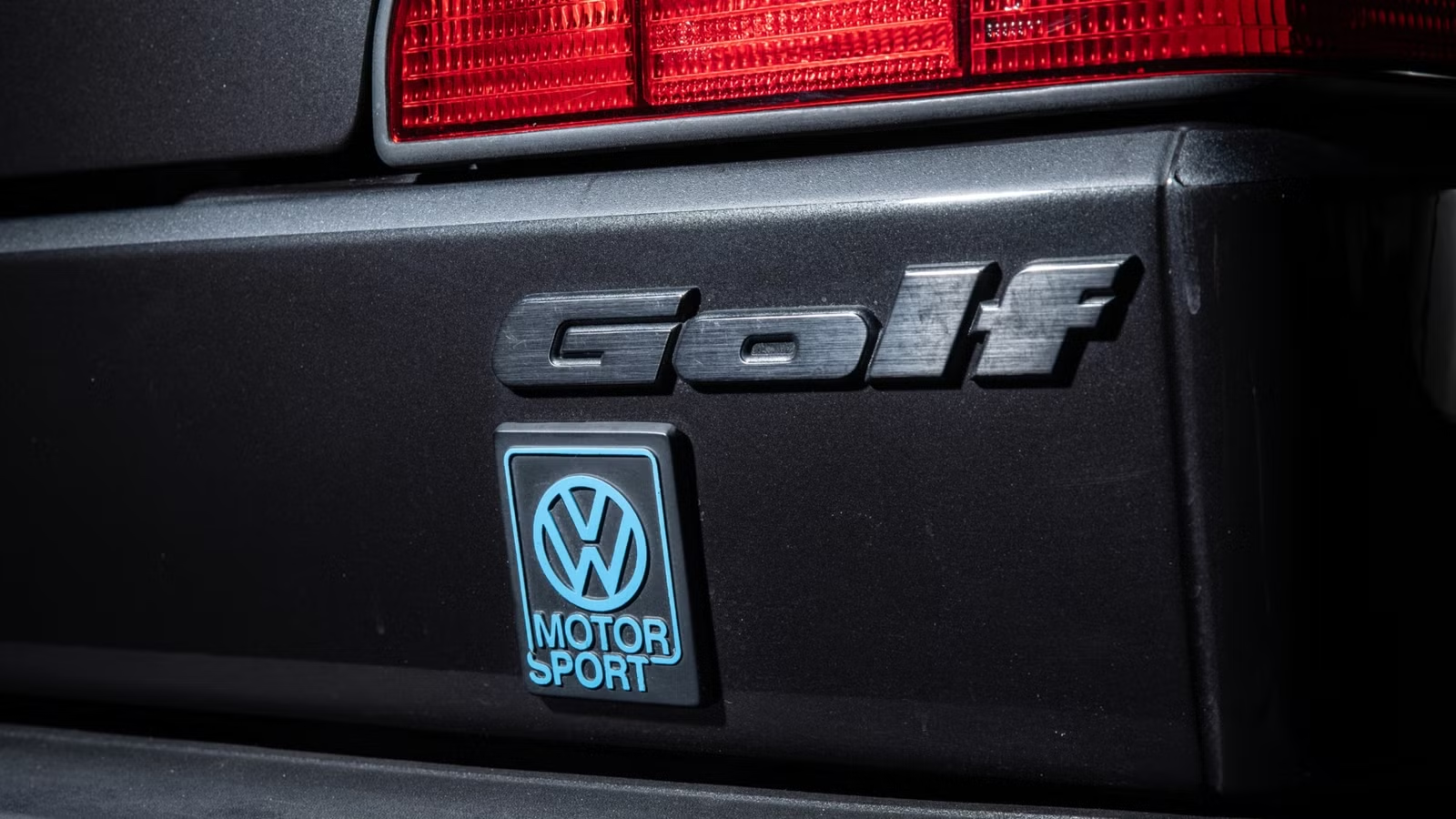
Volkswagen quoted a 0–100 km/h (62 mph) sprint of about 7.4 seconds and a top speed near 230 km/h (143 mph). That put this Golf within reach of some genuine sports cars, yet it looked ready for a school pickup. The five-door body skipped the Rallye Golf’s swollen fenders. Instead, the Limited wore 15-inch BBS wheels, discreet Volkswagen Motorsport badges, and a thin blue outline around its grille. Anyone expecting loud graphics and giant wings would have walked right past it.
Volkswagen Built Only 71 Examples Of Its Most Ambitious Golf Ever

The tiny production run reflected a demanding specialist build. Motorsport technicians had to unite a specially prepared Golf body, the unusual supercharged 16-valve engine, and the Syncro drivetrain. Even packaging all that hardware required serious work. Each car also received its own numbered identification plate. There is no solid reason to claim that Volkswagen deliberately capped production at 71 to create a future collectible. Making these machines was complicated and expensive enough without inventing a marketing conspiracy.
The price proved it. At roughly 68,500 Deutsche Marks in 1989, the Limited had strayed a long way from the affordable GTI formula. Volkswagen softened the blow with leather upholstery, heated sports seats, electric windows, and an electric sunroof. That blend of comfort and hidden speed made it more intriguing than the showier Rallye Golf. Surviving cars now attract collectors, although rarity alone doesn’t establish a market price.
The 71-Car Golf That Predicted Volkswagen’s Performance Future
The G60 Limited got something important right long before the Golf R arrived. It combined a powerful compact engine, all-wheel-drive traction, five-door usefulness, and restrained styling. Volkswagen could build a Golf that challenged sports cars without making its owner give up the practical stuff. It simply couldn’t build this particular version cheaply or in large numbers.
The later Golf R32 and Golf R family pursued a similar balance, though their engines and drivetrains followed different paths. The Limited wasn’t a direct blueprint for every fast Golf that followed. It was an early glimpse of what Volkswagen performance could become.
Source: Volkswagen

Related posts



Latest Post


No Comments