
Hyundai Patent Reveals Convertible GT With EV Powertrain
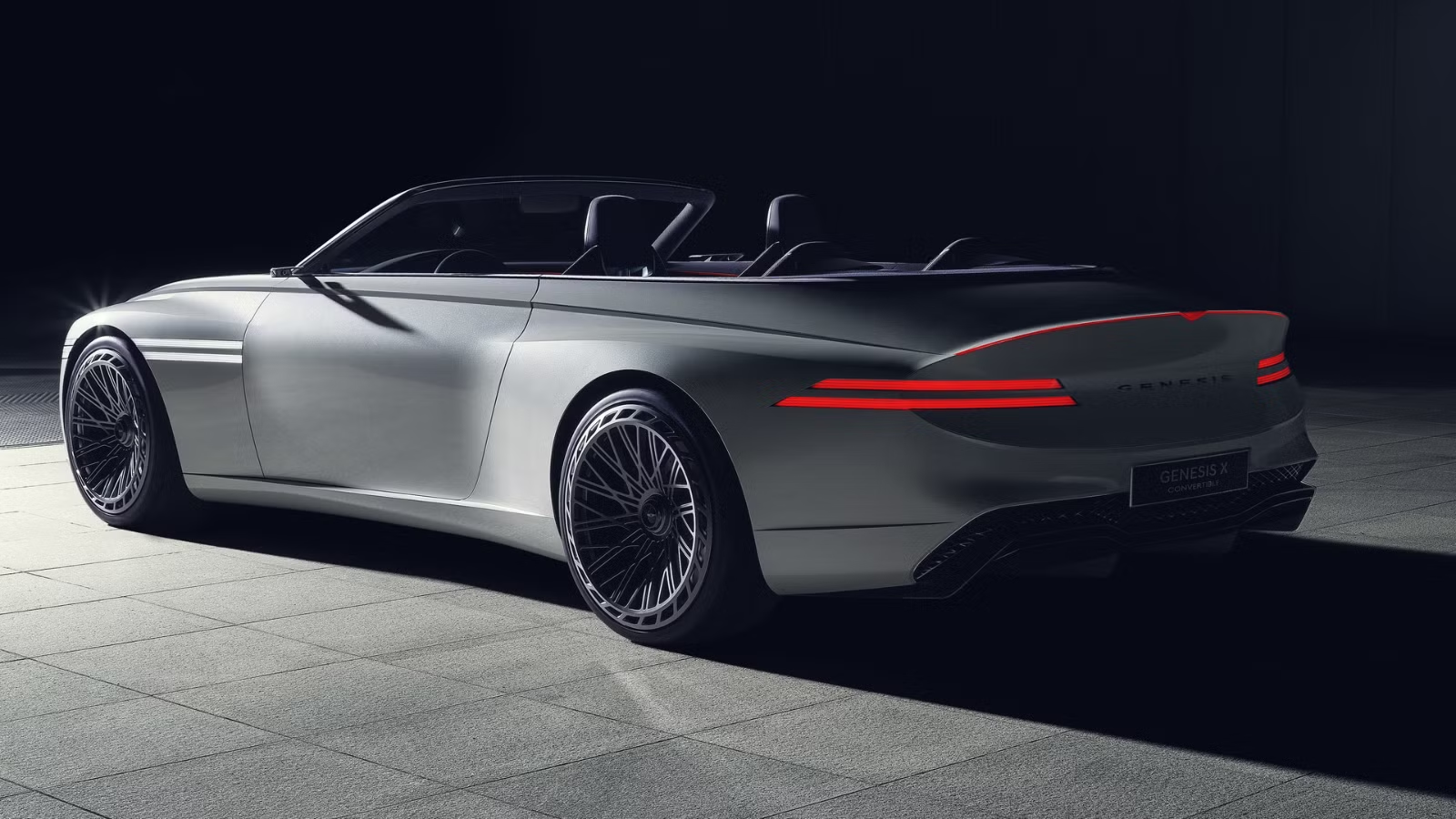
A patent filing uncovered this week reveals that Hyundai Group engineers have been quietly working through the structural challenges of building a long-hood, open-top GT car — and the level of detail suggests this goes well beyond a design exercise. The filing, surfaced by CarBuzz on September 16, describes a redesigned firewall and dashboard structure purpose-built for a convertible with rear-drive proportions and an electrified powertrain. No such car exists anywhere in the current Hyundai, Genesis, or Kia lineup.

The patent doesn’t name a model, but the engineering clues point hard in one direction: a rear-biased grand tourer, almost certainly wearing a Genesis badge, that would enter one of the thinnest segments in the luxury market. For a group that has spent years teasing convertible concepts without pulling the production trigger, this filing is the most concrete evidence yet that someone at Hyundai is spending serious money to make it real.
What the Patent Actually Reveals About the Car’s Engineering
The filing centers on a specific problem that any engineer building a long-hood convertible has to solve: without a roof and its associated pillars to redirect crash energy, a traditional firewall-and-dashboard structure can fail badly in a frontal impact. Forces that would normally travel up through the A-pillars and over the roof instead push rearward into the cabin, potentially hinging the top of the dashboard backward — a serious safety hazard and a structural nightmare.

Hyundai’s solution integrates a strut tower brace directly into the body structure rather than bolting one on as an aftermarket stiffener. That brace does double duty, helping manage crash loads while also providing the torsional rigidity that makes a convertible feel solid rather than shaky over rough pavement. The patent also specifies a dedicated mounting point for a charging system and battery module, which confirms the car is designed from the ground up for an EV or PHEV powertrain — not adapted from an existing combustion platform.
The proportions described in the filing — long hood, rearward cabin placement, double-wishbone front suspension — are consistent with a performance-focused rear-drive or rear-biased GT. That combination doesn’t describe a crossover or a mainstream sedan. It describes something built to cover ground quickly and look dramatic doing it.
Genesis Has Been Telegraphing This Move for Years

The Genesis X Convertible concept arrived as a large electric grand tourer with a folding hardtop and a transparent roof panel. Then came the X Gran Convertible in 2025, an even larger Bentley-scale droptop riding on G90 underpinnings — that one used a combustion powertrain rather than an electric one, which showed the brand was willing to be flexible on the drivetrain question.
Genesis COO Luc Donckerwolke has been direct about his intentions. Speaking publicly about the convertible concepts, he acknowledged that early EV droptop experiments showed customers weren’t quite ready, so the team pivoted to adapting existing platforms for coupe and convertible body styles. His exact words: “You can believe that I will not let that go.” That’s not the language of someone filing a patent for the sake of intellectual property protection.
This new filing suggests something beyond a G90-based flagship. The structural approach described — particularly the integrated strut brace and the EV/PHEV mount — reads more like a purpose-built platform than a body-style adaptation of an existing sedan.
Why the Convertible GT Segment Is Wide Open Right Now

The timing matters because the open-top luxury GT market has rarely been thinner. Above $75,000, buyers have real choices: the Bentley Continental GTC, the Mercedes-AMG SL, the Porsche 911 in various open-top configurations, the Aston Martin Vanquish Volante, and McLaren’s Spider variants. Below that number, the options collapse quickly. BMW’s 4 Series convertible starts around $61,300 and the Z4 is already out of production. Audi dropped the A5 Cabriolet when it rebranded that nameplate. Mercedes consolidated the C-Class and E-Class convertibles into the single CLE for 2024. The Ford Mustang convertible and the Mazda MX-5 Miata are doing the heavy lifting at the accessible end of the market, but neither competes in the GT category.
A Genesis convertible positioned above the CLE and below the Continental GTC would occupy a gap that no current product fills. A smaller variant — something closer to a Hyundai N or Kia performance flagship — could do something even more disruptive: bring rear-drive, open-top motoring to buyers who can’t or won’t spend six figures for the privilege.
Patents Are Not Production Promises, But This One Is Different

The standard caveat applies: patent filings protect intellectual property, and plenty of detailed engineering patents never result in a production vehicle. Hyundai Group files patents regularly across a wide range of technologies, and this one could remain a development study.
But the specificity here is notable. This isn’t a design patent for a body shape or a trademark filing for a name. It’s a structural engineering solution to a real problem that only exists if you’re actually trying to build a convertible GT. Someone ran the crash simulations, worked out the load paths, and filed the paperwork. That’s a meaningful investment of engineering time, and it lines up directly with what Donckerwolke has been saying publicly for the past year.
Whether the badge reads Genesis, Hyundai, or Kia, the group is clearly moving past the concept-car phase. Gearheads who’ve been watching the X Convertible and X Gran Convertible renders and wondering if any of it would ever reach a showroom have the best reason yet to believe the answer is yes.

Related posts




Latest Post


No Comments