
The Rare AMC Muscle Car That Beat The Big Three At Their Own Game
Sometimes the little guy gets left out when it doesn’t deserve to be, and it ends up on an inspirational journey to prove itself. This may sound like an emotional trope commonly used in your favorite movies and TV shows. But it has actually occurred naturally in the automotive world a few times.

For example, when it came to drag racing in the late 1960s, all the attention was on Detroit’s Big Three. Ford, Chevrolet, and Chrysler were ruling the racetracks as they primarily battled each other. Smaller companies such as American Motors Corporation (AMC) weren’t even noticed in their rearview mirrors.
But AMC didn’t simply give up and exit the track. It decided to make the Detroit Big Three eat its exhaust by building a rare muscle car to defy the odds. It features a smart design that completely shocked racing engineers and left them speechless as it embarrassed top performers from the era.
Ford, Chevy, And Dodge Were Dominating The Drag Strip

If you were to borrow a DeLorean and travel back in time to a drag strip in 1968, you would see the Detroit Big Three getting all the love, attention, and racing wins. Some of the most powerful cars built for drag racing include the Mustang 428 Cobra Jet, Camaro SS 396, and Dodge Super Bee 440.
Each of these rare muscle cars has massive big-block power in common. They use enormous engines to churn out low-end torque to aggressively launch off the line. Plus, the engines are paired with stripped-down lightweight bodies. The Dodge Super Bee 440 even deleted hubcaps and wheel covers to reduce weight. Features for creature comfort such as air conditioning and radios were set aside to enhance track performance.
Other similar features include rear-gear ratios specifically designed for rapid acceleration and drag racing. Their hood scoops and induction cowls vary to optimize airflow for unique drag-oriented setups, as the Mustang 428 Cobra Jet utilizes high-flow cylinder heads. But they didn’t realize how closely they were being watched by competitors, and one underdog noticed a weakness to exploit.
The 1969 AMC Hurst SC/Rambler Stormed The Scene

American Motors Corporation really decided to think outside the track in an effort to outrace Ford, Chevrolet, and Dodge. This led to the creation of the drag-oriented 1969 AMC Hurst SC/Rambler that surprised rivals by being able to embarrass them. Plus, teaming up with Hurst to save money while sourcing crucial track-ready parts like the T-handle four-speed shifter definitely helped.
The 1969 AMC Hurst SC/Rambler is powered by a 390 cubic-inch (6.4-liter) AMC V8 engine with 315 hp and 425 lb-ft of torque. This factory-built drag racer can accelerate from 0 to 60 mph in about 6.3 seconds and crushes a quarter-mile in about 14.3 seconds.
Meanwhile, the Mustang 428 Cobra Jet uses a 428 cubic-inch (7.0-liter) V8 engine with 335 hp and 440 lb-ft of torque. It can accelerate from 0 to 60 mph in about 5.9 seconds with a quarter-mile time of roughly 13.9 seconds. The Camaro SS 396 has a 396 cubic-inch (6.5-liter) V8 engine with 385 hp and 415 lb-ft of torque. It accelerates from 0 to 60 mph in about 6.6 seconds with a quarter-mile time of around 14.2 seconds.
|
Car |
Engine |
HP |
Torque |
0 – 60 MPH |
|
1969 AMC Hurst SC/Rambler |
6.4-liter V8 |
315 |
425 LB-FT |
6.3 seconds |
|
Mustang 428 Cobra Jet |
7.0-liter V8 |
335 |
440 LB-Ft |
5.9 seconds |
|
Dodge Super Bee 440 |
7.2-liter V8 |
375 |
480 LB-FT |
6.3 seconds |
|
Camaro SS 396 |
6.5-liter V8 |
385 |
415 LB-FT |
6.6 seconds |
Then the Dodge Super Bee 440 buzzed with its 440 cubic-inch (7.2-liter) engine with 375 hp and 480 lb-ft of torque. It flexes with a 0 to 60 acceleration time of roughly 6.3 seconds and a quarter-mile time of about 14.0 seconds. But remember, the tires, transmission options, and available dealership upgrades also made a difference with official times.
Rivals Couldn’t Believe The Scrambler’s Price Or Success

Competitors were quite shaken by the 1969 AMC Hurst SC/Rambler as they challenged their prized muscle cars. First of all, AMC wasn’t known for building high-performance cars. Automotive journalists noted that the Scrambler regularly gave Ford, Chevy, and Pontiac a view of its taillights.
But it had a superior power-to-weight ratio. While the Detroit Big 3 used bigger and heavier intermediate cars, AMC stuffed a small-block V8 in an incredibly lightweight commuter car instead. It was also more aggressive in stripping the car down to reduce weight by not using premium interior materials.

The car came with a radio delete plate, and engineers clamped a Sun tachometer to the steering column to avoid having to redesign the dashboard. AMC also ignored street manners in favor of features like staggered rear shocks, a torque-link system, front disc brakes, and a 3.54:1 “Twin-Grip” limited-slip differential.
Rivals were also baffled by the 1969 Scrambler’s low price, with an original MSRP of $2,998, while the Mustang 428 Cobra Jet started at about $3,500. But it was saved by partnering with Hurst for components, deciding not to provide a premium interior, and not requiring a special ‘backdoor’ dealership order to access potent V8 engines.
The Chevy Small-Block That Revved Like A Japanese Superbike
One American V8 was engineered to behave nothing like the muscle cars surrounding it, and almost nobody outside the paddock understood why.
Sadly, The 1969 AMC Hurst SC/Rambler Didn’t Last Long

The beloved affordable Scrambler only lasted in production for a single model year. AMC only planned on building 500 models to satisfy the minimum homologation requirement set by the NHRA’s F Stock drag racing class. But demand was so strong that it ended up building 1,512 models before the partnership with Hurst ended.
It was built for drag racing and was never intended to be a mass-marketed option. As a result, it was too wild and spartan for daily driving. Once it completed the goal of improving the brand’s performance image, it wasn’t needed anymore. Also, AMC wanted to make a few massive marketing changes.
The company based the SC/Rambler on the Rambler American compact, then decided to retire the ‘Rambler’ moniker in 1969 when it decided to rebrand its entire compact lineup. As a result, the AMC Hornet replaced it. Plus, AMC wanted to build muscle cars in-house and shifted its focus to the AMC AMX and Rebel Machine instead.
The Economy Compact Smuggling A Big V8 Underneath
This compact muscle car hid big-block power to avoid higher insurance premiums while secretly outperforming rivals.
The 1969 AMC Hurst SC/Rambler Is Too Rare To Ignore

Collectors actively hunt for the 1969 AMC Hurst SC/Rambler due to its extreme rarity and racing-oriented history. People are still mainly obsessed with 1960s muscle cars from the Detroit Big Three, but AMC managed to embarrass them with an extreme power-to-weight ratio. It’s a true underdog and a hero worth rooting for.
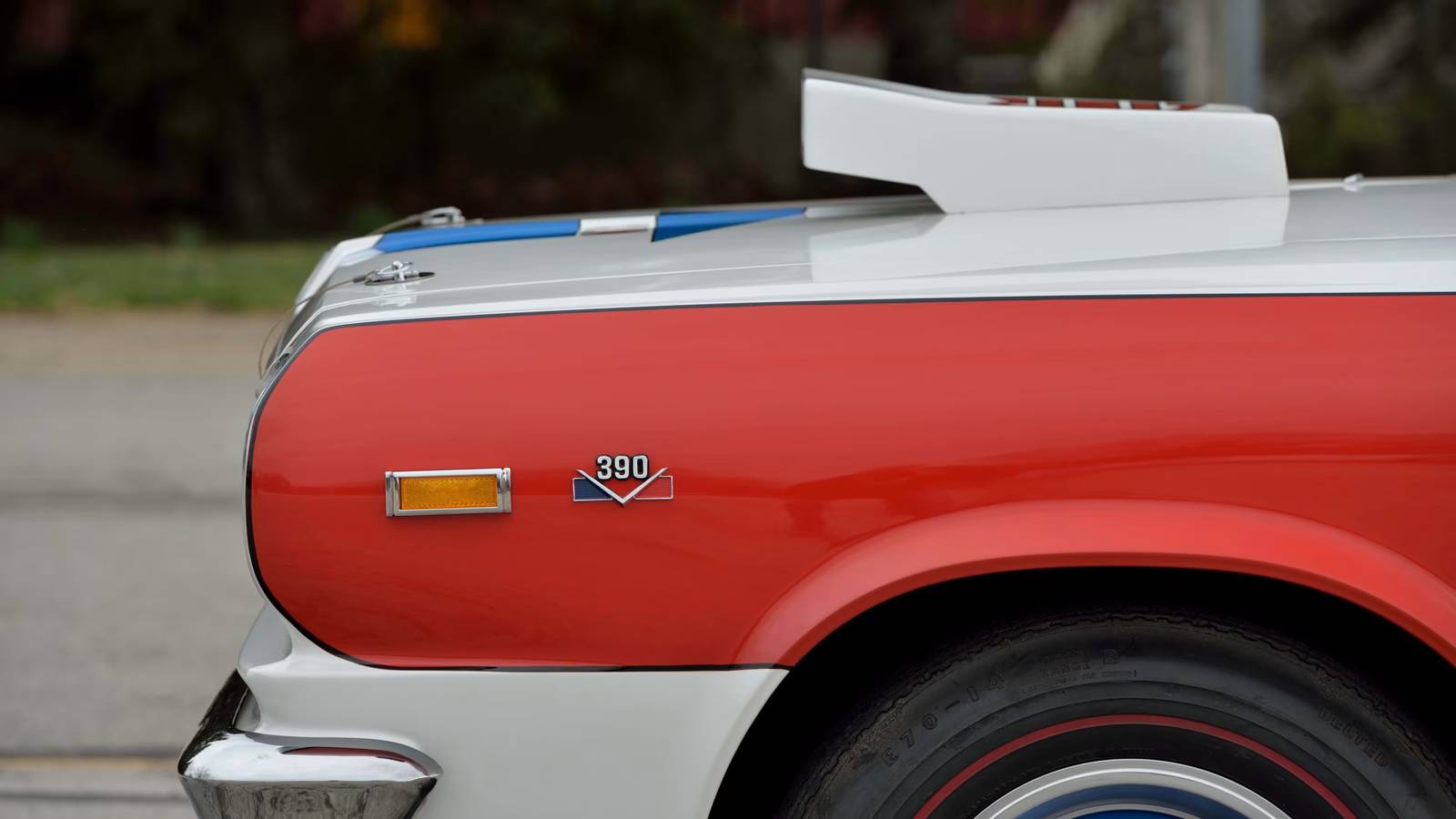
Plus, it has a distinct style with in-your-face patriotic paint schemes. The most sought-after style features a white coat paired with red stripes and blue accents. Even the wheels are blue! The functional Ram Air fiberglass hood scoop draws attention to its 390 engine. Enthusiasts also enjoy its basic, no-frills setup to reduce weight for drag racing.
This car has an average market value of $45,000 to $65,000 depending on mileage, quality, and condition. Typically, project builds or models that have been heavily modified go for around $35,000. But the cream of the crop includes models in pristine condition with matching numbers. Those can sell for over $90,000.
Source: Automobile Catalog, How Stuff Works, Hagerty, Hemmings

Related posts

Latest Post


No Comments