
The 1978 Dodge SUV With A Removable Roof And A 440 Big-Block
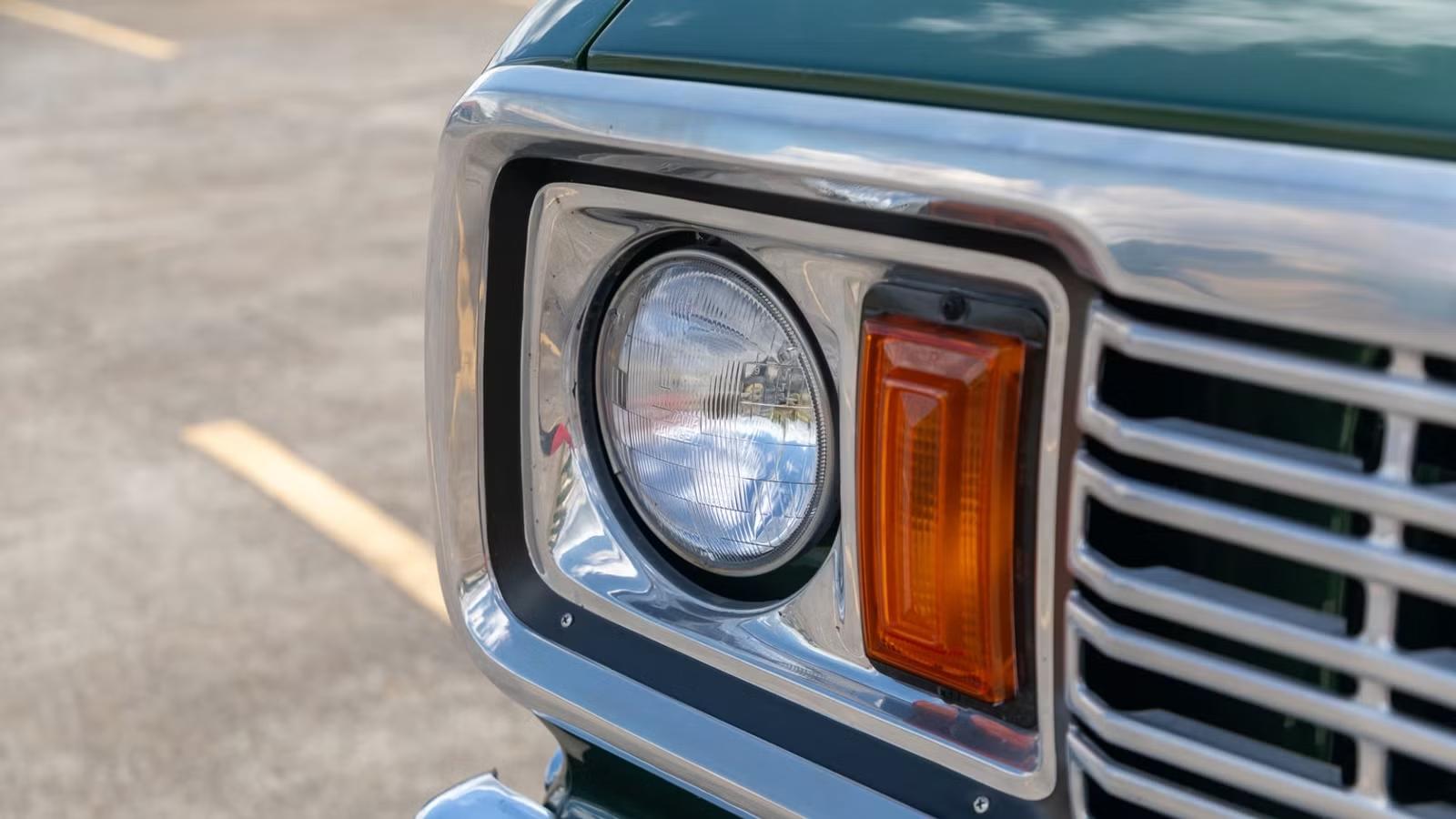
Admit it, nothing beats connecting with nature like taking your top off! One 1970s Dodge SUV lets you do exactly that. It was the last factory option to combine an open-air roof with big-block V8 power after the Chevy K5 Blazer and Ford Bronco abandoned that design. Now surviving Dodge models are favored by collectors for their mechanical simplicity and unique style in a market flooded by K5 Blazer and Bronco SUVs with steel welded tops.
The Chevy K5 Blazer Killed Its Open-Top Design, And The Bronco Wasn’t Far Behind

Sadly, the Chevrolet K5 Blazer killed its fully removable open-top design in 1975, ending its run as a full convertible. The automaker noticed government safety discussions about vehicle rollovers and anticipated new rollover-safety regulations that would require improved overall cabin strength.
Plus, the K5 Blazer struggled against structural problems with its open-top design. The gigantic fiberglass top removed crucial support, causing the Blazer’s body to flex and twist while off-roading and during uneven driving. It also required multiple people to unbolt and safely remove the heavy top. On top of that, the rubber seals were prone to leaking and allowed wind noise to enter the cabin.
In 1976, Chevy replaced the fully removable top with a permanent steel half-cab over the front seats, leaving the rear section open to the elements. Also, the biggest K5 Blazer engine available at the time was the 400 ci (6.6-liter) small-block V8 with 175 to 185 hp and 300 lb-ft of torque.


The Ford Bronco’s fully removable hardtop was also prone to water leaks and rust problems that led to stress cracks in the frame mounting points. It was also extremely heavy and required multiple people to remove it. Ford switched to a fixed steel roof over the front seats in 1978. At the time, the Bronco’s most powerful engine was the 400 ci (66-liter) medium-block V8 with 158 hp and 277 lb-ft of torque.
The Dodge Ramcharger Was The Last Factory SUV With A Removable Roof And Big-Block V8 Power

But you could get a Dodge Ramcharger with a fully removable hardtop from 1974 through 1980. Convertible options included a removable steel hardtop or dealer-installed fabric soft top. The 1974 model allowed the front door window frames to be removed, providing a convertible with half-doors. This provided a convertible with half-doors. However, the 1975 design switched to a permanent, fixed front windshield structure that keeps the door window frame intact.
This was part of a redesign that included standard pickup-style doors. The removable top pairs with a unique flip-up tailgate rear window design. Because the rear glass hatch lifts upwards on hinges, it allows easy access to the cargo area. But the metal tailgate folds straight down to match the design of 1970s full-size pickup trucks.
The Ramcharger was available with two big-block V8 engines. The 400 cubic-inch (6.6-liter) B Series V8 delivers 185 hp and about 190 to 305 lb-ft of torque. Then the 440 cubic-inch (7.2-liter) RB V8 churns out 235 hp and 340 lb-ft of torque. The engines could also be paired with a three-speed automatic TorqueFlight A-727 or four-speed manual New Process NP-435 transmission.

Ramcharger SUVs of this era are regarded as excellent finds because of their mechanical simplicity as the perfect option for DIY restoration projects. The weather stripping is easy to replace with basic tools, and the top is held in place by standard bolts and alignment plates that are easy to find. Plus, the Ramcharger shares a platform with Dodge D-Series pickups, so the parts are widely interchangeable and affordable.
The Rare Ramcharger Configuration Was Short-Lived

In 1981, the Dodge Ramcharger switched to a permanent, welded steel roof like the Chevy K5 Blazer and Ford Bronco. Chevrolet was correct in predicting that safety regulations for open-air SUVs were about to increase. The National Highway Traffic Safety Administration (NHTSA) mandated stricter passive occupant protections for rollovers.
Chrysler also found that only two percent of owners were removing the steel top, so drivers weren’t taking advantage of the feature. The fixed roof improved overall structural rigidity while providing more rollover protection by spanning the entire interior cabin, including the rear cargo and passenger area.
While some Dodge fans were upset by the decision, others were pretty happy. The fixed roof provides better cabin insulation, reducing rattling, preventing water leaks, and delivering a quieter ride. The redesign also improved reliability, as the fully open-top design led to severe flex: driving on uneven terrain caused the frame to sag. Sometimes the tailgate would become misaligned, making it difficult to open or close.

Last but not least, Dodge benefited from the fixed-roof design of the second-generation Ramcharger because production was streamlined alongside the D-Series pickup trucks. Other Ramcharger updates in 1981 include a new egg-crate front grille, refreshed hood and fender designs, rectangular headlights, a revamped dashboard, and a new instrument cluster layout.
The First-Generation Ramcharger Is A Bargain

While collectors are busy throwing tons of money at 1970s Chevy K5 Blazer and Ford Bronco models, you can pounce on 1974 to 1980 Ramcharger models for a fraction of the cost. About 109,073 first-generation open-air Ramcharger SUVs were produced, but it’s unclear how many models survive today. The 440 big-block engine was available through 1978, then was dropped due to rising emissions standards and increasing fuel costs.
Value for a 1975 Ramcharger in project condition ranges from about $3,000 to $8,000. Models in good condition fetch between $24,000 and $28,000. Then Ramcharger SUVs found in excellent condition cross the auction block from between $27,900 and $51,000. Examples with the big-block V8 engines or rare packages like the Sidewinder or D-Code fetch higher premiums.
Meanwhile, 1974 Chevy K5 Blazer models in project condition hover around $20,000 to $22,000, while models in excellent condition sell for between $38,000 and $55,000. Entry-level 1976 Ford Bronco models in project condition sell for between $6,900 and $40,000, while pristine examples sell for between $130,000 and over $280,000.
Source: Hemmings, Hagerty, NHTSA

Related posts



Latest Post


No Comments