
Ford Built A Supercharged V8 Ranger You Could Never Buy
Ford and pickup trucks go together better than most brands do with a specific segment. For nearly 50 years, the Ford F-Series has been the best-selling truck nameplate in the U.S., and over the last few decades, the American powerhouse has broken the mold with models like the Ranger Raptor, the F-150 Raptor, and the F-150 Tremor.

Performance trucks may be a relatively common sight today, with the ’91 GMC Syclone kicking things off, but there is an extraordinary one-of-a-kind Ford performance truck that never made it past the prototype stage. It should have.
Ford’s Performance Trucks Used To Break The Rules
Ford has never been short of sensible and hard-working pickup trucks, but some of its best trucks have come from ignoring the sensible option. The Ford F-150 SVT Lightning turned a workhorse into a street brawler, while the Raptor has given us a factory truck that can attack a desert at serious speed.

The idea was never simply to add a ton of horsepower and call it a day; Ford performance engineers know a truck still needs hardware to make its extra muscle useful. That means a whole host of changes to the suspension, chassis tuning, and handling, not just a bigger engine.
SVT Turned Ordinary Ford Pickups Into Serious Performance Machines

Ford’s Special Vehicle Team (SVT) gave the Blue Oval a way to build pickup trucks for those of us who don’t value towing as much as we do speed. The original F-150 SVT Lightning arrived in ’93 with a 5.8-liter V8, firmer suspension, a clear preference for pavement over job sites, and 0–60 mph times of around 7.2 seconds — which, for a 1990s truck, is quite quick. Then Ford and SVT tried something similar with one of their smaller trucks, but, unfortunately, we could never buy it.
The Ford Ranger SVT Lightning Bolt Is A One-Of-A-Kind Truck

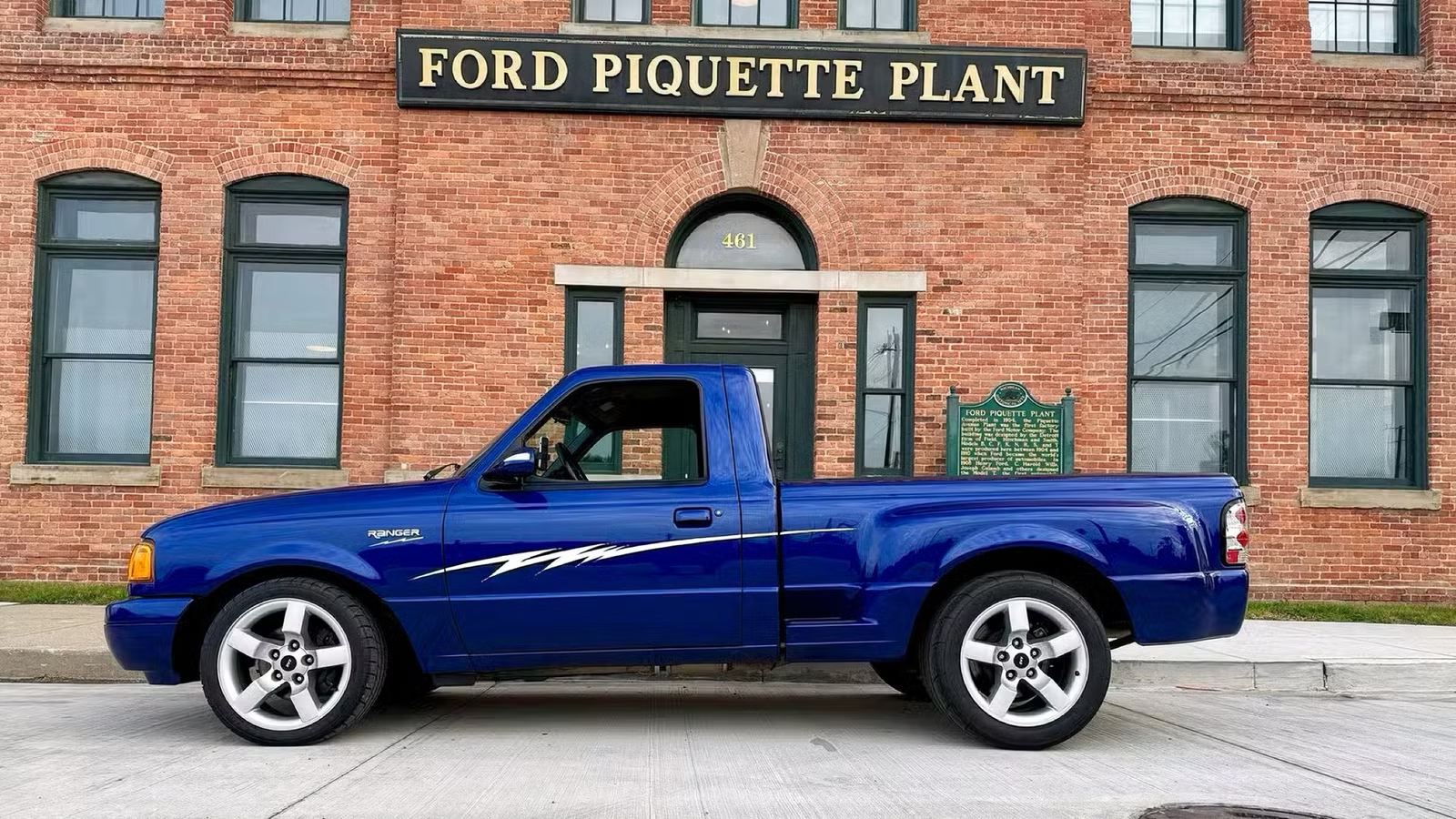
Based on the third-generation Ford Ranger, and the brainchild of SVT powertrain engineer Dave Dempster, the Ford Ranger SVT Lightning Bolt was a one-of-a-kind prototype performance truck that we so wish made it past build number one. Unlike a factory special built around an existing recipe, the Lightning Bolt pushed the compact Ranger into waters reserved for much larger performance trucks.
Supercharged 5.4-Liter V8 Makes It More Powerful Than The F-150 Lightning
At the heart of changes to the Ranger was the engine swap. SVT pulled the inline-four and added a supercharged 5.4-liter Triton V8, which was borrowed from the second-gen F-150 Lightning.
This beast is good for 420 horsepower and 480 pound-feet of torque. Power is routed through an HD 4R100 four-speed automatic transmission to the rear wheels, and 0–60 mph times have been clocked at 4.2 seconds. It has also posted a 13-second quarter-mile time, and with this kind of power on tap, it is far more powerful than the stock F-150 Lightning (360 horsepower/440 pound-feet).
As we have found with many performance vehicles, just wedging in a massive engine and doing nothing else does not produce good results. SVT knew that, and it turned the Ranger into something quite unrecognizable underneath its familiar facade.
Boxed Frame, Lightning Suspension Parts, And Huge Tires Put The Power To Work

SVT boxed the frame rails and added cross-bracing at key points to cope with the jump from the original inline-four’s 153 pound-feet of torque to the massive 480 pound-feet. It had to; that’s more than three times the twisting force going through a compact pickup frame.
The front suspension was lowered by two inches to get the V8 under the Ranger’s standard hood, while SVT adapted the F-150 Lightning’s lower control arms and steering knuckles, adding custom upper control arms to make the donor hardware work with the smaller frame. They kept hold of the Ranger’s original rack-and-pinion steering, but the Lightning’s power-steering pump and a custom steering shaft were added to clear the new headers.
At the back, SVT fitted a shortened 9.25-inch F-150 Lightning axle with 3.73:1 gearing, while modifying the original Lightning wheels to make it fit. The fronts were narrowed to eight inches and wear 245/40ZR18 Michelin tires; the rears were widened to 12.5 inches to fit massive 345/35ZR18 rubber.
Ford Rebuilt The Ranger Around Its Supercharged V8

To top it off, Lightning brakes were fitted, giving the roughly 3,800-pound Ranger proper stopping power for its new performance credentials. Because of the massive V8, the SVT Ranger Lightning Bolt is roughly 800 pounds heavier than the stock Ranger on which it was based, but it is far lighter and more powerful than the 4,670-pound F-150 SVT Lightning.
Chassis Reinforcements And A Custom Fuel Cell Go Beyond Normal Mods
The Ranger’s original chassis and fuel system were never designed for something like a supercharged V8, so alongside the work that SVT did to shore things up, it replaced the factory-fitted fuel tank with a custom cell behind the rear axle. The fuel access door also had to be moved to the back.
Fitting everything else was just as awkward. The firewall moved rearward by 2.5 inches to clear the engine, while the transmission tunnel was widened for the 4R100 automatic. Everything was re-jigged to make way for the V8 and full-size truck hardware, so space was certainly at a premium when putting it together.
Billet Aluminum, Custom Gauges, And Leather Give It A Cabin That Matches Its Performance


Just like the best performance trucks, the cabin wasn’t left alone. Instead of the cheap plastic trim that has become one of the biggest talking points of third-gen Rangers, the SVT Ranger Lightning Bolt got considerably more. It is fitted with custom interior trim, leather seating, and a far more finished feel to match its street-fighting demeanor.
MGW Industries supplied billet-aluminum knobs for controls, while X-treme Graphics and Lettering produced custom gauges for the cluster. Brushed stainless-steel SVT door-sill plates add another bespoke touch, and a 450-watt Pioneer audio system made sure it wasn’t just the roar of the V8 filling the cabin.
The SVT Ranger Lightning Bolt Shows What Ford Could Have Sold

There is no shortage of Ford performance trucks today; we have the Maverick Lobo, the Ranger Raptor, the F-150 Raptor, and the F-150 Raptor R. Classic.com says you can pick up a 1999–2004 SVT Lightning for an average auction price of $34,000 for your old-school performance needs, but there is literally nothing else like the Ranger SVT Lightning Bolt.
The timing would have been perfect for the Ranger SVT Lightning Bolt to hit the market; the 1990s and early 2000s were sport truck territory, with the Syclone, Chevrolet 454 SS, and the SVT Lightning all reshaping the segment.

The Lightning Bolt never made it past the prototype stage, and it remained an exercise in engineering rather than a planned model. All the modifications, the repositioning of components, and the extreme torque it produced made it unviable for public sale, and far too expensive to put into production.
Thankfully, the sole model still exists and is housed at Ford’s Heritage Fleet in Michigan. Most of the performance trucks of the time were bigger and wider; had Ford given the Ranger SVT Lightning Bolt the green light, it would have offered the ultimate lightweight and powerful compact sports truck.
Sources: Ford and Classic.com.

Related posts
Latest Post


No Comments