The Japanese Hybrid SUV With The Highest Driving Range In 2026
11 minutes reading
Thursday, 23 Jul 2026 21:00 0 97 autotech
Fuel efficiency has always been the SUV’s Achilles’ heel — and for good reason. Their height, weight, and four-wheel-drive hardware work against economy in ways that cars naturally sidestep simply by being lower, lighter, and simpler. The real turning point came with the rise of hybrid powertrains, which were originally developed to cut emissions and fuel consumption but quickly proved they could also sharpen performance — a particularly compelling bonus in the SUV segment. Today, hybrid technology has matured to the point where some hybrid SUVs out-sip comparably sized sedans, and the case for going hybrid has never been stronger.
The practical upside is straightforward: burning less fuel means stretching the distance between fill-ups, which matters more than ever given the sustained pressure on household budgets. Honda and Toyota lit the fuse at the turn of the century, and both brands continue to shape the direction of Japanese hybrid SUVs to this day.
2026 Genesis GV70 3.5T Sport Prestige AWD front shotLyndon Conrad Bell | TopSpeed
Self-charging hybrids got their start with the 2000 Honda Insight. The core purpose of the hybrid system was to dramatically cut fuel consumption by recapturing energy wasted during braking and coasting, then converting it into electric boost during acceleration to supplement the gasoline engine. The result was a vehicle that could travel significantly farther before needing a fill-up — and drivers didn’t have to change a thing about how they used it. Just pump in gas; the system handled the rest.
2026 Toyota Corolla Cross blue hybrid model and red regular model driving in opposite directions on a roadToyota
About five years after the Prius set the pace, Toyota brought the system to a segment that needed it most — SUVs. Before launching the first Highlander Hybrid in 2006, Toyota shared its hybrid technology with Ford for the 2005 Escape Hybrid. The payoff was a 38–42 percent improvement in MPG and driving range — enough to add 100–150 miles per tank on the highway, or an extra 140–200 miles for drivers who spent most of their time in city and suburban traffic.
The Hybrid Landscape In 2026 Doesn’t Require Compromises
A rear shot of the 2024 Honda CR-V Hybrid in the city.Honda
Today’s hybrid technology has become precise enough that manufacturers can tune their SUVs to reflect distinct brand identities — whether that means all-around comfort and refinement (as with many Lexus hybrids), on-pavement performance (BMW), or off-road confidence (Subaru). Even in performance-oriented applications, sensible driving habits — prolonged coasting, smooth braking — still unlock meaningful range gains by taking full advantage of the hybrid system’s inherent strengths.
2025 Hyundai Santa Fe Hybrid Exterior Off-RoadHyundai
Today’s SUV buyers no longer have to trade power for efficiency, or vice versa, when choosing a hybrid powertrain. Nor do they have to accept a steep efficiency penalty for AWD or 4WD, since some hybrids generate all-wheel traction entirely through electric motors. The Corvette E-Ray, for example, adds around 300 pounds of hybrid hardware and, while it holds the line on efficiency, it sharpens acceleration and handling while adding the ability to travel three to five miles on electric power alone at speeds below 45 mph.
The 2026 Toyota RAV4 Is The Japanese Hybrid SUV With The Longest Range
Rated By The EPA At 624 Miles On A Single Tank
2026 Toyota RAV4 XLE Premium front 3/4 shotToyota
Starting in 2026, the Toyota RAV4 is a fully electrified model (though it retains a non-hybrid variant in China), available as a PHEV as well as a full hybrid that delivers around 625 miles of range depending on driving style. That’s the longest of any hybrid in its class, trailing only the front-drive Kia Sorento and Hyundai Santa Fe in a metric that increasingly reflects real-world ownership. The 624-mile range carries tangible benefits: RAV4 Hybrid drivers visit gas stations roughly 30 percent less often than CR-V Hybrid owners, save approximately $400 annually in fuel stops, and can complete most weekend road trips without hunting for a station.
By making the 2026 Toyota RAV4 exclusively hybrid, Toyota simplifies the buying process and ensures efficiency is standard equipment rather than an upgrade — a move that reportedly aligns with what buyers actually want. Consumers increasingly expect efficiency to come built in, not as an option. With that settled, the 2026 RAV4 asks nothing unusual of its owners: fill it up and drive, exactly as you would any previous RAV4.
2026 Toyota RAV4 Numbers Are Tough To Match
Rear 3/4 view of a 2026 Toyota RAV4 LimitedIsaac Atienza | TopSpeed
Like all EPA ratings, the 2026 RAV4’s figures are derived from standardized bench testing designed to keep comparisons consistent across models. Range is calculated by multiplying the rated MPG by tank capacity — not a perfect real-world proxy, but a reliable common denominator. In combined conditions (55 percent city, 45 percent highway), the RAV4’s range could theoretically stretch to 682 miles in pure city driving, or drop to around 580 miles on a straight highway run starting from a full tank.
2026 Toyota RAV4
2026 Ford Escape Hybrid
Powertrain
2.5-liter inline-4 + 2 motors
2.5-liter inline-4 + 2 motors
Transmission
Continuously variable
Continuously variable
Power
226 hp
192 hp
Torque
163 lb-ft
155 lb-ft
Driveline
Front-wheel drive
Front-wheel drive
Fuel Tank Capacity
14.5 gallons
14.3 gallons
Range
624 miles
558 miles
Efficiency City
47 mpg
42 mpg
Efficiency Highway
40 mpg
36 mpg
Efficiency Combined
43 mpg
39 mpg
The 2026 Toyota RAV4’s numbers are hard to match within the segment because rivals either post similar MPG ratings with smaller tanks, or carry larger tanks but lower fuel economy. As a rule, larger tanks tend to win on range when MPG figures are close. For context, we’ve compared it against the 2026 Ford Escape Hybrid, which shares a broadly similar hybrid configuration.
What Range Means In Real-World Applications
The 12.3-inch digital gauges of the 2026 Toyota RAV4Toyota
The 2026 Toyota RAV4’s story is only partially told through specs and technology — those are the backstory, the character development. The real narrative is how those elements translate into daily life. A rated range figure is hypothetical until it meets the road, and what drivers ultimately notice is how much less often they stop for fuel compared to what they drove before. That predictability makes it easier to fold fill-ups naturally into a weekly routine.
Dynamic shot of a 2026 Toyota RAV4 Hybrid LimitedToyota
The RAV4’s long range translates directly into fewer fuel stops, with practical implications in every direction. Expect to exceed 600 miles per tank on a typical mix of city and highway driving. If most of your miles are urban or suburban, you can reasonably beat the rated 624 miles — likely meaning one fill-up per week or less. If your driving skews heavily toward the highway, such as a holiday road trip, plan on something under 600 miles before the needle drops.
Engineering The 2026 Toyota RAV4 To Go Farther
Production of the 2026 Toyota RAV4 in Canada, showing interior panel assemblyToyota
The 2026 Toyota RAV4’s range advantage centers on the latest iteration of the Toyota Hybrid System, which continues to set the benchmark for efficiency and integration. The pairing of a 2.5-liter Atkinson-cycle engine with electric motors isn’t new — it debuted in the 2012 Camry Hybrid — but it has been continuously refined across subsequent vehicles and now underpins a wide range of Toyota and Lexus hybrids, while also informing hybrid development at partner brands such as Mazda and Subaru.
2026 Toyota RAV4 engineToyota
Tracing its lineage to the 2001 Toyota Prius (which used a 1.5-liter Atkinson-cycle four-cylinder), the system has always prioritized thermal efficiency over outright performance — but unlike the original Prius, the modern version doesn’t shortchange the driver on power. It still wrings maximum energy from every drop of fuel, and its electric assist is most effective at low speeds and in stop-and-go traffic. Raw range numbers, however, only tell part of the story. The deeper achievement is how Toyota re-engineered the hybrid system to deliver those numbers without adding weight or blunting performance.
Battery, Regeneration, And Energy Management
Gauge cluster of a 2026 Toyota RAV4 Hybrid LimitedToyota
Battery management is a critical pillar of hybrid efficiency, even if it plays a less prominent role than in plug-in hybrids, where externally charged energy also has to be carefully managed. In a self-charging hybrid, energy is continuously harvested through the braking system and redistributed where it does the most good for overall performance.
Unlike the PHEV, where battery capacity is central to extended range, the self-charging RAV4 relies more heavily on the balance between storage and usage — once the battery is depleted, there’s no way to replenish it without driving. This makes the electric motors an integral part of efficiency across all driving conditions, and keeps power delivery stable and predictable.
Packaging, Weight, And Aerodynamics
Front shot of 2026 Toyota RAV4 Woodland driving on trailsToyota
The 2026 Toyota RAV4’s compact footprint remains a meaningful contributor to its range advantage. Heavier, larger vehicles demand more energy to move, and even modest weight increases register on the efficiency ledger. The RAV4 has grown steadily since its 1996 debut, but Toyota has kept its dimensions and curb weight in check, channeling demand for more space into larger models — the Highlander, and later the Grand Highlander — rather than letting the RAV4 balloon.
2026 Toyota RAV4 front-end shotToyota
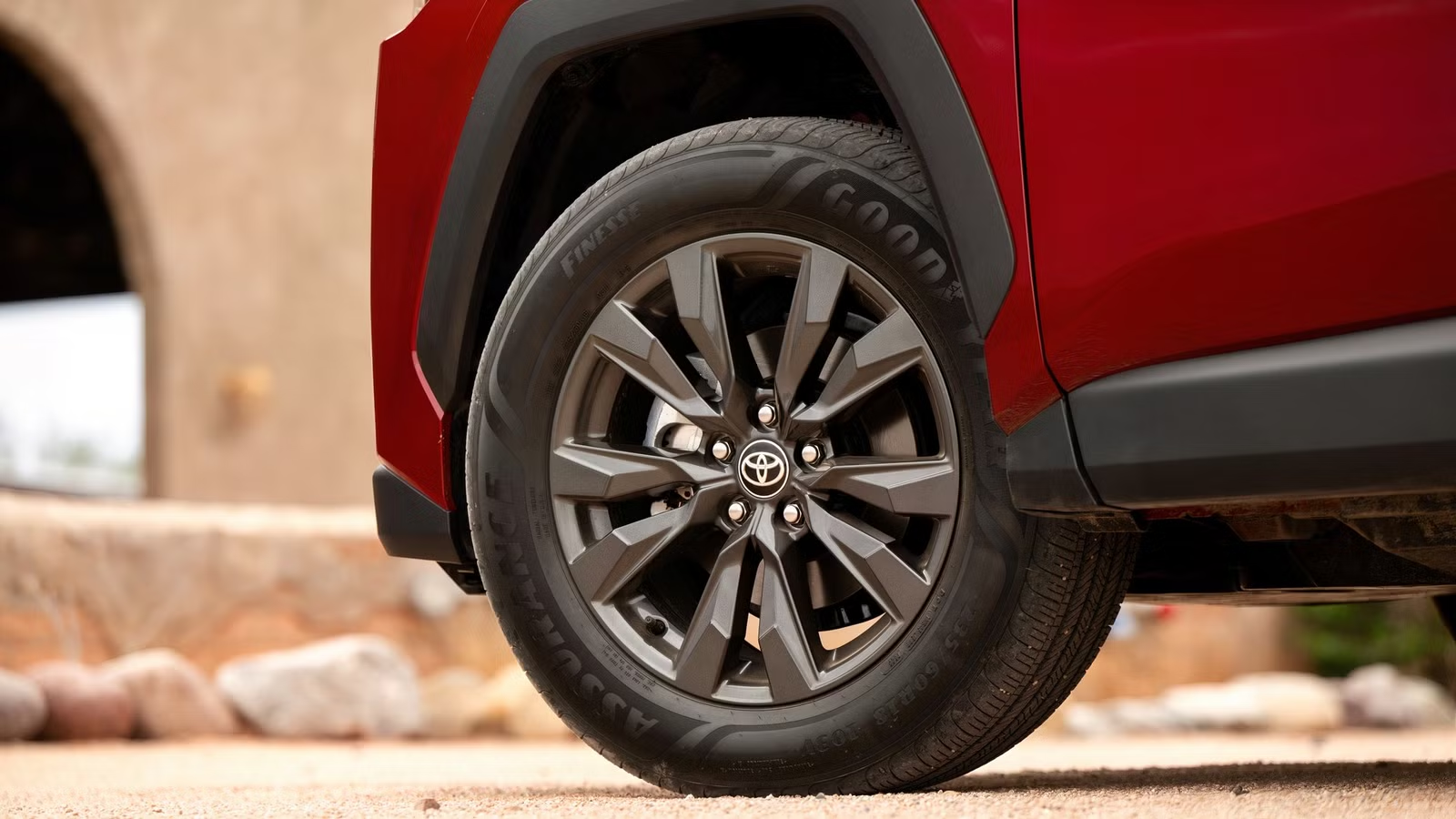
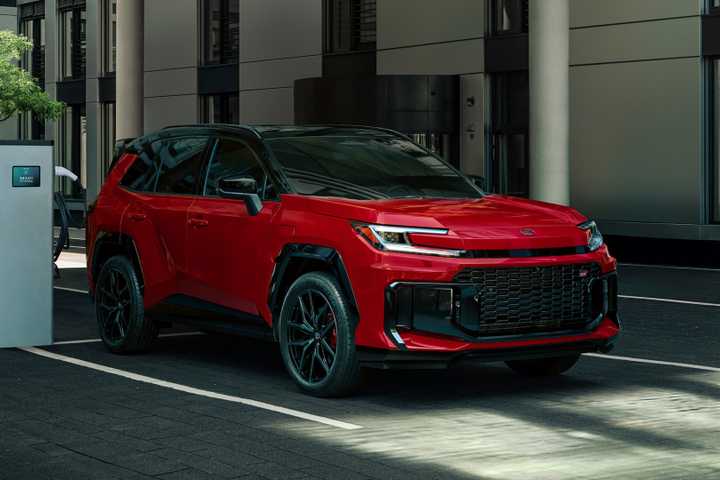
Its styling has evolved just as deliberately — from the “cute” tag that followed the original RAV4, through a rugged phase, and now into something more futuristic. The 2026 model posts a drag coefficient of 0.31 Cd, a modest improvement over the previous generation’s 0.32, while offering distinct visual personalities — Core, Sport, and Rugged — that cater to different tastes without abandoning the family resemblance.
How The 2026 Toyota RAV4 Stacks Up Against Its Rivals
Front 3/4 view of a 2026 Toyota RAV4 Hybrid LimitedToyota
The 2026 Toyota RAV4 earns its place as the Japanese hybrid SUV with the longest range not through innovation alone — though that’s undeniably a large part of it — but through an unwavering commitment to efficiency, integration, and everyday usability. That matters because it speaks directly to what most drivers value above all else: consistency, convenience, and the confidence of knowing what to expect from their vehicle.
Front 3/4 action shot of 2026 Toyota RAV4 Woodland driving on roadToyota
As the industry pushes further toward electrification, self-charging hybrids represent perhaps the most practical bridge between conventional and electric motoring, and the 2026 RAV4 stands as one of the most capable and accessible expressions of that mission. As a segment leader in the compact hybrid SUV space, it also functions as a benchmark that other hybrid SUVs — established and emerging alike — measure themselves against.
The 2026 Lexus RX 350h Gives Up A Few Miles Of Range For A Larger Cabin
Front 3/4 action shot of 2025 Lexus RX 350h Premium in red driving on coast roadLexus
As a larger, more refined SUV, the 2026 Lexus RX 350h illustrates how different priorities affect range. Sharing the same efficient powertrain as the 2026 RAV4, the trade-off lies in its larger footprint and the additional weight of premium materials and components — hence the slight drop in overall range (five miles less than the RAV4). It’s a concession that buyers who prioritize comfort and cabin quality are happy to make.
The 2026 Subaru Crosstrek Hybrid Gives Up Range To Preserve Its Core Values
Front 3/4 action shot of 2026 Subaru Crosstrek in blue driving off-roadSubaru
Drawing on Toyota’s hybrid expertise, the 2026 Subaru Crosstrek Hybrid charts its own course, trading some range for genuine off-pavement capability. Standard all-wheel drive, increased ground clearance, and a rugged build make it well-suited to its intended audience, but those attributes come at an efficiency cost. Its smaller size recovers some of the loss, though it still falls short of the 600-mile threshold.
The 2026 Toyota RAV4 Is A True Generalist On A Budget
Front end of the 2026 Toyota RAV4 WoodlandToyota
The Toyota RAV4 is America’s best-selling SUV, and a big part of its appeal is the value it delivers for the money. The 2026 model raises that bar further by making electrified efficiency standard across the lineup, starting at $31,900 for the base trim. Prices climb meaningfully as you move up the range, so the RAV4 can serve both budget-conscious buyers and those seeking near-premium features.
Front view of a 2026 Toyota RAV4 Hybrid LimitedToyota
For most buyers, the SE trim represents the sweet spot for value, adding desirable features such as heated front seats and blind-spot monitoring. Those after a more premium experience will find the Limited trim the most complete package, with a panoramic roof, JBL audio, wireless charging, and more. Toyota also offers the Woodland trim for buyers who want a mild off-road edge, equipped with all-terrain tires, a tow hitch, and Rigid Industries LED fog lights.
Front 3/4 action shot of 2026 Toyota RAV4 towing a smokerToyota
In 2025, Toyota sold over 680,000 RAV4 models — hybrid and PHEV combined — sustaining its position as the top-selling SUV in the United States. That success reflects just how practical and dependable the RAV4 has proven to be. For 2026, the move to standard hybridization adds more power and a longer driving range from the entry level up, while preserving the practical interior and updated styling buyers already know. The result is an even more capable all-rounder: a vehicle that can handle nearly anything asked of it and travel farther doing it.










No Comments