
The Cruiser Harley Loyalists Quietly Switch To After 50,000 Miles
The cruiser owner is a loyalist. You will not find owners as loyal to brands in other segments, for example with basic motorcycles, because in that segment value takes priority over all else. But with a big cruiser, the brand matters, the experience matters, and definitely the brotherhood matters. The cruisers are also near-luxury items, and with the financial freedom that a big profit margin allows, it is possible for manufacturers to also create products that are quite different from other brands, which is another reason cruiser owners tend to stick to a particular brand.
Why Harley Loyalists Remain Loyal To The Brand

Harley-Davidson’s products generate a cult following. The owners are a tightly-knit group. You don’t just purchase a motorcycle, you’re buying into a lifestyle. Harley is one of the pioneers of the ‘merchandise movement’, meaning it profits greatly from its merchandise as well. As a Harley rider, you are buying into experiences rather than just a motorcycle. That is not something you can get with other brands easily, although many are now trying to replicate Harley-Davidson’s success in this area. Still, it isn’t easy to replicate the heritage Harley has — over a century of continuous production and products distinctive even by their sound alone. It is little wonder then that Harley-Davidson has the cult following it has.
The Roots Matter, As Do The Vibes

Of course, none of this would hold up if the products themselves weren’t good. And Harley-Davidsons, for all that those that dislike them have to say, are good products. You see, motorcycles are about emotion, not just numbers on a spec sheet. And somehow, Harley-Davidson manages to evoke all the right emotions when you swing your leg over one. They might be slow, have antiquated technology in relation to sport bikes, and have high maintenance costs, but the emotions they evoke are so strong that owners are willing to put up with it much more than the owners of other brands are. And that is why other brands try to replicate Harley’s success by replicating the products, but don’t always manage to find a solution.
The Honda Shadow Ace 1100 Was Never A Direct Competitor – Or So We Thought


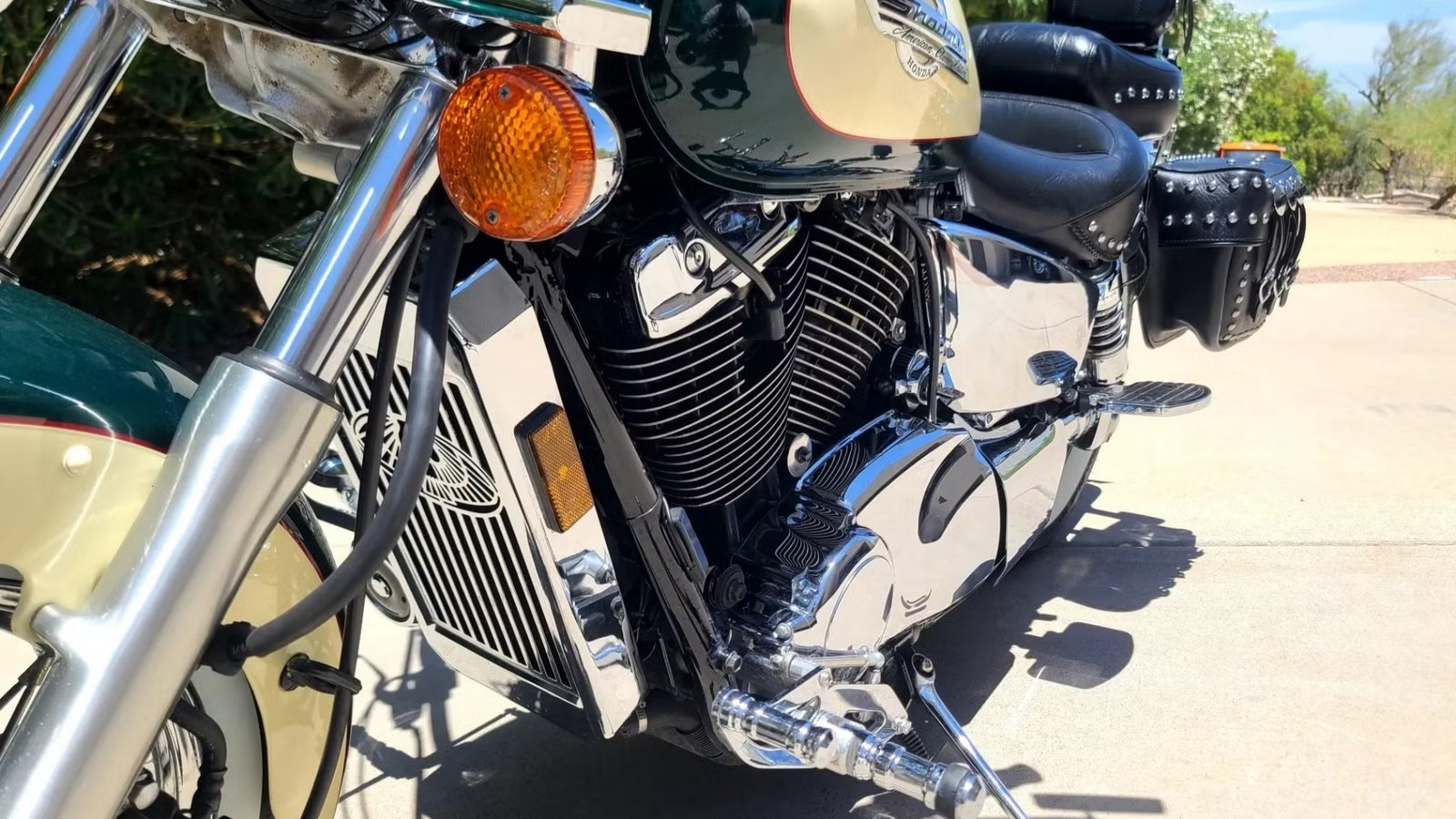
The Shadow series was designed to be Honda’s version of Harley-Davidson’s products, but Honda’s obsession with smoothness and usability meant the Shadow, more often than not, lacked the soul present in Harley-Davidsons. With the Shadow Ace 1100, Honda took a slightly different tack and more closely mimicked full-size Harley-Davidsons. This set up an interesting problem for the Harley loyalist because here was a Honda which suddenly had a lot of the same feel as a Harley-Davidson, but with Honda’s good points, like reliability.
It Has Its Own Reasons For Being A Cult Motorcycle

We see that the Shadow aped Harley-Davidsons, but in the case of the Ace 1100, it had a number of differences that made it stand out compared to the Harley-Davidsons of the time. For one, it was considerably cheaper, retailing for under $10,000 new when equivalent Harleys cost at least $2,000 more. Then there was the liquid-cooled engine and shaft drive. This meant it would offer more reliable performance, especially on long rides. And there was no real maintenance required on the enclosed shaft drive other than oil changes, which could be done at home with some transmission oil and the right set of tools. Honda didn’t skimp on quality either; the two-tone paint job looked good. There was a lot of chrome with spoke wheels. And the fenders were balanced, so it appealed to the traditional cruiser aficionado of the time.
The Shadow’s V-Twin Marches To A Different Drummer But Has A Similar Soundtrack

The Shadow is powered by a V-twin engine, but the Shadow 1100 is the most interesting product. Traditional Shadows have always had two different crank journals, one for each conrod. This was done so that the cylinders’ firing order was 90 degrees, which gave it a much smoother feel than Harley-Davidsons. However, cruiser riders did not like the anodyne feel that this refinement offered. And so for the ACE, which is the American Classic Edition, Honda changed this to a single crank journal, in much the same way that Harley-Davidsons have a single crank journal for their conrods.
This Honda engine displaces 1,099cc from two cylinders arranged in a 45-degree V, and has a relatively relaxed compression ratio of 8.5:1. It is fed through two 36mm Keihin carbs and generated 52.3 horsepower at 5,500 RPM and 67 pound-feet at 2,700 RPM when new. This was fed through a five-speed transmission and an enclosed shaft drive to the rear wheel. There are differing power figures for the Shadow series, even among models with similar displacement engines, because some used the single-pin crank while others had the dual-pin one.
While it aped the Harley-Davidson engines of the time (the Twin Cam and Evolution engines were both air-cooled), it was still a liquid-cooled engine despite appearances, which meant it delivered much more consistent performance. With separate control of the engine temperature, there was less wear and tear, and thus it lasted a lot longer.
The Performance Is Better Than The Spec Sheet Conveys

A shade over 50 horsepower and under 70 pound-feet don’t really make for very impressive figures on the spec sheet, but in the real world, the Shadow had decent enough performance. If you look at the revs at which the peak torque is generated, you realize that this engine was about usable torque. All you had to do was twist your right wrist and the Shadow would respond to your demands. Another benefit was that with the peak torque being so low, you didn’t have to shift gears too much. And in top gear, the Shadow 1100 would lope along easily at 70 miles an hour all day without feeling strained. Other versions of the VT1100 will have more power, because of the different engine configuration.
Conventional Chassis, But The Handling Is Enjoyable

Honda kept the Shadow simple because nothing more was required from it. This is a traditional double cradle steel frame with 41mm telescopic forks and twin rear shocks with preload adjustment. There is a very decent 5.9 inches of wheel travel available at the front and 3.9 inches at the rear.
It uses an 18-inch front wheel and a 15-inch rear wheel. In the case of the ACE, these are spoked rims. The only area where the Shadow could have used some improvement was braking: the front has a single 316mm disc with a two-piston floating caliper, whereas the rear brake was a 276mm disc with a single-piston caliper.
The Dimensions Make It Easier To Manage Than Harleys
The Shadow is not a light motorcycle per se, at 620 pounds. But Honda engineered it to keep its weight very centered and low. This is something you see with the smaller Honda Shadow 750 as well: it feels like a big bike to look at, but a small bike to ride. The seat height is low at 28.7 inches, which helps make it more accessible to even short riders. Honda also took care to make sure the reach to the handlebars isn’t uncomfortable, and the seat isn’t wide. This is something most Shadow riders comment on: the Shadow feels a lot more nimble at slow speed than Harleys.
Why Harley Loyalists Respect The Shadow Ace 1100

Honda might not have the brand cachet or the extremely loyal following that Harley-Davidson has. But it has earned the respect of Harley loyalists with its ability to cover an impossible number of miles without trouble. 50,000 miles is not much for a Honda Shadow. Features like the shaft drive make it really easy to do without compromises, even if you like doing the maintenance by yourself at home.
Where The Shadow Gets Better After 50,000 Miles

There is a conceptual difference between the Twin Cam and Evolution engines that Harley ran at the time and the Shadow’s V-twin engine. The main difference is the liquid cooling. Why this is important is that it doesn’t just contribute to consistent performance. Control over engine temperature also means control over thermal expansion. In effect, liquid-cooled engines do not heat up too much, and they don’t heat up differently in different areas, which is why the Shadow’s engine will wear less over a long period of time.

Couple this with the fact that it has an enclosed shaft drive requiring only a bare minimum of mechanical knowledge and the right oil on hand. At 50,000 miles, you are looking at at least one belt replacement on the Harley, which requires expertise and experience. You have to get the belt off, put the new one on, and tension it correctly. It is not something that someone new to the job can do easily.
Finally, since the Shadow is known to be a reliable motorcycle, quite a few are running around. This means that there are more than enough sources for spares when you need them. So if you intend to keep your American-style cruiser for over 50,000 miles, it’s probably better to buy Japanese – something that high-mile Harley owners have come to realize through experience. We’re not saying that Harleys cannot go the distance; there are a number that will hit 100,000 miles without much work. It’s just that it is easier with a Shadow.
Can The Shadow Be Improved?

The answer to this is yes! The Shadow Ace might have been in production for only a few years during the second half of the ‘90s, but owners have put a lot of miles on it. Little wonder, then, that there is an aftermarket solution for whatever problems you might have. A couple of common complaints about the Shadow are its rear ride quality and its braking performance. You can get aftermarket shock absorbers from a number of companies that do exactly this. You can have them tuned to your exact purpose and weight, but don’t expect too much additional travel due to the driveshaft.
The brakes, on the other hand, benefit significantly from better pads. You can opt for sintered pads on the front with a braided steel line. This improves both feel and power as per owners. Of course, if you intend to spend long hours in the saddle, a seat upgrade is advisable. If you want to do multi-day rides, there is a touring version of the Shadow Ace worth seeking out, though that version uses the other crankshaft common to the rest of the Shadow range.
The Shadow Ace 1100 Can Only Be Had Used Now – But That’s Okay

The last new Shadow Ace 1100 probably rolled off a Honda showroom in the early 2000s. But even though it will be at least a quarter of a century old, the age of the Honda Shadow Ace 1100 is not a deal-breaker. It was engineered to be a low-stress, high-mileage motorcycle from the outset, so if you find one today that is in good condition at a decent price, it is worth buying.
A decent price for an old Japanese cruiser does not mean the same thing as a decent price for an American cruiser, because examples of the latter tend to hold their value much better — thanks to nostalgia, or the fact that keeping one in good condition requires considerably more time and money invested in it. The Japanese ones are easier to maintain and run, especially at high mileage figures. The Shadow Ace 1100 is the best of both worlds in a sense: the feel and offbeat rumble of an American-style V-twin, but with the reliability of Japanese engineering behind it.
Source: Honda PowerSports, Honda Global

Related posts


Latest Post



No Comments