
The Last True Big-Block Muscle Car Nobody Appreciated
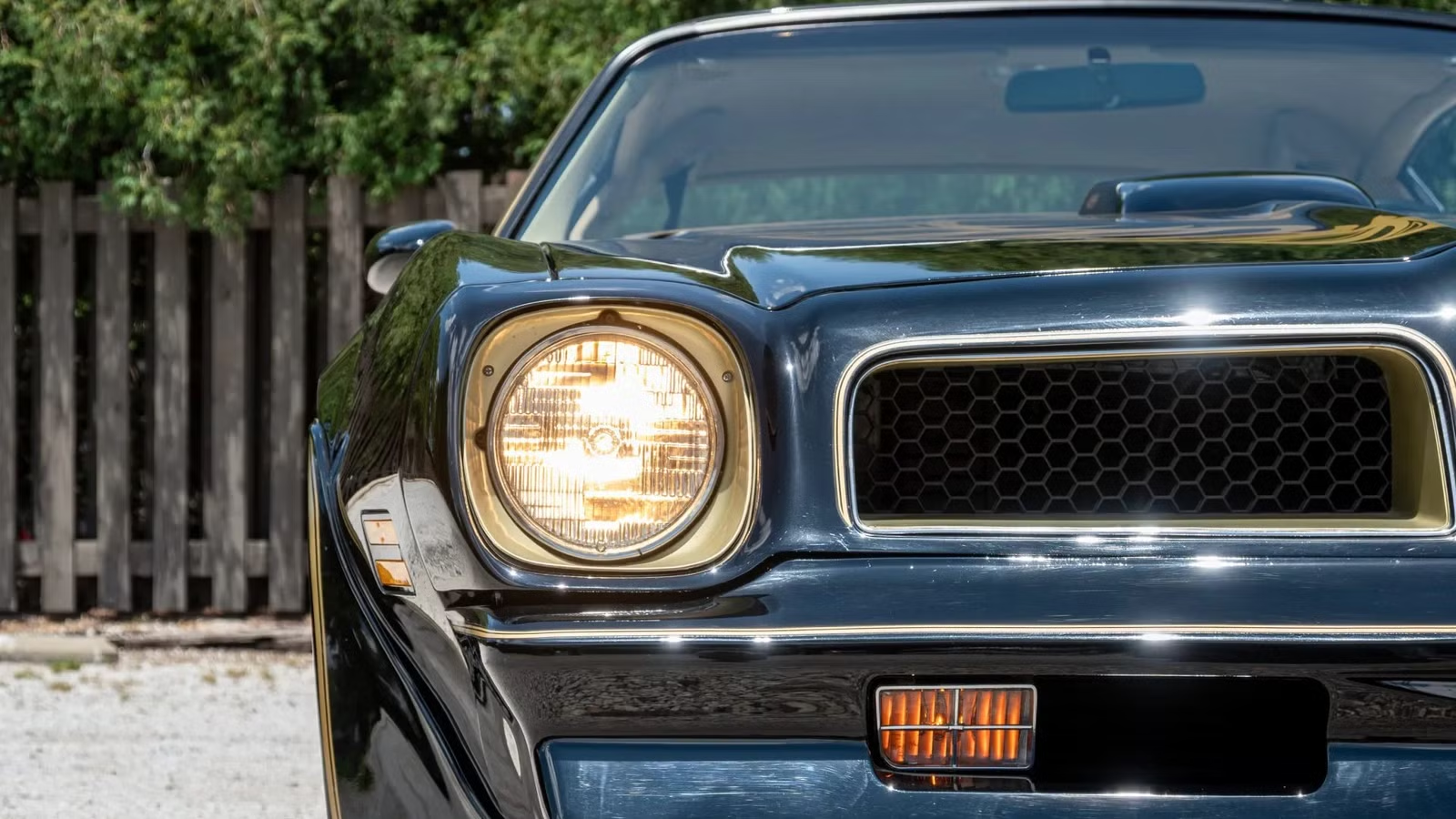
By 1976, America’s muscle-car formula was already becoming an anachronism. Emissions regulations had reduced engine output, fuel concerns had changed buyer priorities, and insurance costs had made traditional performance increasingly difficult to justify. Detroit still built cars that looked like muscle machines, but the enormous engines that once defined them were disappearing. Yet one manufacturer continued offering a performance coupe with a V8 whose displacement belonged to another era. Its horsepower was no longer spectacular. Its survival was. For one final model year, the old formula remained available to anyone willing to order it.
The Muscle Car Era Was Already Supposed To Be Over

The original muscle car formula depended on a simple proposition: put a large V8 into a relatively affordable rear-wheel-drive coupe and let displacement provide the performance. It worked brilliantly when fuel was cheap, emissions rules were less restrictive, and manufacturers could chase horsepower without the constraints that would define the middle of the 1970s.
Those conditions had changed dramatically. New emissions requirements forced manufacturers to alter engines that had previously relied on high compression and relatively unrestricted breathing. The transition to unleaded fuel added another complication, while the 1973 oil crisis made the fuel consumption of large-displacement engines considerably harder to ignore. Performance cars weren’t disappearing entirely, but the mechanical excess that had created the muscle-car boom was becoming increasingly difficult to defend.

The numbers told the story. Engines that had once produced huge outputs were being detuned, while heavier safety equipment and emissions hardware made the cars themselves harder to move. Some manufacturers abandoned their largest engines altogether, and performance versions increasingly depended on smaller V8s or emphasized handling and appearance instead of straight-line power.

By 1976, the muscle car was therefore caught between two eras. Its styling remained desirable, and buyers still wanted performance, but the mechanical recipe that had made the breed famous was rapidly becoming obsolete. One American manufacturer nevertheless kept its largest production V8 available for one more year.
One American Automaker Kept Its Biggest V8 Alive For One More Year

There was little obvious business logic in preserving a huge engine after its performance had already been substantially reduced. A smaller V8 could deliver adequate power while consuming less fuel and fitting more comfortably into the regulatory environment. Keeping the largest engine therefore became less about winning a horsepower war and more about maintaining a connection with buyers who still wanted the old formula.
The engine itself had become a curious contradiction. Its displacement remained enormous, but its output had fallen far below what enthusiasts associated with the muscle-car years. The low-rpm torque that came naturally from such a large engine survived, however, giving it a different character from the increasingly smaller powerplants appearing elsewhere in the market.
There is an important distinction here. The engine offered in 1976 was not the celebrated Super Duty V8 that had powered limited-production Firebirds in 1973 and 1974. That earlier engine represented a much more serious performance program, while the later powerplant was a regular-production unit shaped by the realities of the emissions era. Its significance came from its survival, not from pretending that the old performance figures had somehow returned. That made the decision surprisingly meaningful. The manufacturer wasn’t reviving the muscle-car era. It allowed the formula’s final appearance, even after the conditions that created it had largely disappeared.
Meet The 1976 Pontiac Firebird Trans Am 455

The car carrying Pontiac’s big-displacement formula into 1976 was the Pontiac Firebird Trans Am 455. Its L75 455-cubic-inch V8 produced 200 horsepower and 330 lb-ft of torque, with a Rochester four-barrel carburetor and four-speed manual transmission sending that output to the rear wheels. The engine was available only in the Trans Am, making the combination considerably more specific than a routine engine upgrade.
Those numbers require some historical context. The 200-hp rating was nowhere near what Pontiac’s earlier high-performance 455s had achieved, and the L75 should not be confused with the earlier SD-455. This was an emissions-era version of the large Pontiac V8, built to operate within a very different regulatory and market environment. Its significance came from what it represented rather than from an impressive horsepower figure.

The 455’s 330 lb-ft of torque still gave the Trans Am the low-speed character associated with large-displacement American V8s, while the four-speed manual kept the driver directly involved. Pontiac was therefore still offering the essential ingredients of the old muscle-car formula—large displacement, rear-wheel drive and a manual transmission—even though the performance landscape around them had changed dramatically.
That made the 1976 Trans Am 455 an unusual endpoint for the era. It was not a return to the high-output muscle cars of the early 1970s, and it did not pretend to be one. Instead, it preserved the architecture and character of that formula for one more model year, just as the industry was steadily moving toward a very different definition of performance.
The 455 Had Lost Its Muscle-Car Glory, But Not Its Character

The 1976 engine makes more sense when its torque is considered separately from its horsepower. Producing 330 lb-ft at 2,000 rpm meant the 455 could deliver its considerable shove without needing to chase high engine speeds. That low-rpm character was one of the few things the emissions era could not completely remove from a large-displacement V8.
It also complemented the Trans Am’s chassis rather than existing merely for decoration. The limited-slip differential helped transmit the available torque, while Pontiac’s Radial Tuned Suspension gave the car a level of composure that distinguished it from the stereotypical big-engine machine. Contemporary testers were responding to the entire package, not simply the size of the engine.

The distinction from the SD-455 is crucial here. The earlier Super Duty represented Pontiac’s serious effort to preserve high-performance engineering under increasingly restrictive regulations. The 1976 L75 represented something more understated: the survival of the underlying formula. Pontiac could no longer offer the same level of output, but it could still sell a 455-powered rear-wheel-drive performance car with a manual transmission.
That is why judging the car purely against its predecessors misses the point. The 1976 Trans Am was not trying to win the horsepower race that had defined the early 1970s. By then, that race was effectively over. Its significance came from the fact that Pontiac continued running the old course after most of its competitors had already left it.
The Final 455 Trans Am Became A Time Capsule Of The Muscle-Car Era

The market gave Pontiac little reason to abandon the Trans Am itself. Firebird sales reached 110,775 units in 1976, while the Trans Am accounted for more than 46,000 of them. The figures showed that buyers had not suddenly stopped wanting dramatic performance coupes simply because the industry had become more cautious about horsepower.
The 455 versions were much less common. Hagerty records 7,099 Firebirds equipped with the 455, while 319 Trans Ams received the 455 with a four-speed manual. An especially rare combination was the Limited Edition with the 455, four-speed and Hurst T-tops, of which 110 were built. Those numbers establish genuine scarcity, but rarity alone isn’t what makes the car historically useful.

The 1976 Trans Am is easily overshadowed because almost every neighboring chapter of its history sounds more impressive. The earlier SD-455 had greater engineering drama. The later cars became cultural phenomena. The 1976 version sits between them, carrying a compromised engine at the precise moment when the industry was moving toward a different definition of performance.
Then the 455 disappeared. That is what makes this car more significant than its 200-hp rating suggests. Pontiac didn’t preserve the old muscle-car formula because it was still dominant. It preserved it long enough for the formula to reach its final showroom appearance. The 1976 Trans Am 455 wasn’t the last great muscle car because it represented the peak of the era. It mattered because it arrived at the moment the era was ending, and for one last year, the biggest V8 was still there.
Source: Pontiac

Related posts





Latest Post


No Comments