The Nissan That Makes A Used Porsche 911 Look Like A Gamble
8 minutes reading
Wednesday, 29 Jul 2026 20:00 0 79 autotech
Buyer’s guides routinely stack a pristine new or lightly used modern sports car against a higher-mileage, older Porsche 911 because dealer markups, options, and market depreciation inevitably pull them into the exact same financial territory. It is an incredibly tempting proposition. The 911 keeps its unmatched prestige, its flawless chassis pedigree, and that legendary badge. But at this price bracket, the decision isn’t merely a comparison of lap times or interior leather quality. It’s a fundamental choice of risk-transfer. At $60,000, choosing the used icon means you are acting as your own insurance policy in the event of a catastrophic engine failure. Choosing the modern Japanese alternative means you make a multi-billion-dollar corporation the insurance policy.
To understand the gamble of a used 911, one must look directly at the intermediate shaft (IMS) bearing flaw. The IMS is a critical component that drives the camshafts indirectly off the crankshaft. In the 996 and early 997 generations, spanning 1997 to 2008, Porsche utilized a sealed ball-bearing design that was lubricated by factory grease rather than engine oil. Over time, the rubber seals on these bearings degrade, allowing engine oil to wash out the factory grease without providing a continuous stream of fresh lubrication.
The highest risk is concentrated in the 2000 to 2005 model years, which feature a single-row bearing design. Data from warranty claims and independent specialists like LN Engineering show that these single-row variations suffered a catastrophic failure rate of eight to percent. When the bearing disintegrates, it causes a complete loss of camshaft timing, sending valves smashing into pistons. There is no warning, no gradual loss of performance, and no check engine light to save you. It is an instantaneous, unannounced event that destroys the engine block, requiring a complete and agonizingly expensive rebuild or replacement.
When The Owner Becomes The Insurance Policy
2002 Porsche 996.2 911 GT2 front cabinBring a Trailer
Because these cars are long out of any factory warranty protection, the 997 owner is left with an incredibly heavy financial burden. A catastrophic IMS failure typically results in an out-of-pocket bill ranging from $15,000 to well over $20,000, depending on the severity and whether you source a rebuilt motor or a new Porsche crate engine.
This reality alters the entire ownership experience. Every rattle, every puff of smoke on a cold start, and every speck of metallic debris found in a routine oil filter inspection becomes a source of high-stakes anxiety. The enthusiast who buys a used 997 to actually drive it often finds himself paralyzed by the fear of mileage accumulation. You are no longer just a driver enjoying an iconic chassis; you are an uncompensated risk manager. If the car breaks down on a Sunday drive, your personal bank account is the only safety net that exists.
The Nissan Z: 400 Horsepower With A Corporate Safety Net
The RZ34 Performance Proposition
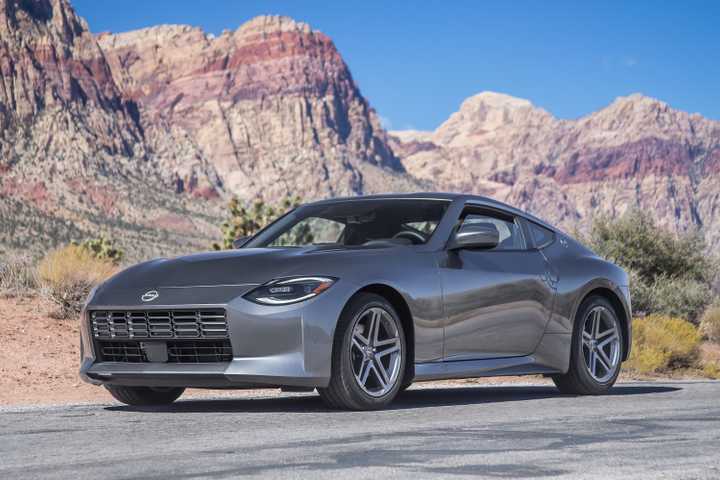
A side view of a 2026 Nissan Z parked in the desertNissan
If you want to escape that cloud of mechanical anxiety without sacrificing pure sports car performance, the modern solution arrives in the form of the Nissan Z (RZ34). By introducing a new or lightly used Nissan Z into the equation, the $60,000 budget shifts from buying someone else’s high-mileage past to buying a low-mileage future.
Under its long hood sits the VR30DDTT engine, a 3.0-liter twin-turbocharged V-6 that pumps out a muscular 400 horsepower and 350 pound-feet of torque. It routes that power through a crisp six-speed manual transmission with synchronized downshift rev-matching or a lightning-fast nine-speed automatic, sending it straight to a mechanical limited-slip differential at the rear wheels. It easily matches or exceeds the straight-line performance metrics of a standard 997 Carrera, ensuring that choosing the rational option doesn’t mean settling for a boring drive.
The Financial Shield Of A Factory Warranty
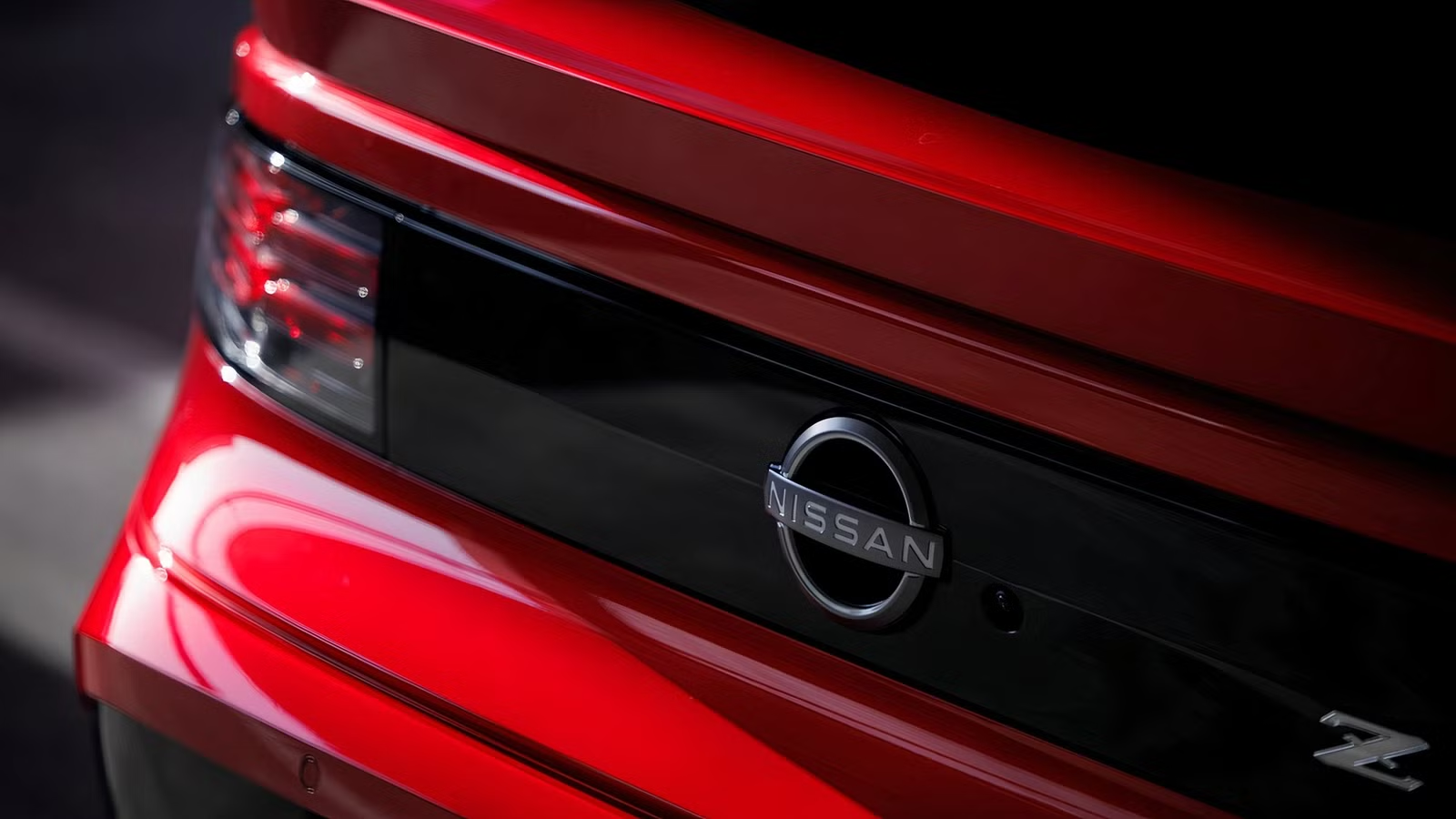
A rear tracking shot of a red 2026 Nissan ZNissan
The true brilliance of the Nissan Z in this comparison, however, lies in its corporate safety net. Every new Nissan Z leaves the showroom floor wrapped in a comprehensive three-year/36,000-mile basic bumper-to-bumper warranty, paired with a robust five-year/60,000-mile powertrain warranty.
This completely changes the financial math of ownership. The five-year powertrain warranty acts as an absolute financial shield for the enthusiast. If you take the Z out on that exact same Sunday morning drive, pin the throttle to the redline, and the mechanical gods decide it is your unlucky day, the outcome is fundamentally different. There is no panicked calculation of your savings account. You simply press the roadside assistance button, have the car towed to a dealership, and hand the keys to a service advisor. Nissan absorbs the entire cost of the repair, provides you with a loaner vehicle, and ensures that your financial life remains completely uninterrupted.
The Flaw In The Z: Acknowledging The VR30DDTT’s Weak Spot
The Oil Pressure Control (OPC) Solenoid Issue
2023 Nissan Z engineNissan
To be entirely fair, the Nissan Z’s VR30DDTT is not a bulletproof engine. It is a highly complex, heavily boosted, modern piece of engineering, and it comes with its own well-documented, catastrophic failure mode: the Oil Pressure Control (OPC) solenoid issue.
The OPC solenoid is designed to regulate oil pressure dynamically across the engine’s operating range to optimize efficiency. However, in certain instances, this solenoid can suffer an electrical or mechanical failure that causes it to stick, severely restricting oil flow or dropping oil pressure entirely during high-load conditions. When this happens, the engine suffers immediate oil starvation at the rod and main bearings. Just like the Porsche IMS failure, this starvation causes the bearings to spin, instantly destroying the crankshaft and the bottom end of the engine. Out of pocket, a catastrophic VR30DDTT failure due to an OPC solenoid issue will result in a replacement bill of $10,000 to $15,000.
Covered Vs. Uncovered: A Tale Of Two Financial Realities
2025 Nissan Z, front 3.4 shotNissan
At first glance, this might look like a total wash. Both cars have a known mechanical vulnerability that can completely destroy the engine without warning. But this is exactly where the risk-transfer thesis proves itself.
The distinction lies entirely in who pays for the destruction. If the OPC solenoid fails within that five-year/60,000-mile window, it is a covered powertrain defect. Nissan writes the check for the $15,000 engine, not you. The failure is transformed from a life-altering financial crisis into a temporary logistical inconvenience. Furthermore, for those planning to keep the Z long past the warranty period, the aftermarket has already developed a permanent solution: affordable, simple mechanical block-off plates that delete the problematic solenoid variable entirely. The 997 owner enjoys no such corporate safety net; an IMS failure on day one or day one thousand of ownership is met with the exact same cold requirement for a personal bank transfer.
The Compounding Math Of A Five-Year Ownership Cycle
The Quiet Premium Of Sports Car Insurance
2026 Nissan Z Heritage Edition dashNissan
2026 Nissan Z Heritage Edition front seatsNissan
Beyond the catastrophic “what-if” scenarios of engine failures, the daily, quiet financial friction of running these two sports cars further widens the gap. Insurance companies view an aging, high-performance German sports car with expensive body panels and astronomical parts pricing far differently than they view a modern Nissan, even one with 400 horsepower.
According to data compiled across major insurance aggregators, the average annual cost to insure a Porsche 911 sits at a steep $3,261. Meanwhile, the modern Nissan Z averages $2,716 per year. At first glance, a premium delta of $545 a year might seem like pocket change to someone cross-shopping $60,000 sports cars. However, when you look at a standard five-year ownership period, that quiet annual difference compounds into a substantial $2,725 saving just for choosing the Z. That is cash that stays in your pocket, completely unbothered by premium hikes or out-of-pocket maintenance surprises.
Calculating The True Cost Of Daily Driving
Front action shot of 2024 Nissan Z Performance in blue driving on desert roadNissan
When you combine all of these financial variables into a comprehensive view, the true cost of daily driving becomes crystal clear: The Nissan Z allows you to actually use the performance you paid for. You can commute in it, take it on cross-country road trips, and track it on weekends without calculating the exact depreciation hit or mechanical risk of every single click of the odometer. The fixed, predictable operational costs of the Z contrast sharply with the volatile, unpredictable running costs of an aging 997.
There is no denying the emotional pull of a used Porsche 911. The steering precision, the badge prestige, and the iconic silhouette will always make it a darling of the automotive purist. But the reality is that buying a high-mileage, out-of-warranty 997 for sixty grand is a high-stakes financial gamble that can go sideways at any moment.
A front 3/4 outdoor shot of a 2003 Porsche 911 Carrera, parkedBring A Trailer
By delivering a 400-horsepower twin-turbo V-6 protected by a comprehensive factory warranty, the Nissan Z alters the entire enthusiast equation. Nissan openly acknowledges that high-performance engines have vulnerabilities, but it steps up to absorb that risk on your behalf. For the enthusiast who wants to spend their weekends actually driving a sports car rather than preemptively saving for an engine rebuild, the Nissan Z isn’t just an alternative; it is quietly the smarter, more rational bet.











No Comments