
Buick’s Mid-Engined Supercar Would Have Crushed Corvette And GM Killed It
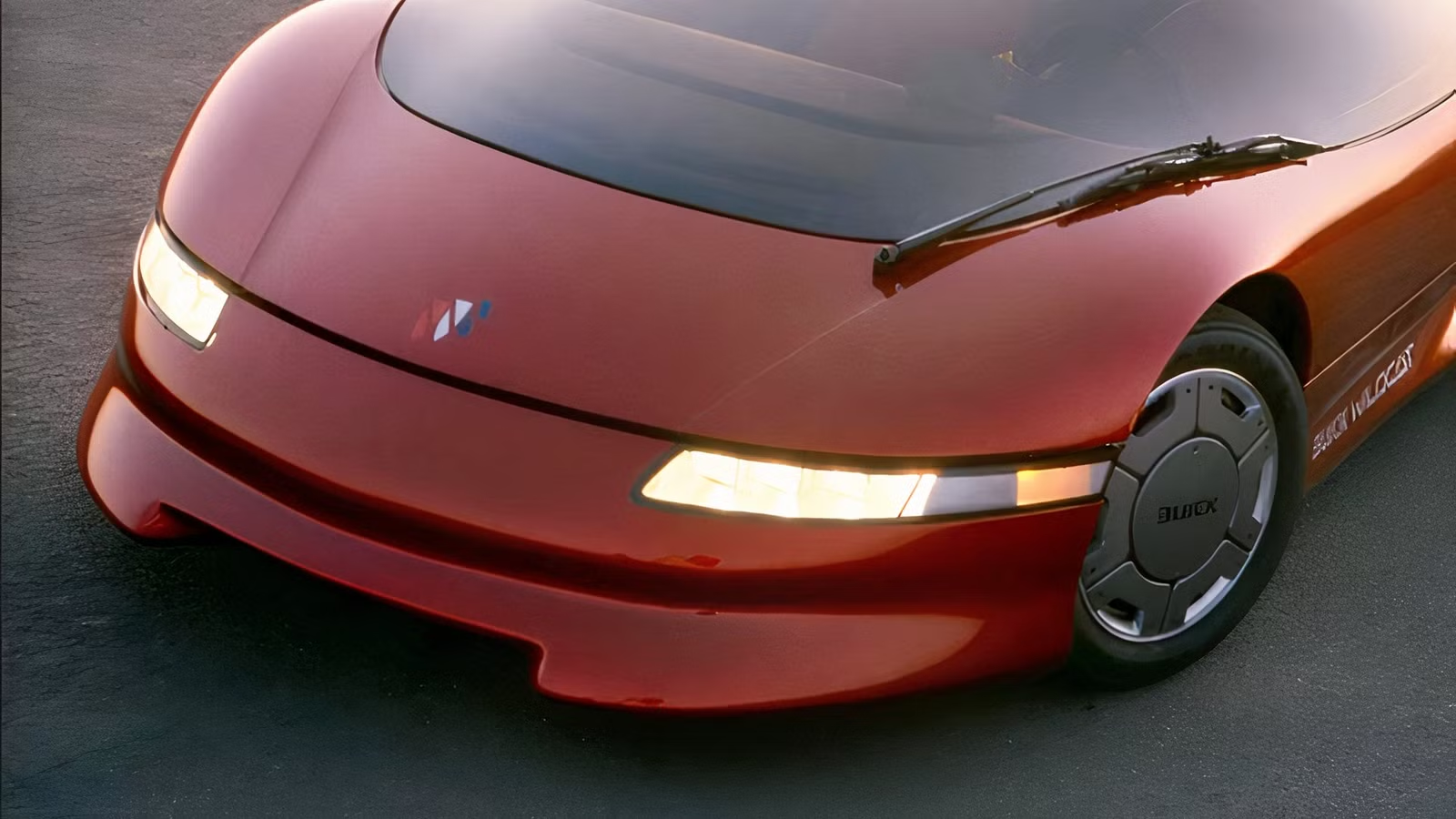
Buick was in an unenviable spot in the mid 1980s. Trapped between the end of the muscle car wars a decade prior and squeezed by German and Japanese automakers that ate their lunch, so to speak, high points like the Grand National and the GNX were juxtaposed by the rest of the lineup floundering when it mattered. In the face of mounting pressure to innovate or go under, Buick took the initiative in the middle of the ‘80s to design their own future. At least, it was Buick’s imagined future in the minds of GM’s design team of the period. On the face of it, the future they had in mind sounded awesome compared to what we got instead.
Buick in the 80s: Desperate Times and Desperate Measures

You could write off Buick’s folly in the mid-80s as little more than a lack of desire to innovate against the rising tide of Honda, Toyota, Nissan, and VW, and not many people would fault you for it. On closer examination, problems were just as much internal as they were brought on by other OEMs that thought outside the box better. With the high days of the muscle car era long gone by 1985 to ’86, Buick underwent a significant downsizing period over the next 15 years that saw the brand become a far different entity than it once was.
Looking at Buick’s lineup of the day, one found a cacophony of plush but otherwise mediocre front-wheel-drive land barges like the fifth-generation Century, far removed from its Fireball glory years that predated even the muscle car era. There were also the Gen-V and VI LeSabre, actively transitioning from a floaty B-body coupe into an FWD runabout Buick hoped would compete with BMW, as well as the emerging Lexus and Acura brands. Aside from the fairly impressive T-type and the 3800-series V6, the LeSabre failed in that regard, just as much as the Oldsmobile 88 it shared an H-body platform with.
Elsewhere, the cushy but otherwise uninspired Skylark and Somerset were mere pale imitations of German luxury sedans—not the kind of cars that could hope to draw new young money away from Mercedes-Benz or Audi on their best day. In short, Buick was on the brink of total irrelevancy. While the entire GM lineup wasn’t in a great spot at that time either, it was clear something radical and just a little desperate was needed to inject some life back into the brand. Without a giant Chinese market to save them like today, Buick would have to innovate its way out of this rut.

Teaming With an Icon: Designing a Concept to Change the Brand

Enter a group of senior designers within the Buick division, possessing some of the smartest minds and most impressive credentials of any team within GM. Leading the body styling process was senior exterior designer David P. Rand, then a hotshot young designer who would go on to have a 32-year career within GM, working on icons like the Cadillac CTS and various Corvettes. The interior end was championed by the pioneering Puerto Rican designer Nelly Toledo, one of the first prominent Hispanic female designers in the history of the American auto industry.
Operating under design studio head and industry veteran William Lee Porter, the group endeavored to create something utterly groundbreaking, something that’d merge the world of jet fighters and sports cars like never before. To make it happen, Buick employed the help of a racing legend. Dubbed McLaren Engines, the group was a direct subsidiary of the McLaren racing team that was actively tearing it up in Grand Prix. At the same time Niki Lauda, Alain Prost, and Kiki Rosberg were racking up wins in the MP4/2 racer, McLaren Engines was being contracted to help OEMs like Ford and GM bolster their respective performance divisions.

McLaren set to work designing a dual-overhead-cam 3.8-liter V6 that might’ve displaced the same as a pushrod 3800. Yet, while a Series I 3800 topped out at a measly 150 horsepower, McLaren’s engine revved to 7,000 rpm and pushed 360 hp and 398 lb-ft of torque at the crank without forced induction. Mounted dead-center in the middle of the car, what resulted was nothing short of incredible.
Enter the Wildcat Concept: A Prototype That Could’ve Changed Buick Forever

In truth, the Wildcat moniker had already been applied to a Buick concept car once before by 1985, and it wouldn’t be the last time either. Back in the early-to-mid 1950s, GM design icon Harley Earl applied the name to three back-to-back concept roadsters, ostensibly aimed at the same audience as the C1 Corvette. Still, the return of the Wildcat concept 30 years later was very different indeed. The chassis and body were honed from a mixture of carbon fiber and vinyl-ester resin, molded into a sleek and slippery silhouette that looked more like a Blade Runner movie prop than a real automobile.
The cockpit might as well have been inspired directly by the F-14A Tomcat jet fighter gearing up to become a movie star via Top Gun the following year. Such was the design language: a tinted Plexiglas canopy that tilted forward just like a jet fighter’s. At the front end, the design was a pure drag coefficient monster, mirroring future hypercars with similar cues like the McLaren Speedtail and the Aston Martin Valkyrie decades later. At the back, the engine was displayed prominently, sticking out of the rear deck lid where onlookers could get a clear look at it. Inside, the perfectly round steering wheel housed a black and green digital gauge cluster within it, complete with functional buttons within the rim, and a full heads-up display.
To say folks were in awe when the Wildcat made its debut at the 1985 SEMA Show in Las Vegas would be an understatement. Suddenly, a future where Buick was mentioned in the same breath as Ferrari or Lamborghini didn’t seem as silly as it would’ve been just a few years prior. Of course, the Ferrari F40 was still a couple of years away from production at this stage, and the Lamborghini Countach LP5000 Quattrovalvole would not have felt out of place parked right next to this Wildcat. It was engineering and design excellence all rolled into one, so of course GM decided not to capitalize on it. One can only assume it’s another one of those “you can’t be better than the Corvette” instances rearing its ugly head.
Inspiring Buick Even 40 Years Later

Today, the 1985 Wildcat Concept is just a footnote in a brand that decided to stick to the conventional later on. Thankfully, the Buick brand is still going strong off the back of considerably more demand overseas than back at home in America. Yet, even now, the Wildcat Concept moniker refuses to go away. As recently as 2022, Buick unveiled an all-electric Wildcat EV concept car with a styling language surprisingly similar to its 1985 ancestor.
Certainly, the same swooping, aerodynamic lines of the old car transferred into a modern framework very nicely. As of 2026, the 1985 Wildcat is still in the ownership of GM, fully operational, and occasionally makes outings to the public when Buick feels like showing off. If only they had decided to do more than that, Buick could’ve been a radically different OEM. Speaking of the Corvette, it sure looks more inspired by the 1985 Wildcat design language than it does its own lineage these days. Is that what they call irony? If it isn’t, then it should be.
Source: Buick, McLaren Engines

Related posts



Latest Post


No Comments