
The Forgotten Volkswagen That Drove Like A Motorcycle
Motorcycles have always offered something sports cars struggle to match: an intense connection between driver, machine, and road without relying on huge engines or exotic engineering. In 2006, Volkswagen set out to replicate that experience with a vehicle that looked nothing like the rest of its lineup. Built from familiar production components and carrying a surprisingly realistic price target, it wasn’t designed to be a halo car. It was meant to prove that lightweight engineering could still surprise enthusiasts.
Lightweight Performance Was Making A Comeback

By the early 2000s, performance cars were becoming increasingly sophisticated. Stability control, adaptive suspensions, and ever-larger engines were improving objective performance, but they were also adding weight and complexity. Enthusiasts who valued involvement over outright speed found themselves looking elsewhere.
At the opposite end of the market, companies like Caterham, Ariel and Lotus continued proving that low mass could compensate for modest horsepower. Motorcycles had embraced the same philosophy for decades, delivering thrilling acceleration and sharp responses through favorable power-to-weight ratios rather than sheer engine size.
Volkswagen watched both trends unfold while enjoying strong sales from enthusiast models such as the Mk5 GTI and the R32. Those cars reinforced the brand’s sporting credentials, but neither challenged the conventional definition of a road car. Engineers began asking whether everyday Volkswagen mechanicals could underpin something far more radical.

An Internal Experiment Escaped The Design Studio

The project that followed wasn’t intended to showcase futuristic technology. Instead, Volkswagen’s California design studio worked with engineers to create a vehicle around components already sitting on the company’s parts shelves. Keeping development costs low was as important as creating an engaging driving experience.
Internally, the concept evolved under Project Moonraker, with Volkswagen later working alongside Lotus Engineering to evaluate how the design could be prepared for production. Lotus wasn’t asked to reinvent the vehicle—it was brought in because of its experience refining lightweight chassis for road use.
Affordability shaped nearly every engineering decision. Rather than commissioning a bespoke engine or transmission, Volkswagen planned to reuse proven production hardware. Early estimates suggested a sticker price of roughly $17,000, placing the vehicle within reach of buyers who might otherwise choose a motorcycle or an entry-level sports coupe. Nothing about the business case suggested the project was destined to remain a concept. Volkswagen publicly discussed production, targeted the American market and built fully functional prototypes rather than static show cars.
We Are Talking About The Volkswagen GX3

Volkswagen revealed the GX3 at the 2006 Los Angeles Auto Show, where it immediately stood apart from the flood of conventional concept cars. Instead of oversized wheels, dramatic scissor doors or impossible proportions, the GX3 looked production-ready. It had exposed suspension components, a compact steel space frame and just enough composite bodywork to cover its mechanicals.
Its layout owed more to motorcycle engineering than traditional sports-car design. Two occupants sat side by side ahead of a mid-mounted 1.6-liter inline-four borrowed from the Lupo GTI. The engine produced 125 horsepower and 112 lb-ft of torque, sending power through a 6-speed manual gearbox before a chain drive transferred it to a single rear wheel. With a curb weight of roughly 1,250 pounds (570 kilograms), Volkswagen projected a 0–60 mph time of about 5.7 seconds and a top speed approaching 125 mph.
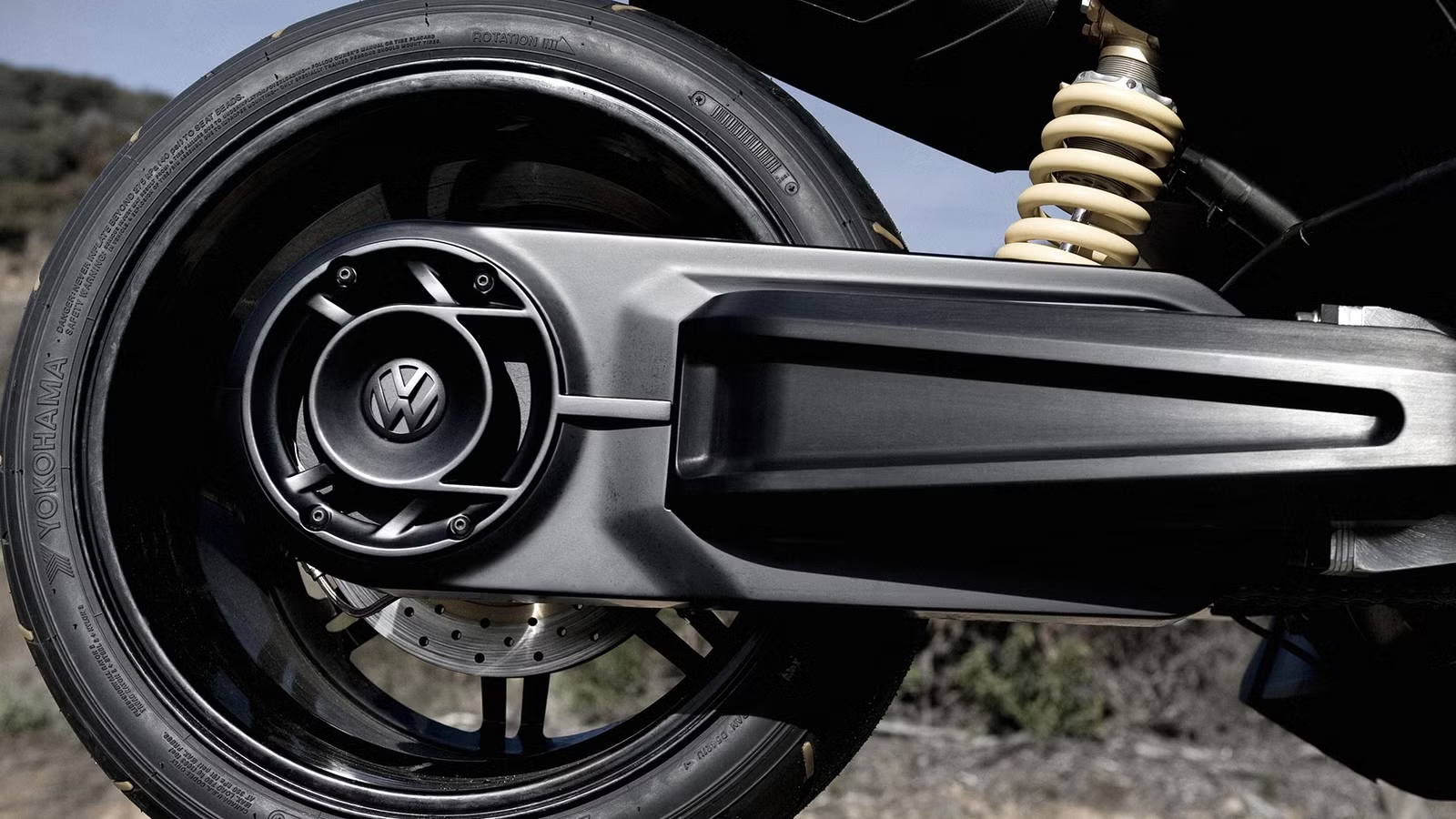
The chassis followed the same minimalist philosophy. A welded steel tubular frame provided the structure, while lightweight fiberglass body panels kept mass to a minimum. Double-wishbone suspension at the front and a single-sided swingarm supporting the driven rear wheel reflected motorcycle influence more than conventional automotive practice.
Volkswagen wasn’t chasing headline horsepower. The GX3 demonstrated how careful packaging and intelligent component sharing could create performance without resorting to expensive engines or exotic materials. At a time when many concept cars promised impossible futures, the GX3 looked like something buyers might actually be able to park in their garage.
It Behaved More Like A Motorcycle Than A Sports Car

Volkswagen’s engineers weren’t trying to disguise the GX3 as a conventional sports car. The open cockpit exposed occupants to the wind, engine noise and changing road surface much like a motorcycle, while the low seating position exaggerated the sensation of speed. There was no roof, no doors and no windshield frame separating the driver from the environment.
The three-wheel layout also demanded a different engineering approach. Steering was handled by two front wheels using double wishbones, while propulsion came from the single rear wheel through a chain drive—a solution more familiar to motorcyclists than car enthusiasts. The arrangement reduced mechanical complexity and unsprung weight while allowing Volkswagen to package the drivetrain compactly behind the occupants.

Performance came from mass reduction rather than engine output. Weighing roughly half as much as a contemporary hot hatch, the GX3 extracted impressive acceleration from just 125 hp. Volkswagen claimed a 0–60 mph sprint of around 5.7 seconds, demonstrating that careful packaging could rival cars with significantly larger engines.
The driving experience was expected to be equally unconventional. With no electronic driving aids promoted as part of the concept and little separating occupants from the chassis, the GX3 promised immediate steering responses and direct mechanical feedback instead of the refinement buyers had come to expect from modern passenger cars.
The Biggest Obstacle Wasn’t Engineering

From a technical perspective, the GX3 had progressed well beyond the average concept car. Volkswagen had built working prototypes, partnered with Lotus Engineering to evaluate production feasibility and deliberately relied on existing production components to keep manufacturing costs under control. Few concept vehicles reached that level of development without a serious production objective.
The project became more complicated once it approached the American market. Because the GX3 occupied an unusual space between a motorcycle and a passenger car, questions emerged over crash regulations, occupant protection and legal classification. Even where regulations might have allowed a three-wheeled vehicle greater flexibility, product liability presented a much larger concern for a global manufacturer.
Affordability also began slipping away. The proposed price of around $17,000 depended on keeping development costs tightly controlled. Additional engineering, certification work and legal exposure threatened the business case that had made the GX3 attractive in the first place. Volkswagen ultimately canceled the program before production tooling began. The decision wasn’t an admission that the concept failed mechanically—it reflected the growing gap between what engineers could build and what lawyers and accountants could confidently approve.
A Concept That Predicted A Market Before It Existed

The GX3 quietly disappeared from Volkswagen’s future product plans, but the idea behind it refused to vanish. In the years that followed, three-wheel performance vehicles found a niche audience, proving there was genuine demand for machines that delivered open-air excitement without the size or cost of a conventional sports car.
Vehicles such as the Polaris Slingshot approached the formula differently, yet they validated the same basic premise: some buyers valued involvement over outright practicality. Volkswagen had explored that territory years earlier using mainstream production hardware rather than a purpose-built platform.
The GX3 also challenged assumptions about what an affordable enthusiast vehicle could be. Instead of relying on turbocharging, high horsepower or premium materials, it demonstrated that intelligent packaging and disciplined weight reduction could produce compelling performance from an engine already serving duty in one of Volkswagen’s smallest production cars. Collectors have since embraced the GX3 less as a lost supercar than as one of Volkswagen’s boldest near-production experiments. Its rarity comes not from limited production, but from the fact that production never happened at all.
One Decision Changed Volkswagen’s Enthusiast History

The GX3 arrived at an awkward moment. Manufacturers were investing heavily in safety systems, expanding model ranges and preparing for increasingly demanding emissions standards. A minimalist three-wheeler built primarily for driving enjoyment no longer fit comfortably within the industry’s priorities, even if the engineering made sense.
What makes the GX3 noteworthy isn’t that it was extreme. By supercar standards, it wasn’t. It borrowed an existing engine, an existing transmission, and a straightforward steel space frame. Volkswagen’s achievement was showing how familiar components could create an entirely different driving experience when assembled around a clear engineering objective.
Had the project reached showrooms at its intended price, it would have become one of the least expensive ways to buy a factory-built performance vehicle from a major manufacturer. Instead, the prototypes became reminders of how close Volkswagen came to redefining its enthusiast identity. One detail captures the GX3’s unrealized potential better than any performance figure: Volkswagen didn’t unveil it as a fantasy. It unveiled it with a target price, a production plan and working prototypes. Few concept cars get that far before disappearing.
Sources: Volkswagen

Related posts
Latest Post


No Comments