
Volkswagen Once Built A Supercar-Beating Hot Hatch And Then Buried It
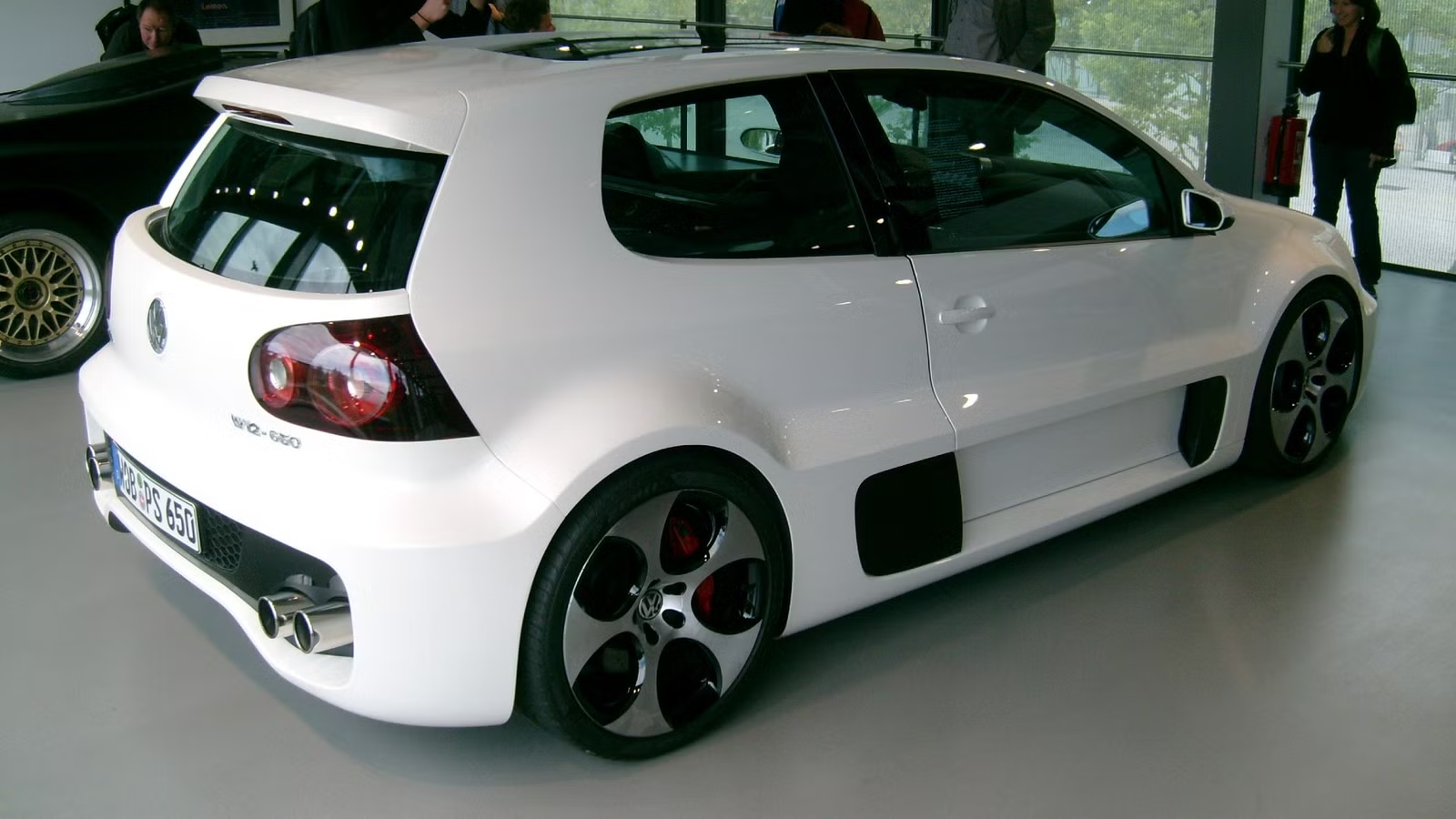
Volkswagen doesn’t exactly have a reputation for building unhinged performance machines — but dig into its history and you’ll find some genuinely wild engineering experiments hiding in the shadows. Long before the brand became synonymous with sensible family transportation, its engineers were given the freedom to chase truly outrageous ideas. One of the most spectacular results was a concept car that can legitimately claim the title of the king of hot hatches It packed supercar-rivalling performance and was assembled in a timeframe that seems almost impossible.
The Volkswagen Golf GTI W12 650 Is A Supercar-Beating Hot Hatch

What would happen if you took the concept of a hot hatch to its most extreme conclusion? That’s exactly what Volkswagen explored with the Golf GTI W12 650. From the outside, it looks like a slightly aggressively modified Mk5 Golf GTI. But beneath the skin, it’s a genuine engineering marvel. Instead of the 2.0-liter turbocharged inline-4 the Mk5 Golf GTI came with, it houses the 6.0-liter twin-turbocharged W12 sourced from the first-generation Bentley Continental GT.
This insane hot hatch had an output of 650 hp and 531 lb-ft of torque. That was enough to give the Golf GTI W12 650 properly supercar-rivalling levels of performance. It could sprint from 0–62 mph in just 3.7 seconds, and go on to a top speed of 202 mph.
How Volkswagen Got The W12 In
Perhaps the greatest engineering challenge of the entire build was how VW’s engineers managed to shoehorn that massive W12 into a Golf chassis. They pulled it off, but it demanded a lot of work. The car needed to be made lower and wider than the standard Golf GTI to accommodate everything. The engine also had to be positioned in the middle of the car, where the rear seats would normally sit in a conventional front-engined Golf. This effectively turned it into something not unlike the classic Group B homologation specials of the past — cars like the MG Metro 6R4 or the Renault 5 Turbo — or more modern takes on the same formula, such as the Renault Clio V6.
It Was Built In Only 8 Weeks!

Perhaps the most impressive thing about the Volkswagen Golf GTI W12 650, though, is how quickly VW’s engineers built it and got it running. They completed the entire build in just 8 weeks — including all the major chassis modifications and the work required to fit and properly connect that enormous W12 engine.
While the speed of the build is remarkable, some corners were inevitably cut to hit that deadline. Quite a few of the car’s less critical features simply didn’t work. The air conditioning system was never connected up, the hazard lights didn’t function, and neither did the entertainment system. Even the paddle shifters on the steering wheel weren’t linked to the transmission, meaning the driver couldn’t enjoy manually rowing through the gears like a racing driver.
It Was Only A Prototype

As you’d perhaps expect for something this extreme, the Volkswagen Golf GTI W12 650 was never intended to be a production car. It was always purely a concept, a showcase of just how far Volkswagen’s engineers could push things. It’s a shame it never received even a limited production run — the engineering was fundamentally sound, the car was fully drivable, and it wouldn’t have taken a great deal more work to bring everything up to production-ready standard. Still, it’s such a niche machine that realistically only a small number of dedicated enthusiasts would ever have wanted one.
Where Is The W12 Golf GTI Now?
After its initial public debut, the Volkswagen Golf GTI W12 650 largely disappeared from view. Volkswagen rarely mentions it these days, and for many enthusiasts the car only registered at all because of a memorable road test on Top Gear during the Clarkson, Hammond and May era. Fortunately, the car hasn’t been lost. It remains in Volkswagen’s ownership and still makes occasional public appearances, though these days it typically does so as a static display rather than under power.
There don’t appear to be any recent records of the Golf GTI W12 650 being let loose for proper high-speed runs, which is a shame — it would be spectacular to see it stretch its legs again. For now, it lives as something of a garage queen within VW’s heritage collection, though perhaps its moment in the spotlight will come again one day.
Other Crazy Volkswagen Concepts

The Golf GTI W12 650 is far from the only wild concept car Volkswagen has unleashed over the years. During Ferdinand Piëch’s tenure at the helm, Volkswagen became notorious for producing some of the most audacious cars — and engines — the automotive world had ever seen. Unfortunately, like the Golf GTI W12 650, many of these have faded into relative obscurity. That doesn’t make them any less worth celebrating, though.
Volkswagen W12
You might wonder where the W12 engine in the Golf GTI W12 650 originally came from. While the specific unit used in the GTI W12 650 was derived from the first-generation Bentley Continental GT, the W12 concept itself has deeper roots. It traces back to the late ’90s, when VW produced a series of W12 concept cars — three in total, all powered by naturally aspirated versions of the engine. The first was the Syncro, unveiled in 1997: a coupe fitted with a 5.6-liter W12 producing 414 bhp. True to its name, it featured all-wheel drive. A roadster version of the Syncro followed a year later, mechanically identical to the coupe.
A couple of years after that, in 2001, VW created a higher-performance coupe version of the W12 called the Nardo. Named after the legendary Nardo Ring test track in Italy, it used a larger 6.0-liter W12 producing 591 bhp and 458 lb-ft of torque. That translated to a 0–62 mph time of around 3.5 seconds and a top speed of nearly 222 mph.
Volkswagen GX3
Perhaps one of the most unusual designs Volkswagen has ever produced, the GX3 was conceived as part of Project Moonraker — an initiative dreamed up by Stefan Liske, who served as Director of Group Product Strategy at Volkswagen.
First shown at the 2006 Greater Los Angeles Auto Show, it was a super-lightweight, open-wheeled three-wheeler sports car powered by a 1.6-liter inline-4 engine borrowed from a Lupo GTI. That engine produced around 123 hp and 112 lb-ft of torque — modest figures, but more than adequate given the GX3’s minimal weight. Volkswagen claimed it could reach 62 mph from rest in 5.7 seconds and top out at 125 mph. Reinforcing its raw, driver-focused character, it was fitted with a 6-speed manual transmission.
The GX3 drew an enthusiastic public response, and Lotus was even brought in to help refine the chassis ahead of a potential production version. It never made it beyond the prototype stage, however. VW concluded that significant revisions would be needed, partly due to concerns about the safety of the original design.
Volkswagen GTI Roadster Vision Gran Turismo
The GTI Roadster Vision Gran Turismo is another Volkswagen concept that remained strictly virtual — because it was designed specifically for a video game. Sony invited VW to create a car to celebrate the 15th anniversary of the Gran Turismo series, and this is what the team came up with. The GTI Roadster Vision Gran Turismo is a carbon-fibre-bodied sports car powered by a 3.0-liter twin-turbocharged VR6 engine producing 496 hp and 413 lb-ft of torque, sent to all four wheels through VW’s 7-speed DSG dual-clutch transmission. Volkswagen claimed a 0–62 mph time of 3.6 seconds and a top speed of 190 mph.
You can’t drive one in the real world, of course. But if you own a copy of Gran Turismo 6, Gran Turismo Sport, or Gran Turismo 7, you can take it for a virtual spin. It sits alongside the other imaginative concept cars created exclusively for Gran Turismo, and it certainly looks and feels the part.
Source: Volkswagen.

Related posts





Latest Post


No Comments