
Mercedes Made Just 80 HP From 3.0 Liters, And Built A Million-Mile Legend
These days, a well-maintained SCR or DEF-equipped diesel engine can run for as many as 300,000 to 500,000 miles before it needs to be replaced or rebuilt. If you ask the owner/operators and civilians who own them, most would tell you that figure is pretty good. Well, what if we told you there’s a 50-year-old lump of Mercedes iron that easily doubled that mileage, doing so running on everything from old-fashioned diesel to used deep fryer oil. Half a century ago, the disposable economy as we know it today would have been unrecognizable.
Mercedes in the 1970s: A Beast of Efficiency and Dependability

To describe Mercedes-Benz’s recovery and meteoric rise in the 30 years post-World War II as a miracle would be putting it lightly. Emerging from the rubble of West Germany in the late 1940s, the company didn’t just rebuild its factories; it completely redefined its engineering ethos. The mandate in Stuttgart was clear: build vehicles without compromise. For decades, MB flatly rejected the disposable, planned-obsolescence trends creeping into the broader automotive industry, most notably in America.
Everything was obscenely overbuilt, everything was heavy, and everything was built to last. Just look at the W123 and W114 sedan chassis of the mid-1970s for proof positive that Mercedes was outpacing the rest of the auto industry. Compared to the equivalent BMW 5 Series or Audi 100, an old Mercedes sedan was more like a rolling bank vault or a tank than a commuter car. The foundation of this trend was the engine department, where notable engineers like Dr. Kurt Obländer and Hans Scherenberg designed powerplants that could outlive the people buying them, and perhaps even their children.
W114


Entering the 1970s, while many other automakers started to slack on build quality, Mercedes did the exact opposite. That was especially true on the diesel end of things, where the brand was tasked with supporting taxi, police, and utility fleets the world over, often in places that couldn’t afford to have cars in the shop for very long. The end result was nothing short of legendary.
Setting a 2.85-Million-Mile Benchmark

If you think a diminutive little four-cylinder N/A diesel engine’s performance would be pathetic, well, you’re not wrong. But what the Mercedes-Benz OM616 lacked in grunt, it more than made up for by being pretty much indestructible. It sported a cast-iron block of especially sturdy construction, plus internals featuring forged-steel connecting rods, induction-hardened valve seats, and a remarkably stout valvetrain. Without forced induction or significant emissions restrictions, these 65 to 70 hp, 2.4-liter four-cylinder engines were substantially understressed.
Outside of passenger cars, the OM616 was a stalwart of the Unimog utility truck from the mid-1970s onward, as well as a series of cargo and passenger vans that saw service everywhere from Europe to the most unforgiving, unpaved corners of South America, Australia, and Africa. The ultimate proof of how substantially overbuilt these four-cylinder diesels are is a 1976 Mercedes-Benz 240D that accumulated a documented 2.85 million miles serving as a taxi in Greece.

Driven by a Thessaloniki resident named Gregorios Sachinidis, the car was operated around the clock, day in and day out until 2004, at which point Mercedes-Benz actually requested the vehicle back so they could display it in their museum. Numbers like that aren’t the result of a lucky production run, a freak survivorship anomaly, or gentle highway driving. They happen because an engine is structurally incapable of tearing itself apart under any reasonable operating conditions. Still, one more cylinder would not hurt.
The OM617: The German Cummins

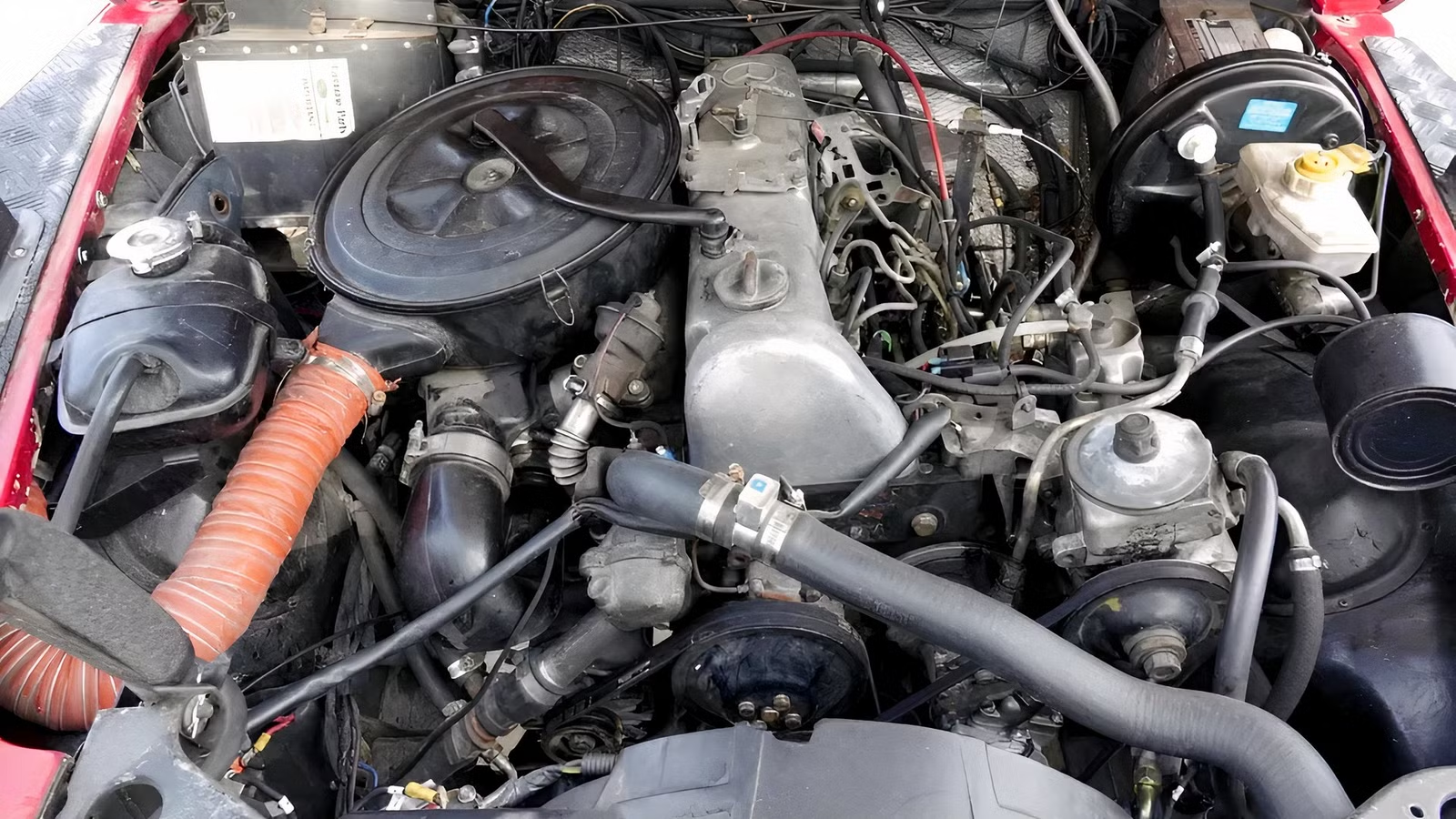
Debuting a year after the OM616 in 1974, the OM617 was a direct development of the notably underpowered four-cylinder. Sporting one extra cylinder, a forged-steel crankshaft and forged connecting rods, Bosch MW injection pumps, and the same heavy-duty cast-iron architecture, this 3.0-liter West German engine produced a modest 80 hp. With a 21.0:1 compression ratio, the OM617 needed that tractor-like bottom end to handle all that pressure.
Instead of a wimpy timing belt, the OM617 used a beefy double-row timing chain to power the camshaft and the Bosch mechanical injection. The pump itself was lubricated by the same oiling system as the rest of the engine, meaning frequent oil changes ensured the pump survived a lifetime of thermal cycles.Like a 1990s and 2000s Cummins truck engine in the US, the OM617 often outlived the chassis it was bolted to. With simple mechanical fuel injection, no federally mandated emissions hardware, and the ability to run on nearly anything that combusts, diesels of this caliber simply cannot be built anymore.
In the ever-important B50 life category that measures when 50 percent of an engine class reaches the point of needing a rebuild, both a 5.9-liter Cummins straight-six and an OM617 register readings in the several hundreds of thousands of miles. Yet, a 5.9 Cummins’ 350,000-mile B50 rating is among the highest ever recorded, and the Merc’s is right there with it.
Why Modern Diesels Don’t Last Nearly As Long

It would be easy to say emissions hardware and planned obsolescence make modern diesels an affront to older ones. Yet, beneath the surface, Exhaust Gas Recirculation (EGR), Diesel Particulate Filters (DPF), and Selective Catalytic Reduction (SCR) hardware does not just strangle durability; it fundamentally changes how an engine breathes and operates. These systems recirculate exhaust gases back into the intake manifold, effectively forcing the engine to breathe its own emissions.
Add in extreme thermal cycling from DPF regeneration cycles and the extensive wiring required by modern amenities, and today’s diesels are compromised from the factory. That is not to say older diesels are immortal: an OM617 can still fail if you neglect oil changes or allow the timing chain to stretch. Still, it takes significant neglect to reach that point. Meanwhile, a modern Power Stroke or Duramax can suffer catastrophic failure with comparatively little provocation.
Source: Mercedes-Benz, EngineTechSpecs.com

Related posts





Latest Post



No Comments