
The Subaru Flat-Six AWD Wedge That Predicted The WRX A Decade Early
Think Subaru, and you’ll probably think of a blur of blue and gold traveling sideways through a forest, likely with Colin McRae or Richard Burns at the wheel. Subarus have long epitomized the turbocharged, all-wheel-drive four-door for the masses, with the success in rallying mirrored in huge sales in the showrooms. The boxer engines, the boosted engines, the power to all corners — these are all trademarks of the ’90s era and onwards Subies. But Subaru nearly refined its formula for fast and capable road cars when a lot of people weren’t looking, producing a futuristic sports car that has been long forgotten. But this long-lost oddity would shape the company’s future forever…
Subarus Have A Special Sauce

Out of nowhere, Subaru seemed to go from a company selling vehicles you might see on a farm, to ones that were jumping through forests and doing handbrake turns in a car park. As far as reinventions go, the Impreza WRX (World Rally eXperimental), or the Turbo 2000 in some markets, put the Japanese firm on the front covers of magazines everywhere. This car, which looked like a mildly souped-up Kuala Lumpur taxi, could hit 60 mph in 5.5 seconds, using a turbocharged flat-four powering all four wheels. To be fair, the Legacy Turbo had brought pretty much the same ingredients to the kitchen a couple of years before, but it was the Impreza that made them oven ready.
Subaru Hasn’t Strayed Far From What Made It Great

OK, we could argue that Subaru lost a very tight grip on the zeitgeist somewhere around the 2000s. This was possibly triggered by its move to an Impreza hatchback in some markets, with a move to rugged SUVs and all-wheel-drive crossovers like the Outback and Forester in others. But at the core of the company has always been a commitment to boxer engines, turbocharging (as seen in the current WRX) and all-wheel-drive. And we have the Impreza and Legacy to thank for all that. Right? Wrong, actually. There is a forgotten Subaru model that served as the missing link between old and new.
The Subaru XT Predicted The Company’s Future


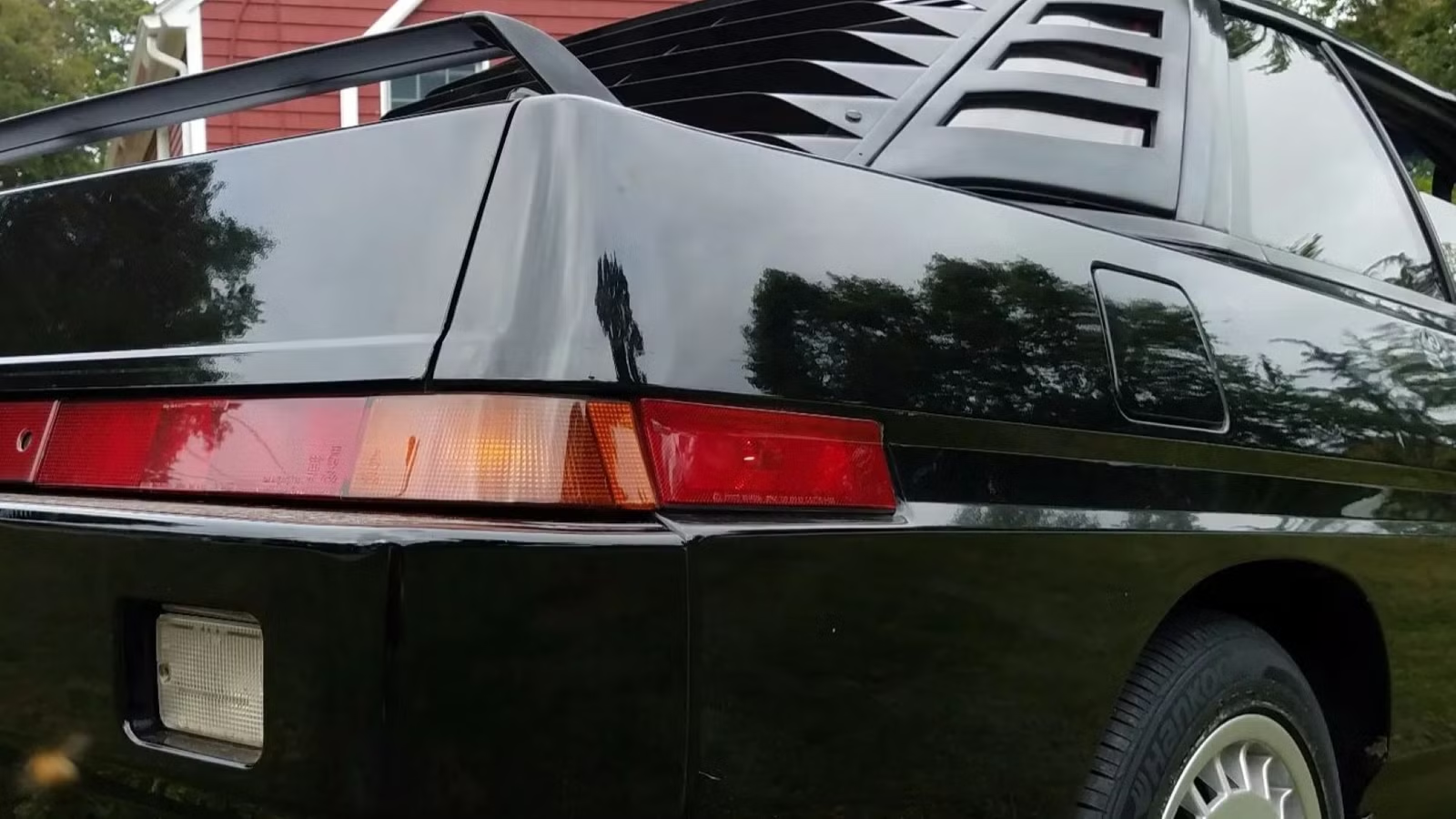
The Subaru XT launched in 1985, and it looked like it had landed from a different time/dimension/planet. Subaru itself had been bossing the JD Power Survey with very sensible, practical and reliable cars — nothing too exciting, mind. Subaru of America had convinced Fuji Heavy Industries that the company needed something interesting and sporty to take it forward in the USA, and the XT (called the Alcyone in Japan and Vortex in Australia) was the result.
The conversation about what makes an exciting flagship may have been lost in the faxes somewhere, because the idea finally translated to a bonkers sci-fi coupe with all-wheel drive and a turbocharger. Think an 8-bit version of the legendary Impreza 22B and you’re kind of on the right lines. The car could be specced with either front- or four-wheel-drive, the latter coming equipped with air springs and electronic height control. Combined with the Buck Rogers styling and Quickshot II gearshifter, you had a car that simultaneously banished Subaru’s bland image and gave a glimpse of its wild future.
The XT’s Spec Is Mighty Familiar

Under the hood of the XT Turbo lurked a 1.8-liter turbocharged flat-four with 111 hp and 134 lb-ft of torque. Hardly face-melting stuff, but that is a very similar spec on paper to what you would find in later Imprezas. Then Subaru decided to fine tune its new formula. The XT6 followed the XT Turbo two years later, with the quirkiness dialed down, and a slug more power.
The extra output came from a single-overhead-cam, 2.7-liter flat-six unit (the clue was in the name). This engine is good for 145 hp at 5200 rpm, and 156 lb-ft. Again, buyers could choose front-wheel drive, but they would be lumbered with an auto only; the four-wheel-drive version came with a five-speed manual as an option. Of course, the flat-six would be another engine that would feature heavily in Subaru’s future, continuing until fairly recently in the Legacy 3.6R.
The XT Was Out Of This World

The XT played to a lot of Subaru’s strengths, but also showed the company’s quirky side — as would be seen in the later SVX. Earlier XTs featured a digital gauge package (which was later dropped), with banks of touch switches behind the wheel to control everything from the ride height to the lights. The electronic display itself shows the car, which has a boost gauge shown as a sidebar next to it, and the body rises when you adjust the height. Talking of high-tech, the later XT6 also came with something called “Cybrid Steering.” This was essentially an early computer-controlled assist system using an electric motor rather than the engine, which was said to be more precise.
The XT Was A Decade Too Early

In some ways, the XT was a bit too forward-thinking for its own good. By the end of the ’80s, Nissan had launched the R32 Skyline GT-R, a car that borrowed a lot of the ethos of the Porsche 959 (not surprising as the company had bought one to dismantle). Then came the Mitsubishi 3000GT VR-4, which had power everything, including active aero, all-wheel-drive, and all-wheel-steering. But the XT helped shape the future for Subaru. It may have been too wacky even for the techy ’80s, but it helped the company find its strongest points: tough turbocharged flat-fours and all-wheel drive. Once they toned down the boxy exterior for the more generic looks of the Impreza and Legacy, they were on to a winner. Quite literally when it came to world rallying.
The XT Is Now A Cult Classic

Arguably, the XT did a lot of things, but didn’t focus on one element enough. It wasn’t sporty enough for enthusiasts, while being too out there for anyone who just wanted a pretty coupe. Subaru managed to shift 98,928 during its production run before it was replaced in 1992 by the SVX, says Hagerty. This puts it in that unusual category of being common enough to be cheap, but rare enough to be interesting when you see one. A Subaru XT6 will cost just $5,400 in good condition, says Hagerty—which is incredibly cheap for such a charming slice of ’80s craziness. A turbo version will set you back the princely sum of $6,100. There are some different trim options that probably aren’t worth looking at, such as a non-turbo four, and the DL base trim with no rear seats. But before you dive into XT ownership…
Buyers Need To Proceed With Caution

As with any techy car, there are a lot of things that can go wrong. On the Grassrootsmotorsports.com forum, owners talk about problems with rust, and the fact that parts can be scarce. The air suspension is prone to failure and often swapped for coils and the “Cybrid” electro-hydraulic steering requires specialized fluid. This is probably a car that will have you getting to know the community well, and keeping it going could be part of the fun (or a total nightmare). There aren’t many cars this unique, however, and few can lay claim to pioneering a brave new future for the company.ports
Sources: Hagerty.com; Grassrootsmotorsports.com

Related posts



Latest Post


No Comments