
The Mercedes-Benz V8 That Proved You Don’t Need To Buy American To Enjoy Muscle
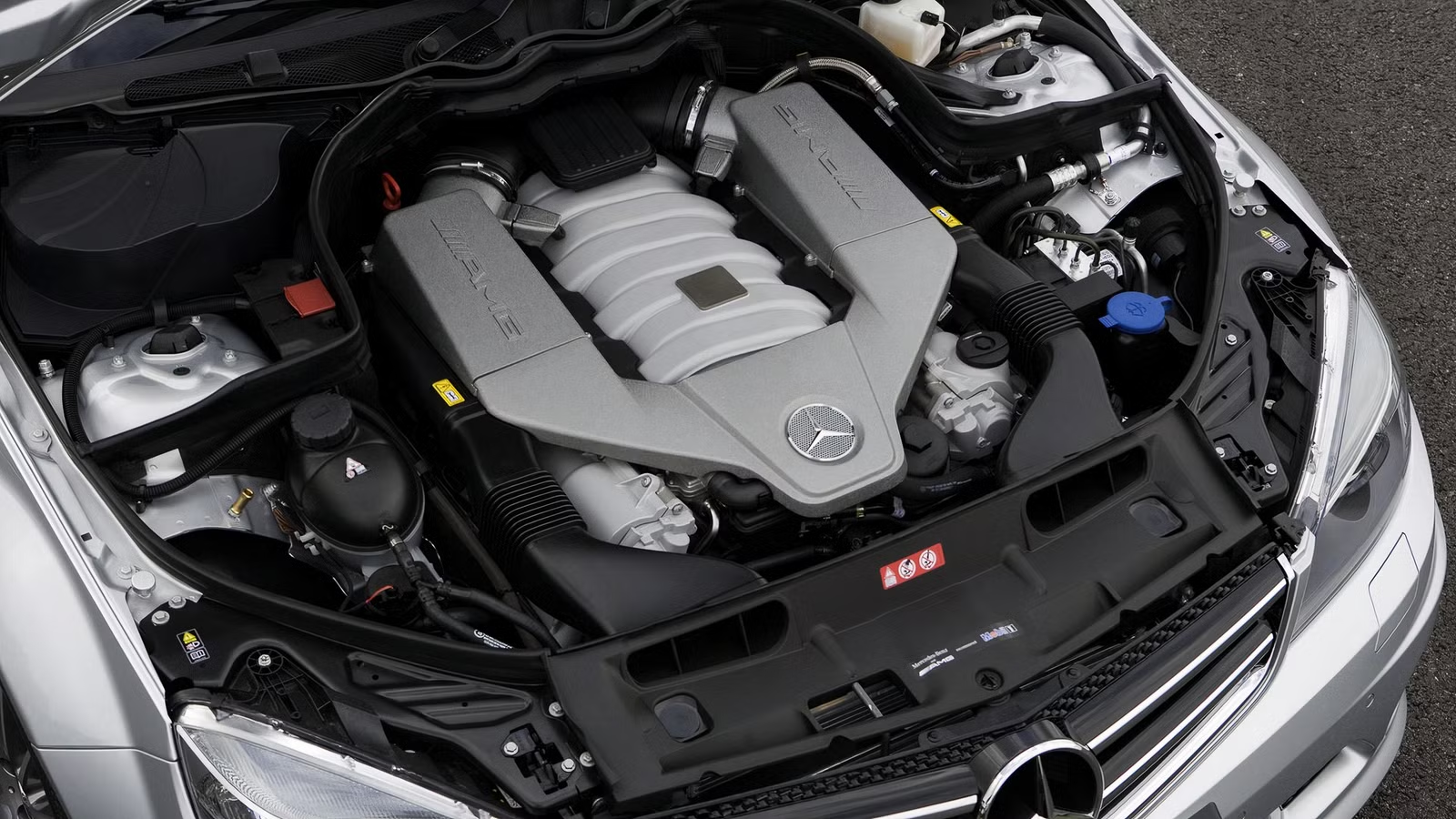
Mercedes-Benz and AMG have gained worldwide recognition thanks to their dedication to mechanical precision, structural integrity, and constant technological innovation. The partnership’s early units represent sophisticated fields of engineering. Industrial standards were developed through careful research, the use of advanced manufacturing tolerances, and thorough durability testing.

This duo prioritizes structural reinforcement, ensuring their engines maintain performance even under harsh driving conditions. Together with strict quality control systems, they used autobahn test facilities to verify high-speed stability and mechanical durability. After decades of technical leadership, Mercedes-Benz has become the global standard for performance engineering.
How Mercedes-Benz And AMG’s Relationship Began
Mercedes-Benz built up its initial reputation by producing luxury passenger cars that prioritize ride comfort, strong safety features, and refined mechanical design. AMG was established in 1967 as an independent performance tuning company by two former Mercedes-Benz engineers. Working outside the corporate rules, AMG altered Mercedes-Benz’s engines and chassis for use in competitive motorsport. The tuning firm achieved notable victories in endurance racing which attracted wide international interest.

This resulted in an increasing global demand from consumers for executive cars that were factory-produced, high-performance models. Mercedes-Benz entered a formal cooperation agreement with AMG in 1990. This strategic arrangement enabled the performance models developed by AMG to be sold, financed and serviced directly via the large and widespread network of Mercedes-Benz dealerships. Mercedes-Benz acquired full ownership of AMG and established Mercedes-AMG as its official high-performance division.
AMG’s First Standalone Engine

Introduced in 2006 and appearing in the 2007 E63 AMG, the M156 6.2-liter V-8 engine represented a major change in the architecture of the Mercedes-AMG range. The M156 was the first power unit AMG designed from scratch rather than being based on a Mercedes‑Benz production engine.
The AMG engineers abandoned supercharging in favor of developing a naturally aspirated, high-revving engine that could provide immediate throttle response throughout the powerband. The design included four valves per cylinder, dual overhead camshafts for each cylinder bank, and a rigid closed-deck crankcase made of aluminum alloy.
Built Using Race Car Parts

The M156 has a special lightweight aluminum bedplate crankcase with cast-iron main bearing caps, which provides excellent structural stiffness at the bottom end and lets it handle the huge internal rotational stresses. To avoid heavy conventional iron cylinder liners without compromising durability, AMG used advanced Twin Wire Arc Spraying. Engineers applied it directly to the internal surfaces of the aluminum cylinder walls, producing a low-friction, extremely hard iron coating.
Air management is handled by a highly advanced magnesium dual-stage variable intake manifold that continuously adjusts the length of the intake runners to optimize low-end torque output without compromising high-speed airflow efficiency. Additionally, continuous variable valve timing is used on all four camshafts to provide precise control over intake and exhaust timing, delivering throttle response right up to the engine’s 7,200-RPM redline. The engine features lightweight forged aluminum pistons, a fully counterbalanced forged steel crankshaft, and high-flow cylinder ports.
The Pinnacle Of The M156’s Performance

The M156 engine reached its peak with the 2012 W204 C63 AMG Black Series coupe. To achieve this, AMG engineers made substantial modifications to the internal rotating components by using lighter forged pistons, improving the forged connecting rods, and incorporating a special lightweight crankshaft which was taken directly from the Mercedes-Benz SLS AMG platform. As a result of these internal improvements, the engine’s maximum power output rose to 510 horsepower at 6,800 RPM and 457 pound-feet of torque at 5,200 RPM.
Power is sent to the rear wheels via a seven-speed AMG Speedshift multi-clutch transmission. This replaces the conventional hydraulic torque converter with a compact wet start clutch in order to enable fast gear changes. It took 3.7 seconds to go from 0 to 60 MPH, completed the quarter-mile in 11.7 seconds at a speed of 121 MPH, and attained a top speed of 186 MPH as limited by the speed governor.
It’s An Expensive German Engine To Maintain

Since the M156 V-8 engine has very tight internal manufacturing tolerances and operates at high speeds and under high stress, it is essential to strictly follow the scheduled maintenance procedures to keep the engine in top working order. Filters should be replaced every 7,500 miles or every year, using special synthetic engine oils that conform to the factory’s strict quality standards. The engine needs almost 10 quarts of oil, so a regular oil change at independent specialist repair shops costs between $200 and $350.
High-performance spark plugs should be replaced every 50,000 to 60,000 miles. Parts and labor typically cost $400–$600. For the seven-speed gearbox, it is advised to flush the transmission fluid and filter every 40,000 miles, at an average cost of $500 to $800 per service. Comprehensive annual maintenance checks, which include replacing both engine air filters, flushing the brake fluid, inspecting the accessory drive belt, and carrying out system scans, usually amount to between $1,200 and $2,500, so careful financial planning is essential if one is to own these high-performance German vehicles in the long term.
Issues That Are Common And Expensive To Fix

Even though the M156 engine had remarkable power output and a famous exhaust sound, the initial batches of the engine suffered from engineering defects which resulted in serious mechanical failures. Most important of these was the fact that the factory-made two-piece cylinder head bolts used on engines manufactured from 2007 up to mid-2011 were very prone to corrosion and to breaking under the stress of thermal expansion. When the head bolts broke, coolant was able to pass through the cylinder head gasket and enter the combustion chambers, leading to severe engine hydrolock and total destruction of the cylinder head.
This also led to premature wear due to insufficient surface hardness in the hydraulic valve lifters and on the camshaft lobes, causing serious engine ticking, flaking of metal, and ignition misfires. Because of these ongoing mechanical problems, owners affected by them brought a significant federal class-action lawsuit against Mercedes-Benz USA in 2011, claiming that there were known defects in the product and that potential repair problems had been concealed. Even though the federal courts eventually dismissed the case since the plaintiffs did not satisfy the particular legal standing requirements, the extensive publicity caused Mercedes-Benz to modify the design of the cylinder head bolts, which left thousands of owners of the early models having to pay out of pocket to fit the improved parts.
How AMG Evolved This Engine For The SLS

The M159 engine was developed by AMG specifically to power the flagship SLS AMG supercar as a highly specialized and ultra-high-performance version based directly on the M156 engine. Even though both engines had the same displacement, the M159 substituted the conventional wet-oil sump with a special dry-sump lubrication system. This modification enabled the engine to be mounted much lower in the chassis, thus reducing the center of gravity, and at the same time prevented oil starvation when experiencing intense lateral cornering forces.
The M159 also had its intake system completely re-engineered, with individual internal throttle butterflies, optimized magnesium intake plenum runners, and exhaust headers that allowed improved exhaust flow. Inside the engine, AMG engineers fitted strengthened forged pistons, reinforced the crankcase main webbing, altered the camshaft profiles for higher lift, and used lighter valve-train components. As a result of these extensive racing modifications, the M159 was able to rev higher and achieved a power output of up to 622 horsepower in the final Black Series version, exceeding the standard M156 in pure power output, high-rpm endurance, and track performance.
Sources: Mercedes-Benz, AMG, Euro Premium Parts, RepairPal, and Piston Heads.

Related posts



Latest Post


No Comments