
Honda Charged $15,000 For The RC30 In 1990, That Now Looks Like The Deal Of The Century
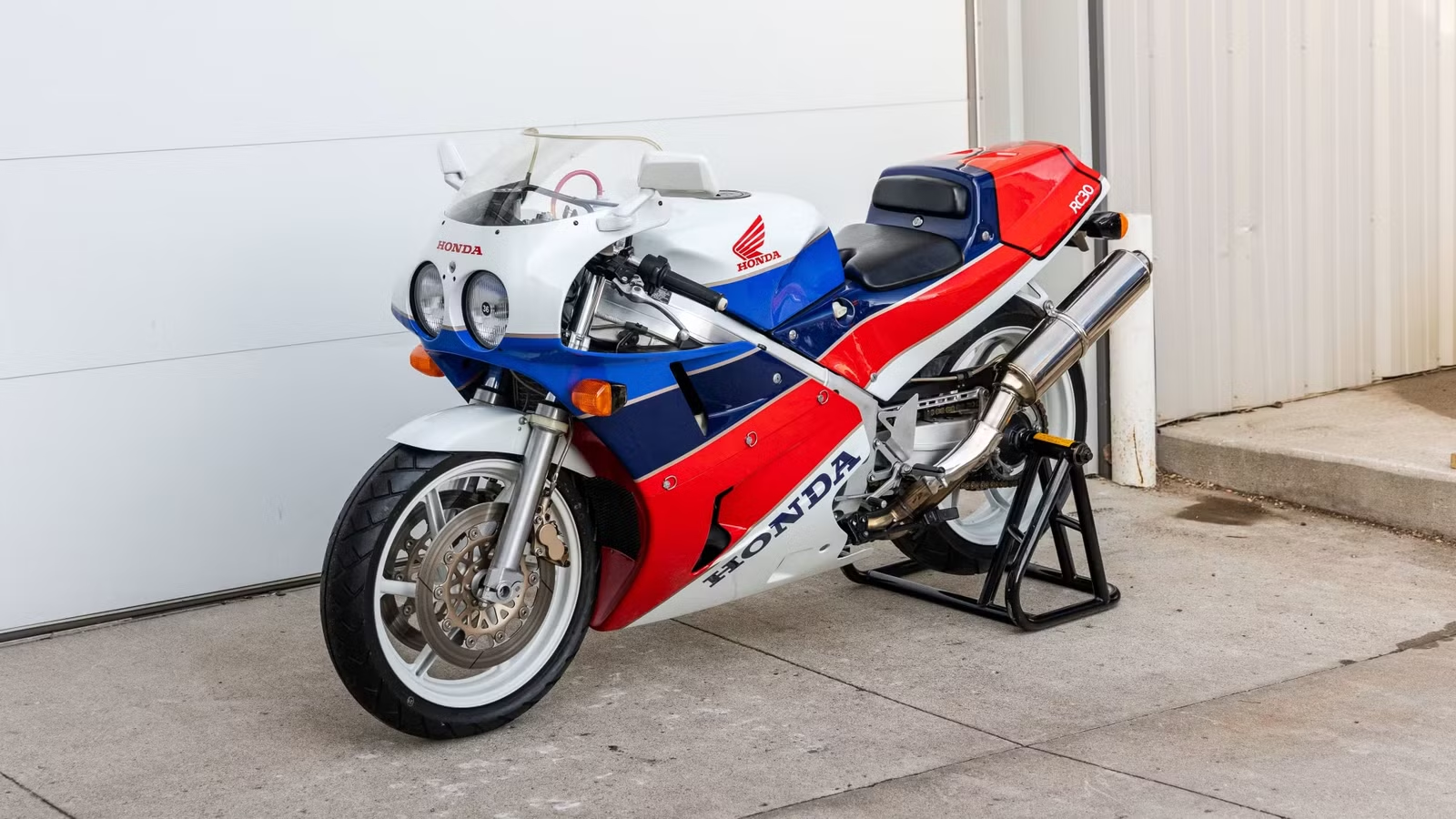
In an effort to join the newly formed Superbike World Championship (or WorldSBK today) in 1988, Honda developed one of the most incredible homologation specials. The RC30 would go on to win both the rider and manufacturer titles in 1988 and 1989. For the 1990 model year, Honda offered this race-proven machine in the US for the princely sum of $15k.
The Honda RC30 Was A Race Bike With Lights

While the RC30, also known as the VFR750R, is a street-legal motorcycle, it features a host of track-focused enhancements. Its twin-spar aluminum chassis might seem unremarkable today, but it was one of the first race-bred machines to popularize this kind of chassis. It also featured a single-sided swingarm that helped aid quick tire changes in endurance racing, and made it look that much more exotic.
Along with the race-bred chassis, it also had a race-bred V4 engine with lightweight internals, adjustable suspension, and hand-laid fiberglass-reinforced body panels. If you knew what you were buying, $15k was an absolute bargain. Adjusted for inflation, it translates to just under $40k, which is actually slightly less than what you would pay for a modern WorldSBK homologation special.
Honda Was Obsessed With The V4 Engine Configuration
Power: 112 – 130 Horsepower


The engine itself is actually closely related to the VFR750F’s V4. Part of this is down to how overengineered this particular lump was. It was built in response to the failure of the previous VF750F (sometimes it feels as though Honda wanted to confuse everyone with the way they named their bikes) engine, which suffered from premature cam failure. Honda were embarrassed by this rather public failure, and the entire engineering kitchen sink was thrown at the subsequent VFR model in an effort to ensure that this didn’t happen again. Today, these engines are known for their durability. They feature gear-driven overhead cams. A costly, yet robust feature that works both on the street and on the track.

From the outside, these engines look pretty similar, but there are significant internal differences to the RC30. The RC30 has racy titanium conrods, which reduce reciprocating mass, and it has a 360-degree “big bang” crankshaft as opposed to the 180-degree crankshaft found in the street bike. The cylinder heads represent the biggest change, with the RC30 making use of a more modern bucket tappets which allowed for a more compact head design (although the regular VFR750F would eventually adopt this design).
As a result of these track-focused changes, the original VFR750R was able to produce 112 horsepower back in 1987, and the RC30, which arrived in the US by 1990, made 118 horsepower. An HRC race kit was also offered, and if equipped, that power figure reportedly went up to around 130 horsepower. By modern standards, this figure may seem unimpressive, but it was more than enough for the RC30 to be competitive on track back in the early 90s.
The US-Market RC30 Is A Little Different To The VFR750R Sold In The Rest Of The World
Price Range: $40,000 – $50,000

Aside from the fact that the RC30 was a little more powerful, it also had a few cosmetic differences to the VFR750R. The most apparent being the fact that it came out with a rather subtle RC30 logo on the tail section, as opposed to the bold VFR750R which was emblazoned on the tail section of the global release. Its Honda wing was also red, as opposed to the yellow wing found on the global release.

With thousands of these motorcycles leaving the factory, it is by no stretch of the imagination a rare bike. But, only 316 RC30s were officially sold in the US. As such, any original US-market RC30 is worth a fair bit more than any of the imported VFR750Rs. Depending on the condition, these bikes are selling for between $40 and $50k, which means they have actually beaten inflation! This is around $10k more than what you would need to fork out for a VFR750R in similar condition.
For those who don’t really care where the bike came from, it is important to note that any Japanese-market bikes may still be restricted to 76 horsepower (a legal requirement back when they came out). By now, most of these bikes would have either been fitted with a race kit of some sort (not necessarily the HRC kit) or have simply been derestricted, but you will need to verify this with the seller if you choose to go in this direction.
The Original WorldSBK Homologation Special

While there were most certainly homologation bikes before the WorldSBK came into being, the race series has given us a steady supply of race-ready machinery. It all started with the RC30/VFR750R, as Honda sought to finally compete on the global stage with a four-stroke motorcycle. While they had long since conceded that the only way to compete in GP racing at the time was to use a two-stroke machine, this was not the “Honda way.” To a company that openly hated two-stroke technology, returning to winning ways with a four-stroke V4 superbike was the stuff of dreams.
By winning both the 1987 and 1988 championships, this dream was realized for the brand. A decade-long itch had been scratched, and although the 1990 model year would be the final year of production for this incredible motorcycle, they remained competitive in races all over the world for several years to come. It helped normalize the twin-spar aluminum chassis for sport bikes, and even though 488 pounds might not seem all that light by modern standards, handled better than pretty much any other race machine back then.
The RC30 had a fairly brief reign at the top of superbike racing, but it represented a return to form for Honda, and paved the way for future racing success. Although we no longer get a Honda V4 street bike, or homologation bike for that matter, Honda’s obsession with the V4 was eventually vindicated. This configuration has proven to offer the highest performance ceiling, and is the engine configuration of choice for every single MotoGP team on the grid today.
Source: Iconic Motorbike Auctions and Cycle World Magazine (February 1988)

Related posts

Latest Post


No Comments