
The Temerario’s Hybrid V8 Is Lamborghini’s Most Radical Powertrain Shift In Decades—Here’s What The Numbers Say
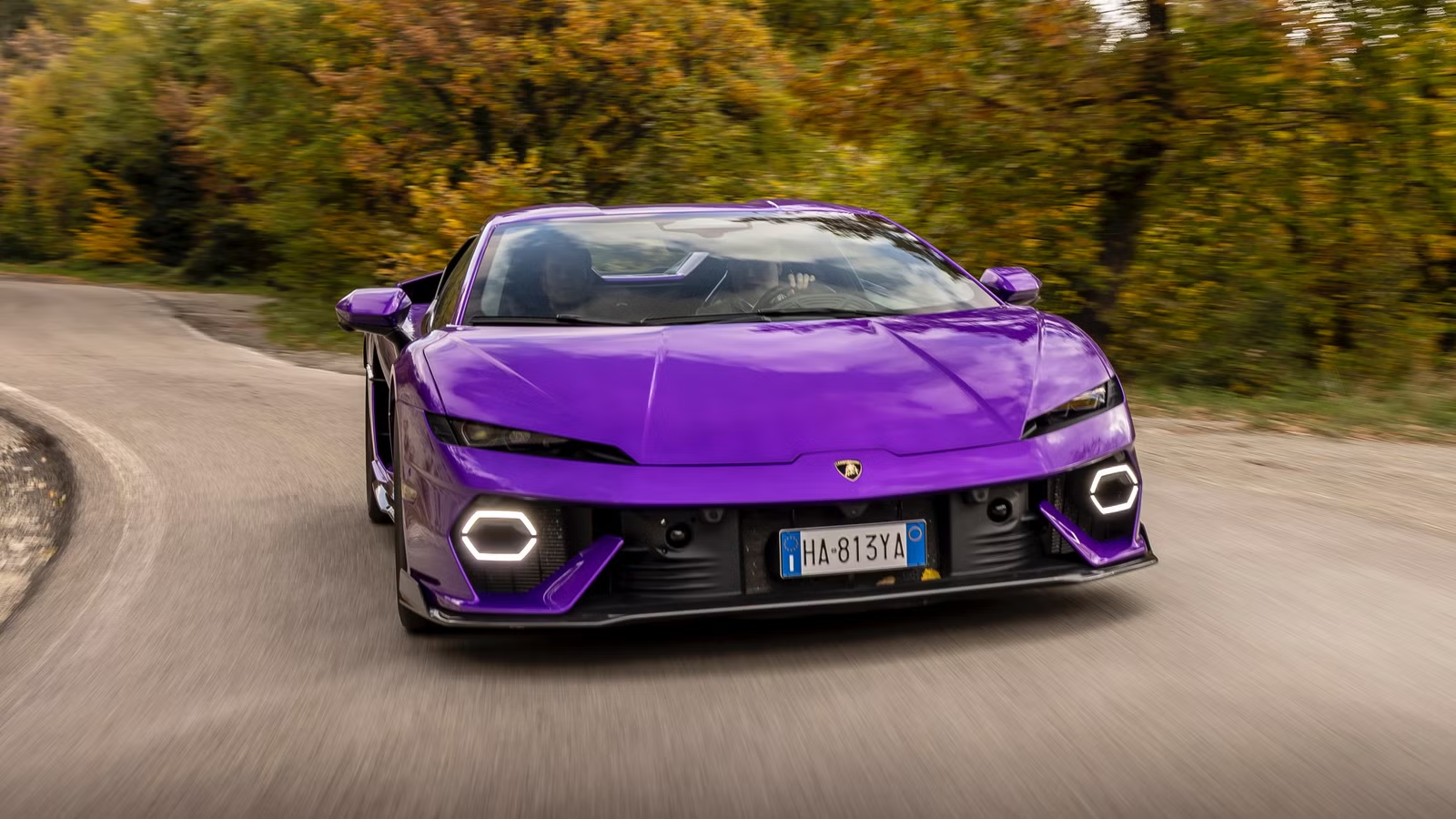
Lamborghini’s Temerario arrived with a lot to prove. The Huracán’s naturally aspirated 5.2-liter V10—a 630-horsepower screamer that revved past 8,500 rpm and defined an era of Sant’Agata supercars—is gone. In its place sits a twin-turbocharged 4.0-liter V8 paired with a hybrid system, a combination that would have seemed unthinkable from Lamborghini even five years ago. Car & Driver’s full road test of the 2026 Temerario, published this week, puts confirmed numbers to what was previously spec sheet speculation.

The headline finding from the review: the Temerario doesn’t act like the junior supercar of the lineup. That’s a meaningful statement from a publication that has tested everything from the Murciélago to the Urus, and it reframes the powertrain debate. The question was never really whether a turbo-hybrid V8 could make big numbers—it was whether it could make the right numbers, in the right way, at the right moments.
What The Temerario’s Hybrid V8 Actually Produces
The Temerario’s powertrain pairs a twin-turbocharged V8 with an integrated hybrid system, with the combined output representing a substantial step beyond the Huracán STO’s 631 horsepower. The hybrid component isn’t a fuel-economy measure—it’s a performance tool, filling the torque curve in the low-to-mid range where a high-revving naturally aspirated engine traditionally runs lean. That’s the core engineering logic behind the switch: where the V10 built power progressively toward its redline, the hybrid V8 delivers a broader, flatter torque band from lower in the rev range.

Acceleration figures from Car & Driver’s test confirm the formula works on paper and on the road. The Temerario’s 0–60 mph time positions it squarely in the company of the Huracán Performante and above, which is notable given that the Temerario is nominally the entry-level model in Lamborghini’s current two-car supercar lineup. The Revuelto—the V12 hybrid flagship—remains the range-topper, but the gap between the two cars is narrower than the price difference might suggest.
The Character Question: Does Forced Induction Change What Lamborghini Feels Like?

This is where the debate gets genuinely interesting. Naturally aspirated engines—particularly high-revving ones like the Huracán’s V10—have a specific character that turbocharged motors have historically struggled to replicate. The power builds linearly with rpm, the throttle response is immediate and unfiltered, and the engine note climbs in pitch as the revs rise. Turbocharging changes all of that: boost builds with a slight delay, peak torque arrives early and holds flat, and the acoustic character is fundamentally different.
Car & Driver’s review suggests the Temerario manages this transition better than skeptics expected. The hybrid system’s electric motors can mask the turbo lag that would otherwise blunt the throttle response, delivering near-instant torque while the turbos spool. Whether that electronic intervention fully replicates the analog feel of the V10 is a matter of driver preference—but the performance outcome, by the numbers, is not in question. What Lamborghini has built is a faster car. Whether it’s a more satisfying one depends on what you value at the limit.
How The Temerario’s Formula Stacks Against Ferrari, Porsche, And McLaren

Lamborghini is not alone in making this shift. The hybrid supercar formula is now the competitive baseline in this segment, and the Temerario enters a market where its closest rivals have already committed to electrification in various forms.
Ferrari’s SF90 Stradale pairs a twin-turbocharged V8 with three electric motors for a combined 986 horsepower—a more aggressive hybrid integration than the Temerario’s system, and one that prioritizes outright performance over driver engagement at the expense of some analog character. Porsche’s 911 hybrid takes a different approach: a smaller electric assist layered onto a familiar flat-six, preserving the 911’s traditional feel while adding low-end punch. McLaren’s Artura uses a twin-turbo V6 hybrid, making it the lightest and most focused of the group but also the least powerful at the top of the range. The Temerario sits between these philosophies—more visceral than the 911 hybrid, more driver-focused in its intent than the SF90, and more powerful than the Artura in base form.

What distinguishes Lamborghini’s approach is the emphasis on keeping the car’s personality intact despite the powertrain overhaul. The Temerario’s chassis, steering, and overall dynamic balance have been tuned to complement the hybrid V8’s delivery rather than simply accommodate it. That’s a harder engineering problem than raw output, and Car & Driver’s assessment suggests Sant’Agata got it right.
The Temerario’s twin-turbo hybrid V8 isn’t a concession to regulation or a softening of Lamborghini’s identity—it’s a recalibration of what that identity means in 2026. The V10 era produced some of the most emotionally compelling supercars ever built. The numbers from Car & Driver’s test suggest the Temerario is ready to start its own chapter.

Related posts


Latest Post


No Comments