
The First American Car With Fuel Injection
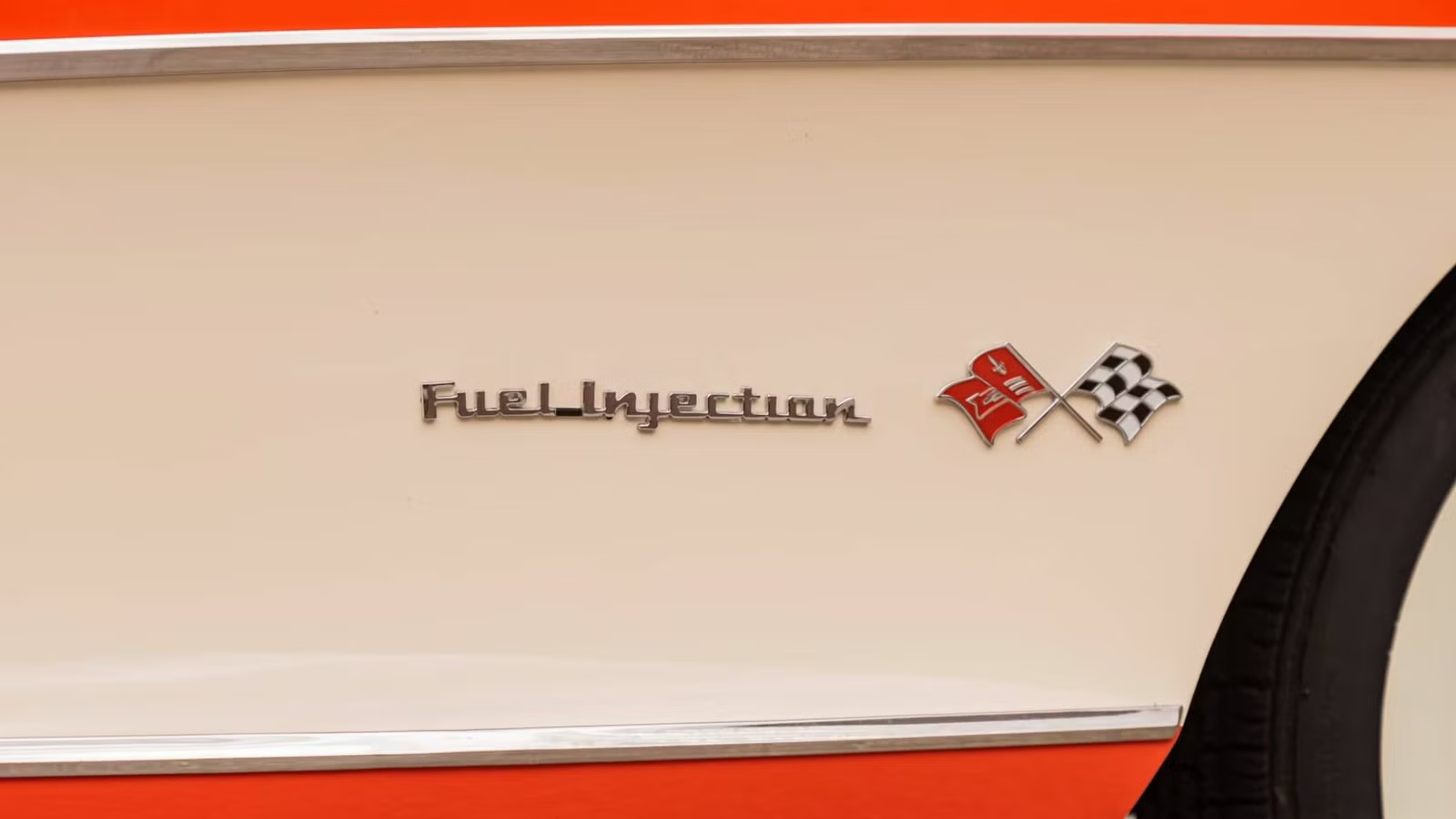
By late 1956, Detroit’s horsepower war had reached the point where a bigger carburetor was no longer news. Three American automakers were chasing something better, and each was racing to put fuel injection on a production engine before the others could claim the milestone.

Two of them would fail in public, with one system never reaching a single customer and another recalled and converted back to carburetors. Only one company delivered injected cars into customer hands, and it did so more than a year before anyone else. Its fender badge said just two words.
Three Automakers Chased Injection And Only One Delivered
The push toward fuel injection began with engineers who had served in the military and watched the technology work on diesel and aircraft engines during the war. Many of them returned to the auto industry determined to bring those same benefits to American production cars. The global first was already taken, since Mercedes-Benz had launched the 300 SL in 1955 with a Bosch mechanical direct-injection system derived from diesel practice.

The first American contender was AMC, which announced the Bendix Electrojector for the 1957 Rambler Rebel at a quoted price of $395, per Ate Up With Motor. The electronic system appeared in Rebel brochures and was displayed alongside the car at the 1957 New York Auto Show. But cold-start problems meant no injected Rebels were ever delivered to customers.
Chrysler tried next, offering the Electrojector from September 28, 1957 on the 300D, DeSoto Adventurer, Dodge D-500, and Plymouth Fury. The Auto History Preservation Society records that the injected cars themselves were built between January 20 and July 15, 1958, while Hagerty cites factory records showing 54 cars took the $600 option before failing capacitors and AM-radio interference ended the program. While both electronic efforts stumbled, one GM division had already been building injected cars since November 1956.
The 1957 Chevrolet Corvette “Fuelie” Beat Everyone By 13 Months

The first to deliver was the 1957 Chevrolet Corvette “Fuelie”, the lead application for the Rochester Ramjet system that Chevrolet offered across its entire 1957 lineup. That makes it the first American production car delivered to customers with factory fuel injection, a claim RM Sotheby’s states plainly in its auction history of the model. The Ramjet ran in Corvettes from 1957 to 1965 and in full-size cars like the Bel Air from 1957 to 1959.
The dates back it up. Vette Vues documents roughly twelve pilot RPO-579 fuelie Corvettes built at the St. Louis plant, with issues corrected before regular production began on November 1, 1956, and one of those pilot cars was sold to a private buyer in December 1956. Chevrolet announced the Ramjet publicly on December 6, 1956.

Corvette historian and former GM engineer Ken Kayser, who wrote the definitive history of the Ramjet program, documents regular RPO 579 production beginning on November 1, 1956, following a pilot build of roughly a dozen cars at St. Louis. One of those pilot cars was sold to a private buyer in December 1956, per Vette Vues, and the National Corvette Museum confirms injected factory race cars were competing at Nassau by December 7, 1956.
Set that against Chrysler’s timeline and the gap is stark, since the first Electrojector car was not built until January 20, 1958, roughly 13 months after fuelie Corvettes entered regular production. The system itself was developed by John Dolza, E.A. Kehoe, Donald Stoltman, and Corvette chief engineer Zora Arkus-Duntov, and manufactured by GM’s Rochester carburetor division, per Hagerty. Tachometer Publishing credits GM executive vice president Harlow Curtice with deeming injection a “future technology,” though Chevrolet, not a premium nameplate, became the first application.

A period road test archive at Curbside Classic suggests Chevrolet rushed the system to market partly out of concern over all-new Plymouth and Ford rivals. Pontiac’s Bonneville received a Rochester-injected 347 in mid-1957, using the same supplier but arriving after Chevrolet’s production start.
How Chevrolet Hit One Horsepower Per Cubic Inch First

The Rochester Ramjet was simpler in concept than the Mercedes system it answered. Per Hagerty, it consisted of just three main components in the form of an air meter, a fuel meter, and a manifold, while Chevy Hardcore notes that Chevrolet chose a port mechanical injection layout rather than the complex diesel-style direct injection Mercedes used. Bolted to the new 4.6-liter (283 cubic-inch) small-block, it produced a number that changed American engine marketing forever.
That number was 283 horsepower, making the injected small-block the first American production engine to offer one horsepower per cubic inch. The Museum of American Speed lists the recipe as 10.5:1 compression paired with a competition-type camshaft and a high-speed valve system. Chevrolet’s own advertising, quoted by Fuel Curve, declared it the first American production car to reach the goal.
Per Corvette Magazine, a fuelie equipped with the optional 4-speed manual and a 4.11:1 limited-slip rear could hit 60 mph in 5.7 seconds, run the quarter mile in 14.3 seconds, and top out beyond 130 mph, numbers that put it among the fastest production cars of its era. The factory rating also ran conservative, with the top engine actually delivering closer to 290 hp than the advertised 283 hp.
Why Fewer Than 1 In 6 Corvette Buyers Chose The Fuelie

The fuelie’s biggest enemy was its window sticker. The $484.20 option cost roughly one month’s salary for the average American in 1957, according to Corvette Magazine, and CorvSport calculates that figure at about 15% of the car’s total price. For context, the base Corvette started at $3,176, while the 270-hp dual-quad engine cost just $182.95, which made the injection premium a hard sell for 13 extra horses.
Exactly how many buyers paid up is genuinely disputed. Some put the figure at 240 units out of 6,339 Corvettes built, Corvette Magazine counts 713 buyers, and RM Sotheby’s reports 1,040 fuelies were sold in 1957, a spread likely explained by whether each source counts all injected engines or only certain versions. Whichever number is right, fuelies were a small fraction of an already low-volume car.
Reliability did not help the cause. Hagerty describes a system rife with hidden complexities that left even skilled mechanics tearing their hair out, with some cars losing their pricey injection setups to a carburetor or three. Corvette Report confirms that disgruntled customers had fuelies retrofitted with carbs at their own request. The rarest version was the RPO 579E “Airbox” car, which added cold-air induction and a column-mounted mechanical tachometer, with only 43 built per Over-Drive Magazine.
The Failed System That Ended Up Powering Every Modern Car

The Ramjet’s victory lap was shorter than its head start suggested. Reports suggest it was dropped from Chevrolet’s passenger lines after 1959 and survived as a Corvette option only through 1965, when Chevrolet itself walked away. The big-block cubic inches made horsepower far more cheaply than a complex fuel delivery system ever could.
The stranger ending belongs to the losers. The Electrojector, the system that could not reliably start a Rambler in cold weather, is now regarded as the father of modern engine management. Its patents were sold to Bosch, which developed them into the D-Jetronic system introduced in 1967, the direct ancestor of the electronic injection running in effectively every car on the road today.
The two companies that lost the race showed where the industry was headed, while the winner’s mechanical system became a dead end within a decade. The market has never held that against the Corvette, though. Classic.com reports that the average value for a 1957 283-hp car sits at $103,591, with exceptional examples reaching $170,000. Mechanical injection got there first, electronic injection got there forever, and the 1957 Corvette owns the date-stamped title either way.
Sources: Chevrolet, Mecum, RM Sotheby’s, Hagerty, National Corvette Museum, Classic, Corvette Magazine

Related posts



Latest Post



No Comments