
The Motorcycle That Quietly Became Suzuki’s Greatest Strength
Of all the powerplants manufacturers develop, most only survive a couple of generations before emissions standards, market trends, or innovations force manufacturers to move to something different. But once in a while comes a powerplant that’s so good, it survives over 2 decades, becoming a company’s greatest strength. Here’s the story of such a powerplant with Suzuki embossed on it, and the sports, street and sports touring bikes it has powered since its inception.
Suzuki Is Known For Three Qualities In 2026

Suzuki has come a long way since its early days and the speed wars. Today, it focuses not on offering the fastest motorcycle in the world, though it still has some bikes that remain among the fastest. At the same time, Suzuki lags behind the competition in innovation. Instead, the manufacturer relies on tried-and-tested formulas to pack its bikes with components that don’t fail and keep the price down. As a result, Suzuki today holds a market position synonymous with three qualities.
Real-World, Usable Performance

The first of which is real-world, usable performance. Unlike some of its rivals that focus on spec sheet numbers or circuit lap times, Suzuki focuses on offering performance that is actually usable on the road. The GSX-R1000 is the perfect example of this. Despite being a liter-class superbike, comfort and usability are impeccable for a machine of its kind. It even inspired a certain German RR.
Overengineered Reliability

Next up, Suzuki is known for overengineered reliability. Instead of adding experimental tech to its bikes, Suzuki uses tried-and-tested components that have proven themselves before implementing them on its road-going motorcycles. That does mean Suzuki is usually the last mover in the market, but it also gives its bikes excellent reliability. It’s the reason why Suzuki, along with Honda, dominates the charts when it comes to reliability. Think SV650, V-Strom 1050, and GSX-R750!
Value For Money


Finally, we come to the value proposition. Suzuki motorcycles are among the most value-oriented products in the market. Given the brand’s last-mover strategy, keeping costs down is essential to attract a crowd already spoiled by great options. This has become a double-edged katana (pun intended) for the brand, though, as its accessible pricing means Suzuki sports bikes often fall into the hands of squids.

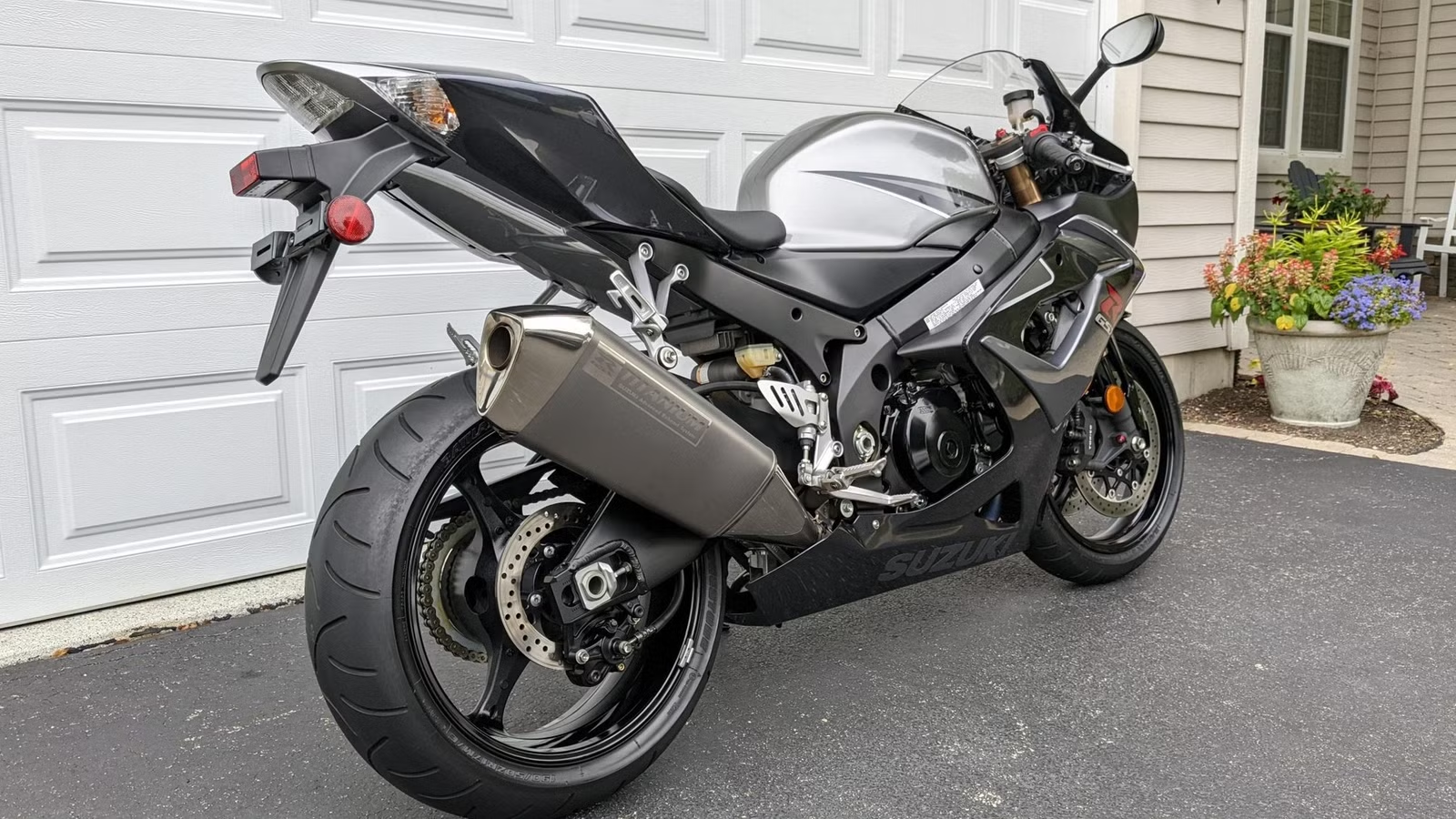
All Suzuki motorcycles embody these qualities, but none do so quite like the 2005 Suzuki GSX-R1000 K5, among the most influential superbikes ever produced. In fact, this bike is so legendary that it set the blueprint for the most iconic sports bike of the 2010s, and even today its soul lives on in the current crop of Suzuki’s street and sports-touring bikes: the GSX-S1000.
This Is The Suzuki That Embodies These Qualities To The T

The early 2000s saw the rise of the liter-class superbike segment, and to keep up with competition, Suzuki launched the GSX-R1000, based on the GSX-R750 that debuted a year earlier. As good as this bike was, it wasn’t perfect. It faced the same problems the GSX-R750 faced: weight. The original GSX-R750 was a benchmark in terms of power-to-weight ratio, but over time, the GSX kept on getting heavier due to liquid cooling and a new twin-spar frame.
The K5 GSX-R Was Designed To Reverse The Damage

Enter the 2005 GSX-R1000 K5, an engineering marvel of its time. This bike was designed to undo the damage and bring the GSX-R back to its roots. It featured a brand-new 999cc inline-four engine with a bore and stroke of 74.3 x 59 mm and a 12.5:1 compression ratio. It was 4 pounds lighter than the previous model, thanks to lightweight titanium valves, lighter pistons, and strengthened crank and rods. It also featured chrome-nitride rings inside the SCEM-lined cylinders.

By all means, this powerplant was a significant step-up from the older K3 and K4 models. It produced 175 horsepower at 11,000 RPM and 87 pound-feet of torque at 9,000 RPM, but it’s how it delivered that power that made it special. Thanks to its long-stroke design, the engine produced a uniquely linear power delivery with mid-range grunt to help you blast out of corners. It also gave the bike incredible acceleration, with a K6 (2006 version of the K5) managing 0 to 60 miles per hour in just 2.35 seconds!

That performance was paired with a new twin-spar frame that was lighter than ever and featured a shorter wheelbase. The entire setup of the K5 weighed just 365 pounds, a whole 30 pounds lighter than the original 1985 GSX-R750. Finally, Suzuki had clawed back to the top of the liter-class chain with the best power-to-weight ratio in the class, undoing a decade of compromises.


Nothing at the time could compare to the K5, not on paper and not on track. While the brutal ZX-10R, the stylish R1, and the RCV-inspired Fireblade made the headlines, the K5 was the silent killer. Reviews of the time suggest the GSX-R1000 was far more controllable than the much more unforgiving ZX-10R, packed more mid-range than the crossplane R1 could only dream of, and felt more spirited than the mild Fireblade.
Among The Most Important Suzukis Ever Made

It’s no wonder that the K5 is still well-regarded and recognized as among the best sports bikes ever made. Despite being a top-of-the-line superbike, it offered usable real-world performance thanks to its mid-range grunt. Plus, the engine was overbuilt in true Suzuki fashion, which meant it could take track abuse all day long without a groan. And it was proper value for money when new. In fact, the K5 was so good, BMW reverse-engineered it to develop the S 1000 RR, which went on to be recognized as the ultimate superbike of the following decade.
The GSX-R1000 K5 Was A Blip In Superbike History

The GSX-R1000 K5 is a blip in superbike history as the last true analog superbike. By the time the K7 was introduced in 2007, Euro 3 emissions standards had already come into effect, forcing Suzuki to change the engine configuration. The K7’s inline-four engine displaced 998.6cc with a slightly narrower bore. While it produced 182 horsepower, the bike also gained a whopping 14 pounds due to its new exhaust system designed to meet emissions regulations. And it featured calmer steering geometry, which diluted the bike’s riding experience.

Things only got worse with the 2009 GSX-R1000 K9, which was often referred to as the “pup” (because K9 sounds like “canine”) when the bike failed to meet expectations. The K9 featured a brand-new engine with a host of technical updates, including higher compression, a larger bore and shorter stroke, and a stacked gearbox. While still sticking to the K5’s formula of long-stroke grunt, the K9 had lost its appeal and fallen off the radar. The K9 and, later, the 2012 L2 models would be the last of the old-school long-stroke GSX-R1000s.

Then came the GSX-R1000 L7, which is the one still in production today. This bike features an engine with a bore and stroke of 76 x 55.1, which is a significantly shorter stroke than the K5’s powerplant. The bike also runs a higher 13.2:1 compression ratio, producing a healthy 192 horsepower. And the engine uses variable valve timing to keep the mid-range punch intact, but it still can’t match the K5’s simplicity in delivering linear power. Fortunately, that long-stroke character still lives on, only not in the GSX-R1000 models.
The K5’s Character Lives On In The Suzuki GSX-S1000 Models

Everything that made the K5 inline-four engine so special back then also made it ridiculously good for street bike and touring applications. Suzuki knows this, as a street-tuned version of the legendary K5 engine now powers Suzuki’s liter-class street bikes and sport-tourers. To be precise, the GSX-S1000’s engine is based on the K7, which was a slight evolution of the K5. The engine has been refined over 2 decades, featuring dual overhead cams, Twin Swirl Combustion Chamber (TSCC) design machined into the cylinder head, flat-top pistons, and camshaft profiles that decrease lift and valve overlap.

The result? The GSX-S1000 family of bikes delivers a respectable 150 horsepower on tap, with the engine’s long-stroke design offering a strong mid-range pull and real-world torque without relying on complicated variable-valve timing tech that would otherwise raise costs. And over 2 decades of refinements have made the already-bulletproof engine even more reliable. Among its peers, the GSX-S1000 models stand as generally more reliable and value-oriented without sacrificing performance.
The Current GSX-S1000 Lineup

The current GSX-S1000 lineup, powered by the K5 engine, consists of three models, starting with the GSX-S1000 at $11,989. This is Suzuki’s flagship naked sports bike, known for its lightweight design and aggressive stance. It offers liter-class performance with upright ergonomics and, with no fairing in place, it’s also much easier to live with in the city and work on. The GSX-S1000 is among the most underrated liter-class bikes on sale today.

Then comes the GSX-S1000GT+, starting at $14,399. This is the grand touring version of the GSX-S1000, and for many, it marks the return of big-bore sports tourers that were popular back in the day. This bike features a sharp fairing, slightly sporty ergonomics, and adjustable suspension, making it an excellent middle ground between a mile-muncher and a corner carver. Like its naked sibling, the GSX-S1000GT+ is also an underrated option in its segment.

At the top is the GSX-S1000GX+, with a sticker price of $18,749. This is the crossover of the family, combining ADV-like fairing, upright ergonomics, and longer suspension travel with sporty engine character. It also features Suzuki Advanced Electronic Suspension (SAES) that adapts to road conditions on the fly. And as you’d have guessed, this is an underrated model, but it’s quickly gaining popularity for its performance, reliability, and value-for-money proposition.
The K5 Legend Gave Birth To New Icons

That is how the Suzuki GSX-R1000 K5 became Suzuki’s greatest strength. Back when it was new, it helped the company undo a decade of compromises in weight savings while setting a new benchmark in liter-class performance. While its powerplant couldn’t survive tighter emissions standards, a detuned, refined version of it now lives on in Suzuki’s current crop of liter-class street and touring bikes. Who knows, the K5 might live another decade in more GSX-S models, maybe a neo-retro roadster this time inspired by the iconic Bandit?
Source: Suzuki Cycles

Related posts


Latest Post


No Comments