
The Most Underrated Mainstream Car With Real Performance Credentials
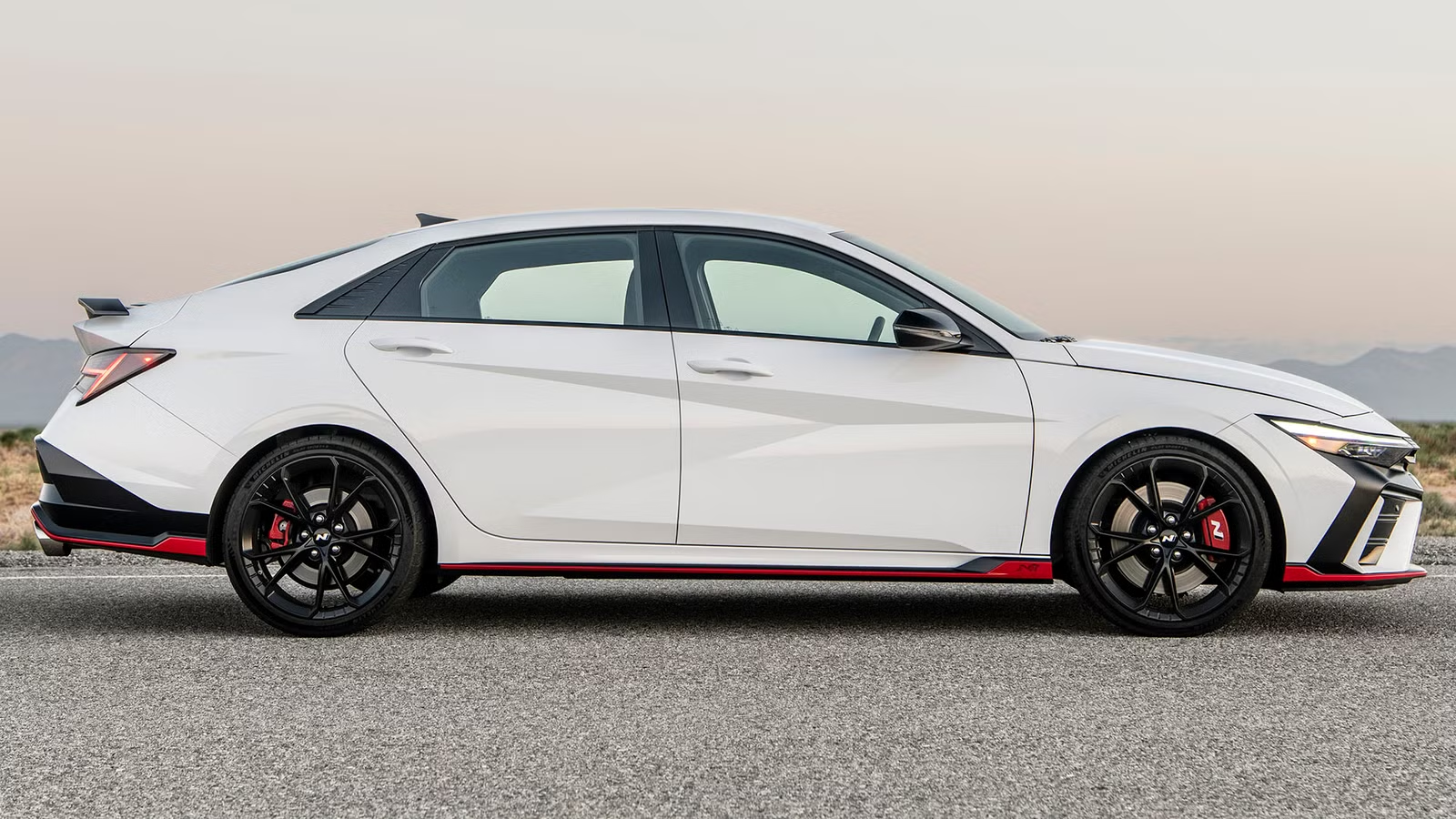
Pick any performance benchmark from the early 2000s and the Hyundai Elantra N will either match it or come embarrassingly close — for a fraction of the price. That’s a sentence that would have sounded absurd a decade ago, yet here we are. The sports sedan has always been the enthusiast’s secret weapon: four doors, room for the family, and enough firepower to embarrass cars that cost twice as much. The Mitsubishi Evo and Subaru Impreza WRX kicked the genre into high gear in the ’90s, bringing all-wheel-drive turbo performance to the masses, while cars like the bonkers Lotus Carlton demonstrated what a four-door could do in high-speed Autobahn trim.

By the turn of the millennium, ridiculously quick sedans were everywhere, offering near-supercar pace with enough room for the whole family and — if you opted for a wagon version — the Labrador too. Fast-forward another 20 years, and one underrated sedan changed the game again when it came to practicality, speed, and affordability, delivering supercar acceleration figures from a couple of decades prior — it’s just a shame that so few people talk about it.
The Super Sedans Of The 2000s and 2010s Set The Bar For Four-Door Performance
While the tuner car scene had gone into bling overdrive, the opposite was happening with sedans in the 2000s. This was the era of the shockingly fast four-door car that had all the visual presence of a taxi cab. BMW was fitting the E60 M5 with a Formula 1-inspired V10 S85 engine producing more than 500 horsepower.

Not to be outdone, Audi launched the C6 RS6 — essentially an A6 fitted with a twin-turbocharged V10 related to the unit found in a Lamborghini Gallardo. This two-ton executive express could hit 60 mph in 4.6 seconds, meaning the kids could have an extra bowl of cornflakes and still get to school on time. For reference, that’s exactly the same acceleration as a 2000 Ferrari 360 Modena with its 395-horsepower V8.
How This Mind-Blowing Performance Trickled Down To Real World Cars

Ferrari needed to up its game quickly, because this performance madness was trickling down to lesser cars fast. By the time the FK8 Honda Civic Type R arrived in 2017, this hot hatch packed a 2.0-liter turbocharged K20C1 engine with 306 horsepower and a 0–60 mph time of 4.9 seconds. The fifth-generation (A90) Toyota GR Supra arrived in 2019 with a sprint to 60 mph in 3.8 seconds and zero to 100 mph in only 9.5 seconds — figures comparable to the Corvette of the day. Even the humble Mazda Miata — a car that was never just about straight-line speed — reaches 60 mph in around 5.5 seconds these days.
The Hyundai Elantra N Offers Old School Super Sedan Speed For Hatchback Money

Hyundai Elantra N Specs
|
Engine |
2.0-liter turbocharged |
|
Power |
276 hp – 286 hp |
|
Torque |
289 lb-ft |
|
0-60 mph |
4.8 seconds (auto) |
Source: Hyundai / Independent tests
Enter the Hyundai Elantra N, a slightly forgotten Korean sedan that blows everything out of the water when it comes to speed, practicality, and affordability. Consider this: the Hyundai Elantra N has a turbocharged four-cylinder engine (276 hp and 289 lb-ft of torque) and will accelerate to 60 mph in 4.8 seconds — just 0.2 seconds off the twin-turbo V10 Audi RS6.
While the Elantra N doesn’t quite have the grunt of the 10-cylinder Audi over a quarter mile, its 13.4-second time is genuinely impressive, matching something like a Dodge Magnum SRT8 (13.5 seconds) — a car with a 6.1-liter Hemi V8 under the hood. Sharp-eyed readers will also notice that the Elantra N is only a shade slower to 60 mph than the Ferrari 360 of a couple of decades back — not bad for a budget sedan. Which brings us to price. The Elantra N starts around $35,000 new. For reference, that Audi carried a sticker of around $158,000, which was roughly in line with the Ferrari at approximately $153,500. If this is the democratization of horsepower, we’re all in.
The Elantra N Is Packed Full Of Tech

That supercar-matching speed comes from a fairly modest powerplant. The N sedan is powered by a 2.0-liter turbocharged GDi unit, paired with either an 8-speed wet dual-clutch transmission or a 6-speed manual (for our younger readers, that’s a gearbox you shift yourself). Handling is kept in check by an N Corner Carving Differential (e-LSD, electronic Limited Slip Differential), and the N also gets a Variable Exhaust Valve System and Launch Control as standard.
For DCT models, N Grin Shift (NGS), N Power Shift (NPS), and N Track Sense Shift (NTS) are all included as standard. No, Grin Shift is not a typo — in Hyundai N territory, it’s very much a real thing. The large red button on the steering wheel adjusts the automatic rev-matching feature on manual versions or, on automatic cars, unleashes the N Grin Shift overboost function, which delivers 10 additional horsepower (total: 286 hp) in 20-second bursts. This is exactly the kind of silliness we love.
Speed Isn’t Everything With The Elantra N

This is a car that is insanely quick but easy to live with and bags of fun. Reviewers have praised it for balancing a hint of wild rowdiness with a genuinely livable character. You can tell that the engineers took the job of setting up the car seriously — and were also allowed to have some fun along the way. Even the engine’s sound augmentation through the stereo speakers can be fine-tuned via an equalizer function.
Factor in competitive pricing, peace of mind (an extensive New Vehicle Warranty, an industry-leading Powertrain Warranty, 24-hour Roadside Assistance, and more), and a solid J.D. Power rating, and you have a performance vehicle without any of the pain and worry that came with fast cars of the past.
The Elantra N Is Seriously Underrated

Ask anyone to name their favorite fast small sedan or hatchback and you’ll likely hear the usual suspects. The Golf GTI, the Honda Civic Type R, and the Subaru WRX are all models steeped in history and ingrained in the minds of enthusiasts. Hyundai’s N brand has only been around since 2015, so perhaps it doesn’t carry the same cultural weight as a VW GTI for the person on the street — but it should. The Golf GTI hits 60 mph in 5.6 seconds with a dual-clutch automatic. The Subaru WRX starts around $33,000 and hits 60 mph in 5.4 seconds (CVT) or 5.6 seconds (manual).
The Honda Civic Type R will hit 60 mph in a similar 4.9 seconds to the Elantra, but it costs significantly more — starting above $48,000. Then there is the TCR version of the Elantra N, which promises to give its competition even more sleepless nights. This is the GT3-style variant of the sedan, complete with an adjustable rear wing, upgraded brakes, and various other performance parts — and it promises to be just $3,500 more than the standard car.
You Can Get An Elantra N Even Cheaper

Having been on sale for several years now, there are used Elantra Ns available at attractive prices. Year-old examples can dip well under the new-car price, and higher-mileage models represent even stronger value. Hyundai’s resale value is best described as middle of the road, according to CarEdge.com — “not the worst, but nothing to write home about either.” For anyone who knows how good the N models are, that means nearly new bargains are out there. A used Audi RS6 from the C6 era will still cost more than a new Elantra N with the TCR kit — something worth keeping in mind when shopping for your next performance family car.
Sources: Classic.com

Related posts




Latest Post


No Comments