
The Motorcycle That Can Outlast Many Of The Cars In Your Garage
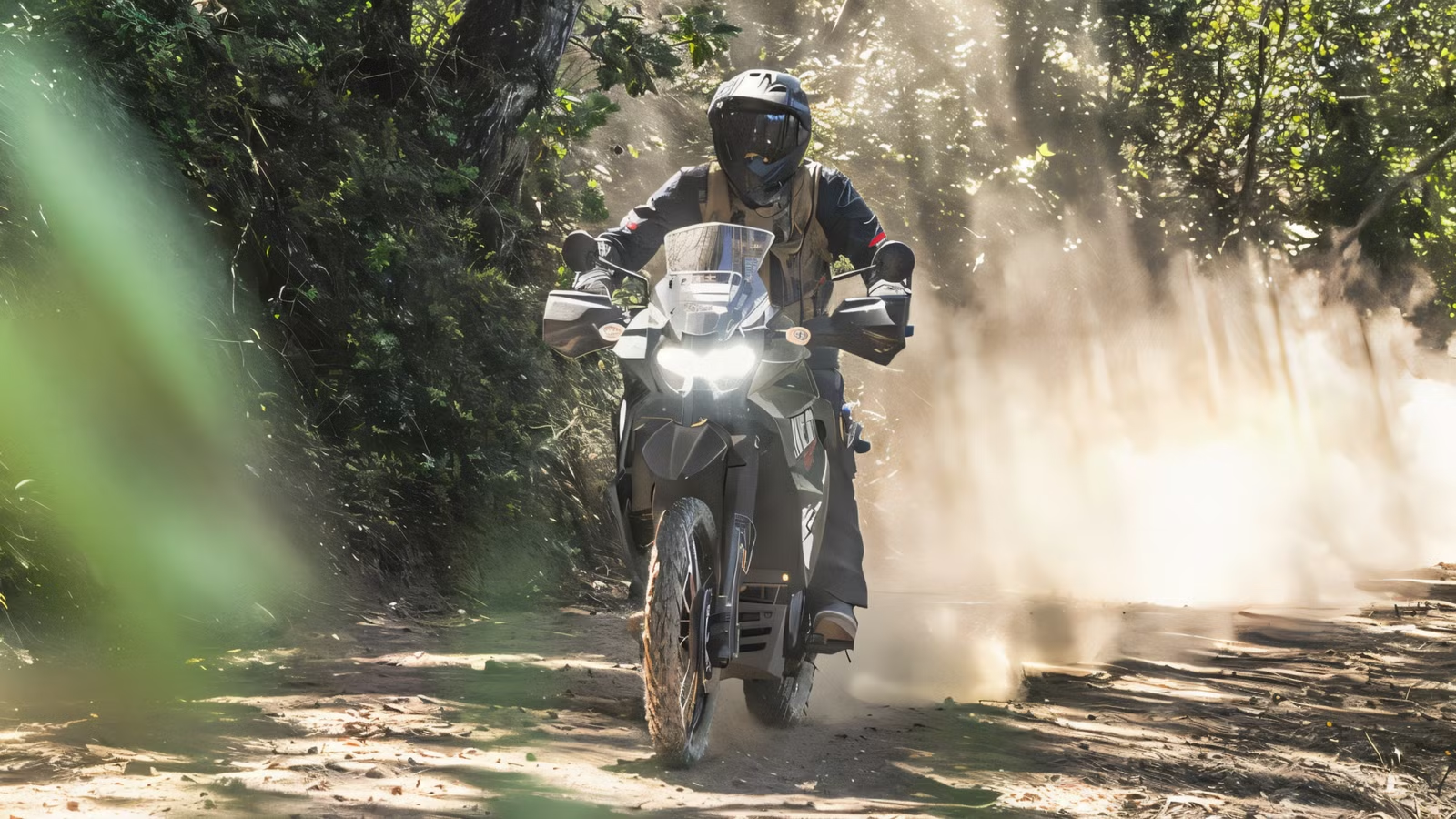
Cars last much longer than motorcycles, especially the bread-and-butter models designed as low-stress motoring companions. But despite motorcycles’ added vulnerabilities, a few are durable enough to be nearly immortal. This is thanks to a combination of low-stress engines, years of refinement and reliability tweaks, and simplified underpinnings that are easy to repair.

Minimal electronic intervention is a huge plus too. Japanese motorcycles score high on outliving their owners, and a long-standing Kawasaki dual-sport does that while also offering a highly durable go-anywhere package. Despite being virtually unchanged for over 39 years, this outdated dual-sport is overbuilt enough to perform strongly for years to come.
Why Do Cars Generally Last Longer Than Motorcycles?
Cars usually last longer than motorcycles because of engine stress, cooling, lubrication, and environmental exposure. Most car engines are relatively low-revving (2,000 to 4,000 RPM), which reduces thermal and mechanical stress relative to their size. By contrast, many motorcycle engines, especially those on sportbikes, exceed 10,000 RPM, increasing stress.

Furthermore, the compact form factor puts more stress on the mechanical components. Cars have much better cooling and lubrication because they can fit larger radiators and higher-capacity cooling and lubrication systems, which help stabilize operating temperatures. Motorcycles, however, rely on open-air or smaller cooling setups that must also work with an engine exposed to harsher temperature swings.

Motorcycles also face greater environmental exposure, as components like chains and electronics take the brunt of rain, dust, and road debris. But a car’s components are well protected under the hood and body panels. Because cars are bigger and better protected than motorcycles, they tend to last longer.
A Few Overbuilt, Analog Motorcycles Routinely Outlast Cars

Despite cars’ advantages, there is still a vibrant selection of highly durable, forever motorcycles. These models excel in durability, reliability, and easy-to-service components, thanks to simplified engineering that helps them outlast cars. Contrary to popular belief, these don’t have to be confined to old-school or traditional offerings like the Suzuki DR650 and the Yamaha TW200. Instead, unique and luxurious motorcycles like the Honda Gold Wing and tech-loaded flagship ADVs like the BMW R 1300 GS also make the cut.

However, old-school offerings that have continued without major updates since inception still have a notable advantage in refinement and reliability. Also, the minimal technological suites on these bikes help with their longevity, as they don’t go “outdated” like fellow tech-savvy rivals. Furthermore, the raw rider-motorcycle connection these bikes offer truly transforms the riding experience in a way no sophisticated or more powerful rival can. Bundling all the best bits mentioned above is the Kawasaki KLR650—a go-anywhere dual-sport that shows simplicity still wins.
From Reagan-Era Dirt Bike To U.S. Army Workhorse: The KLR650’s 39-Year Evolution

The Kawasaki KLR650 broke cover in 1987 as the successor to the KLR600. The first-gen model was offered in both bare-bones and touring-ready trim levels. The US Army also utilized this Kawasaki for its durable construction, albeit with customized diesel powertrains. The first-gen model ran from 1987 to 2007. During this period, updates were limited to improved mechanicals, including lighter, more refined engine components, a more durable shift lever, and an improved brake master cylinder.
The second-gen model (2008 to 2018) brought Kawasaki’s first major upgrades to the KLR650. It was redesigned with new trims, a new fairing, and new turn signals. The instrument cluster was refreshed, and the handlebar control switches were redesigned. Braking was updated with a twin-piston setup at the rear, and the carburetor main jet size was reduced from 148 to 145. The ride quality also improved significantly with a new rear swingarm, thicker front forks, and larger, petal-shaped vented brake rotors. A larger radiator improved cooling too.

Kawasaki introduced the third-gen KLR650 in 2022, with key updates to the engine and electronics. This was when the KLR got electronic fuel injection. It also added optional ABS, a new LCD gauge cluster, and an upgraded alternator with more output. Other notable updates include an adjustable windscreen, a larger front disc brake, and a refreshed look with new bodywork, trim, and fairings for a rugged, muscular appearance. Across three generations, Kawasaki didn’t fiddle with the KLR’s core, simplified powertrain and chassis setup, which further contributes to its near-immortal appeal.
Overbuilt From The Start: The Engineering Choices That Make The KLR650 Nearly Immortal

The KLR650’s simplicity is its trump card, bringing extreme reliability and refinement to the mix. That is also why it can stand tall against more modern, stacked rivals. Years of on- and off-road experience have also earned the KLR a far more trustworthy fan base worldwide. The mechanical components are designed to take a lot of beating. If and when it requires major repairs, components are relatively affordable and easy to come by, thanks to Kawasaki not fiddling with the formula for over 39 years. Kawasaki has since diversified this formula into three models—the standard KLR650, the more road-focused KLR650S with lower seat height and firmer suspension, and the stacked KLR650 Adventure, ready for cross-country trips.
A Low-Stress And Extremely Reliable Engine That Basks In Simplicity

A very reliable single-cylinder engine powers the KLR650. The 652 cc liquid-cooled mill has aged like fine wine, logging innumerable miles and crossing numerous borders over its 39-year lifespan. Its longevity and reliability come from its understressed character. It has a mild compression ratio of 9.8:1, which ensures smooth functioning on any type of fuel.
The 2026 KLR650 produces 40 horsepower at 6,000 RPM and 39.1 pound-feet of torque at 4,500 RPM. Its early torque surge helps this dual-sport tackle challenging trails and tarmac with ease. Power is sent to the rear wheel via a five-speed gearbox with a final sealed chain drive.
A Steel Frame And Long-Travel Suspension Built To Absorb Whatever You Throw At It

Its bulletproof engine sits cocooned in a semi-double-cradle frame made of tubular steel members. It is suspended on 41 mm telescopic front forks with 7.9 inches of travel. The rear uses Kawasaki’s Uni-Trak monoshock with adjustable rebound and preload, offering eight inches of travel. The road-focused KLR650S dials back suspension travel to 6.7 inches up front and seven inches at the rear.
A 300 mm disc coupled to a two-piston caliper handles braking up front. The rear gets a 240 mm disc coupled to a single-piston caliper. Confidence on all surfaces comes from its 90-section front and 130-section rear knobby dual-sport tires wrapped around laced 21-inch front and 17-inch rear wheels. These components complement the KLR650’s rugged, go-anywhere appeal.
Why The KLR650 Fits Riders That Other Dual-Sports Leave Out

Despite this dual-sport’s tall stance, the ergonomics are comfortable, and the seat is mostly accessible. As standard, the KLR has a seat height of 34.3 inches. Shorter riders can opt for the S trim, which drops it to 32.1 inches. Its 30-degree rake angle and 4.8 inches of trail deliver a stable stance on all riding surfaces. Its long swingarm and full-yoke construction are sturdy and confidence-inspiring on both swift highway rides and hardcore trail runs.
Rugged Looks Add To Its Near-Immortal Appeal

The KLR650 has a popular, recognizable design language. It has barely been updated since 2009. Its rugged appeal shows clearly in its muscular design. The front fascia mimics the “angry face” of the Eurasian eagle owl with elements like its dual-pot headlamp and high-mounted front fender. The side profile is accentuated by a half-fairing that flaunts cool graphics and the “KLR650” sticker. The rear section is narrow and minimalist, which helps keep the dimensions tight even when loaded with side cases.
No Ride-By-Wire, No Traction Control: How The KLR650’s Missing Tech Became Its Biggest Selling Point

This dual-sport has a very bare-bones technology feature list. Even ABS is optional, except on the fully loaded Adventure trim, where it comes standard. The instrument cluster has a simple layout, with a slim LCD that cleanly shows the speedometer, fuel level, and clock. While that makes it feel outdated, the minimal tech suite unlocks a rare analog riding experience that is slowly becoming a luxury on motorcycles today. The Kawasaki KLR650 has aged like fine wine and shows no sign of slowing down anytime soon.
Source: Kawasaki

Related posts


Latest Post


No Comments