
Two Of Detroit’s Most Famous 428 Big-Blocks Were Actually 427s
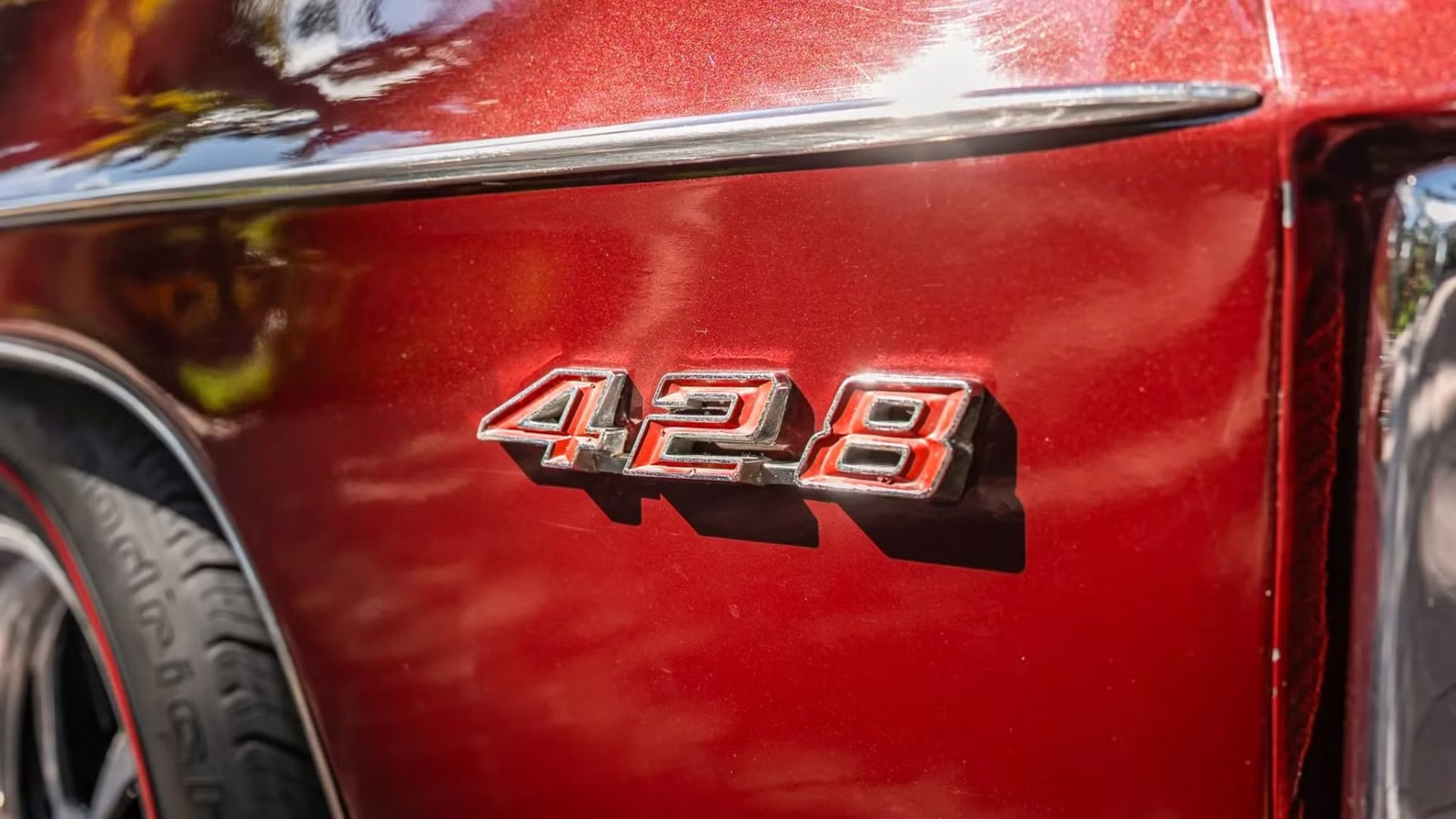
During the golden era of American muscle, the gleaming metal badges gracing a car’s front fender carried serious weight. These emblems were tasked with quickly signaling to prospective buyers why one car was more powerful than the other, and just one digit in a simple string of numbers had the powerful effect of shaping buyer perceptions.

As a result, it was important that American automakers bestowed their prized muscle cars with the biggest, boldest, and most memorable engine designations, in an attempt for their offerings to stand out in a packed segment. However, this race to capture buyers’ attention has sometimes resulted in a slight skewing of the truth.
The Allure of America’s 428 Poster Cars
By the late 1960s, muscle car buyers were craving massive output figures and aggressive hood scoops, and American car giants like Ford and Pontiac eagerly answered the call with larger engines, sweeping rooflines, and menacing recessed grilles. But in the eyes of many, true street performance credibility was earned by nothing more than the number cast onto the front fender.

Some of the most iconic vehicles of this generation proudly wore the bold “428” badge, alluding to a massive power plant beneath their long, sculpted hoods. In theory, the emblem suggested that the eight-cylinder engine hidden under the sheet metal measured a massive 428 cubic inches. This new wave of high-displacement muscle cars brought immense levels of low-end torque, resulting in effortlessly smooth straight-line acceleration at drag strips and stoplights alike. They also avoided the high-strung nature of their “427” badged counterparts, which meant that eager buyers could easily afford to purchase and maintain these muscular coupes.
Detroit’s Great Displacement Lie

Beneath the high-displacement facade, these 428-badged muscle cars from Ford and Pontiac did not exactly live up to the emblem that they proudly wore on their front fenders. In fact, neither automaker was selling an engine that truly measured a precise 428 cubic inches in displacement, even when rounded to the nearest whole number.
Instead, both auto giants engaged in a sly marketing tactic in which they wrongly rounded up the displacement of their big-block V8s, rather than settling with a more transparent 427. By presenting these newly minted eight-cylinder engines under a high-numbered identity, Ford and Pontiac were able to portray the irresistible image of massive, unbridled big-block performance that attracted muscle car buyers from all directions. After all, the badge had the power to influence buyer perceptions before they even stepped behind the wheel or turned the key.
However, the exact reason why these manufacturers jumped up to the revered “428” badge goes far beyond simply chasing a higher, more impressive number on paper. The crowded muscle car market of the late 1960s already featured an array of offerings with 427 badges, but those vehicles featured high-strung powertrains derived from racing. This was a dramatically different philosophy than the new smooth, torque-abundant entries, and both Ford and Pontiac needed to avoid the risk of confusing prospective buyers. To properly differentiate the two entirely distinct engines, the solution was clear.
Ford’s 428 FE Is A Marketing Illusion

When Ford introduced its 428 FE engine for the 1966 model year, it was designed as an attainable street engine with plenty of low-end torque. The powertrain found its way into full-sized passenger cars such as the Galaxie 500 sedan, and even Ford’s more luxury-oriented models, including the Thunderbird and Mercury Marquis. Eventually, the new eight-cylinder engine would land under the hood of high-performance Shelby Mustangs like the 428 Cobra Jet, which is arguably where it earned its icon status.
Built on Ford’s proven FE block architecture, this 428-badged engine utilized a cylinder bore measuring 4.132 inches combined with a stroke length of 3.984 inches. However, a closer look at the displacement of this engine quickly reveals that the math doesn’t quite add up. With the measurements of the bore and stroke taken into account, the engine features an exact displacement of 427.386 cubic inches. Even when rounded to the nearest whole integer, the engine measures 427 cubic inches, rendering the “428” in its name technically inaccurate.

However, Ford could not stick with the 427 emblem for one crucial reason. The automaker already possessed a legendary 427-badged big-block in its lineup, but it was a high-strung racing engine designed specifically for NASCAR ovals and endurance racing applications such as Le Mans. It paired a massive bore with a shorter stroke, meaning that it was better suited for high-rpm operation. Meanwhile, the new 428-badged FE engine delivered low-end grunt for the streets rather than raw, high-revving track performance.
If Ford were to cast the 427 badge onto this smooth eight-cylinder engine, it would have caused massive confusion among buyers who might have expected the opposite. By employing imprecise marketing math to round the 427.386 up to 428, Ford was able to create an entirely separate identity that was not to be mistaken with high-strung racing performance.
Pontiac Sneakily Rounds Up To 428

Pontiac followed a remarkably similar strategy when developing its own large-displacement V8 engine to replace the outgoing 421 engine. Headed for the engine bays of full-sized models such as the Grand Prix, Catalina, and Bonneville, this next-generation eight-cylinder was tasked with delivering smooth power delivery and snappy acceleration for its time period. The new 428-badged powertrain lived up to these expectations, and it was introduced with a 4.12-inch bore mated to a 4.0-inch stroke, resulting in a displacement of 426.613 cubic inches, which rounds to 427. Like Ford, Pontiac chose to bypass mathematical reality and cast a 428 badge onto the sheet metal of its performance cruisers, but it had a strong reason to do so.

Pontiac itself did not produce a high-revving, 427 cubic-inch racing engine, but this did not keep the automaker safe from naming confusion. If the automaker had added the 427 label to its smooth new V8 with abundant low-end torque, prospective buyers would have mistakenly pitted it against the legendary big-block racing engines from Ford and Chevrolet.
Pontiac also avoided rounding down to 426, as it needed to differentiate its large-displacement street performance offering from Chrysler’s feared 426 Hemi, which was already dominating the low-end torque game that Pontiac was aiming at. By making the sly decision to round all the way up to 428, Pontiac was able to avoid confusion with high-revving racing engines while simultaneously projecting a badge number that sounded much bigger and bolder than its crosstown rival from Chrysler.
Why Buyers Did Not Complain

Even though Ford and Pontiac took it upon themselves to rewrite the rules of mathematics, enthusiasts and buyers alike hardly raised their voices in complaint. While the 428 badge didn’t quite match the true engine displacement, drivers were still given the massive low-end torque and smooth acceleration that marketing campaigns had promised them.
With the 428-badged muscle cars ultimately succeeding in their mission to deliver a satisfying, torque-abundant experience that muscle car buyers clamored for, the slight exaggeration behind the emblem did not become a stain on the reputation of these vehicles. Instead, the 428 badge successfully represented the smooth big-block experience that remains a legendary part of American muscle car history.
Sources: Bring a Trailer, Ford, Pontiac

Related posts



Latest Post


No Comments