
Hyundai Is Coming For Toyota And Subaru With A More Serious Tucson
The Tucson has been Hyundai’s bread-and-butter crossover SUV for more than two decades now. In that time, it’s seen the brand elevated from second fiddle to Japanese manufacturers to becoming a full-blown rival. While four generations of Tucson followed a very similar formula, the all-new fifth-generation is breaking the mold. No longer is it just an everyday crossover—it’s a larger, bolder step up into a full-on classical SUV. In one specific trim, it’s quite a capable off-roader as well. HotCars was able to get a first-hand look at the new Tucson at an exclusive soft opening event just outside New York City, and what we found was certainly surprising.
Radical New Styling for a Well-Known Nameplate

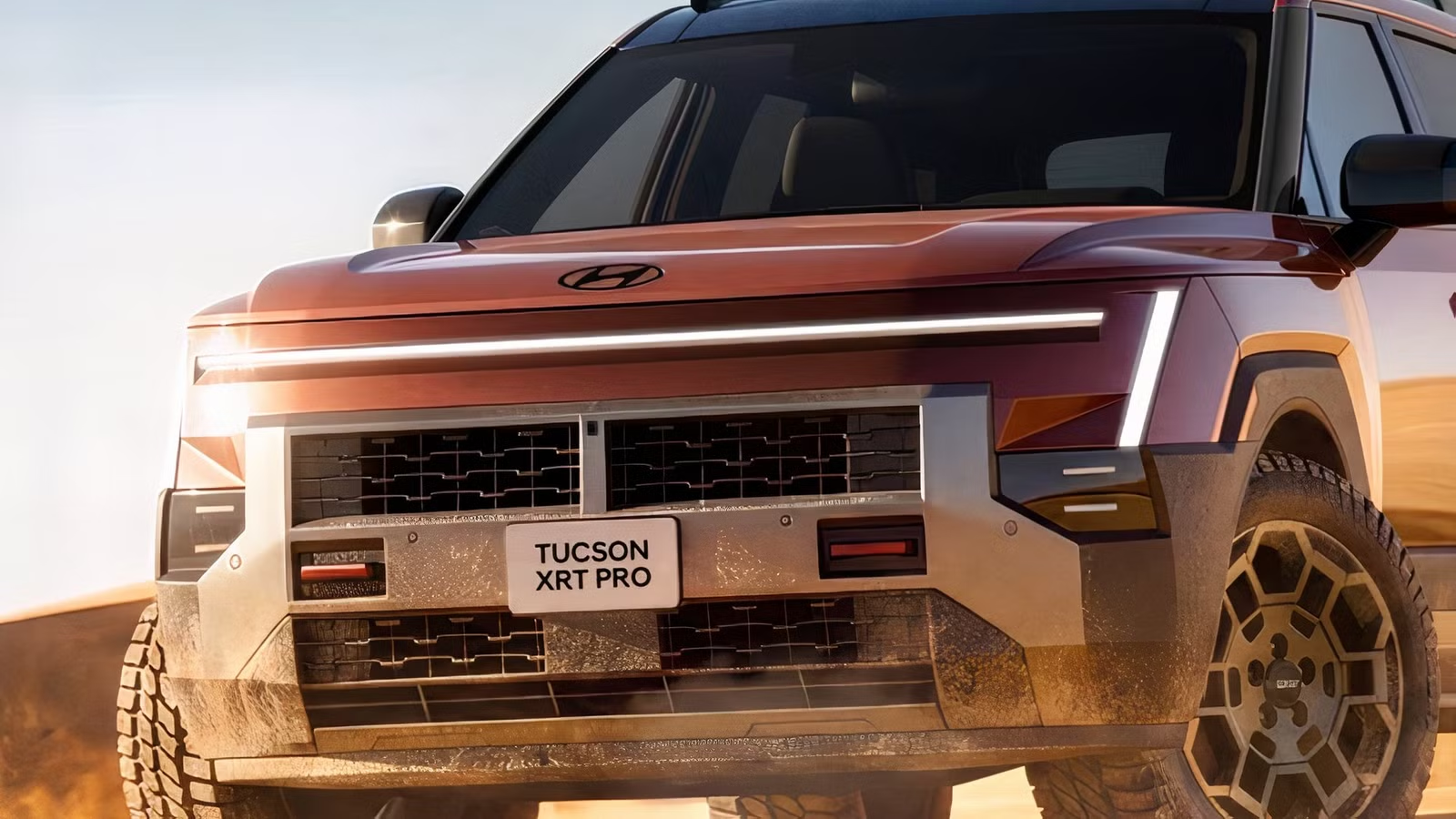
On first impressions alone, it’s hard to look at what Hyundai’s come up with and immediately think “Tucson” in the mind’s eye. Twenty years and change of being Hyundai’s flagship mid-size crossover makes it difficult to square away just how different the fifth-generation looks from its predecessors. Almost body-on-frame in appearance, the unibody Tucson is guided by a design language Hyundai calls the “Art of Steel.” The front end is monolithic and imposing, with a thin slit of a light bar running across the grille where two daytime running lights and headlights are nearly joined together in a pattern Hyundai calls “H-Edge lighting.”
The side profile is aggressive, angular, and ripping with fender flares and bulges in the door that convey ruggedness in a meaningful way. At the back, the taillight arrangement mimics the front end with all-new “Prism rear lamps,” and prominent black body cladding all around gives a stark contrast to the sculpted lines of the rest of the vehicle. Far from pancaking the air as it drives along, the new Tucson boasts an impressive drag coefficient of 0.30 Cd. It borders on low-slung sports car levels of slipperiness through the air making the subtle rear spoiler and the sleek angle of the front glass no coincidence.

The new Tucson has larger dimensions than its predecessor, being 2.4 inches (184”) longer and 1.67 inches (75”) wider not counting the door mirrors. That extra length and width equals extra usable space inside the cabin, both in passenger legroom and in cargo storage. Taking the full 360-degree circuit around the new Tucson, its exterior transformation is nothing short of profound. As an impact statement for Hyundai’s broader Art of Steel design refresh, the Tucson appears to be a pretty impactful ambassador.

A Respectable Powertrain

Until recently, the engine department was something of a sore spot for Hyundai, as well as its Kia sister brand. Yet, recent years have seen massive leaps in powertrain technology, particularly on the hybrid side. The new Tucson offers the option of a hybrid powertrain as well as straight-ICE, something of a dying selection in a market rapidly shifting toward partial electrification. The base gas engine is a 1.6-liter GDI four-cylinder engine making 184 horsepower. It’s good for zero to 60 in anywhere from 9.5 to 12.4 seconds depending on whether you opt for two or four drive wheels, to the tune of 26 to 28 mpg, drive wheels-dependent.
Up the range, the hybrid powertrain boosts performance up to 233 horses and a zero-to-60 sprint of 8.5 seconds. The hybrid configuration is also rated to tow up to 3,000 lbs behind it with AWD equipped, and delivers up to 42 mpg combined in its most efficient layout. Interestingly, the Tucson will offer a novel plug-in hybrid variant with 50 miles of all-electric range and a 17.1 kWh battery pack internationally. Whether this setup lands in the US later on remains to be seen, yet for now, what’s promised to hit American dealerships looks extremely promising

Beneath the skin, the new Tucson’s brakes and suspension are beefed up to accommodate the burly body on top. Hyundai boasts the new Tucson both brakes and handles better than the Gen-IV Tucson crossover that came before it. Knowing that the new Gen-V is bound to be at least a bit heavier than what came before, this is a welcome sign. Holistically, the innards of the new Tucson are just as momentously different as the Art of Steel body. The unibody chassis is also stiffer than before, further assisting in better handling while supporting a smoother ride. In stepping out of its native market segment to a new frontier, it looks Hyundai didn’t skimp on the underpinnings as well as the exterior.
A Shockingly Nice Interior

As we’ve established, the new Tucson is a larger vehicle than the outgoing model, allowing for nearly 42 inches of legroom for back seat passengers and 41.7 cubic feet of cargo space with the rear seats folded down. It presents a marginal improvement over the outgoing Gen-IV Tucson, but where things pick up several notches is in technology and interior quality. Keeping in line with styling cues introduced by the larger Palisade, the new Tucson’s interior is sleek and stylish in a luxury SUV-adjacent manner above its price bracket. Lined with plush leather and sporting a clever dual center console that doubles as an armrest, the cabin is very nicely laid out. It also features calming ambient LED mood lighting, so the Tucson’s cabin is continuously bathed in a warm glow that nearly blends in completely when you’re not paying attention to it.
Above the Double D-Cut steering wheel, a thin strip of a 9.9-inch configurable digital gauge cluster is flanked to the right by a 17-inch center infotainment screen. Though, cheaper models in the range come packing a more modest 12.9-inch center display, no real downgrade if you ask most people. With smartphone levels of responsiveness and a delightfully crisp OLED panel, the center screen serves as a fitting home for Hyundai’s new Gleo AI in-vehicle AI assistant. Based on Hyundai’s proprietary, in-house-developed 42dot LLM, Gleo AI has all the capability of Google Gemini or ChatGPT, but optimized for life on the road.

Through its voice command-operated interface, drivers can operate Hyundai’s next-gen Pleos Connect infotainment suite hands-free. Elsewhere, there are plenty of physical tactile buttons beneath the center stack to control the HVAC and radio settings if LLMs and touch screens aren’t your thing, plus a full assortment of ADAS features that include Intelligent Speed Limit Assist (ISLA), Navigation-Linked Smart Cruise Control (NSCC), Child Presence Detection (CPD), and Rear Occupant Alert (ROA), among others. Coupled with its IIHS Top Safety Pick status and five-star NHTSA rating, the new Tucson ticks all the right boxes in the family-hauler department.
An Exciting Off-Road-Focused XRT Pro Trim

The new Tucson was impressive all around. Yet, its road-optimized trims feel somewhat pedestrian compared to what we at HotCars find to be its most exciting variant, the off-road-optimized XRT Pro. The new Tucson’s XRT and XRT Pro mirrors its Palisade counterpart with all-terrain tires, trim-exclusive Black monotone paint with dark metal accents, beefed-up body cladding to absorb punishment in the sticks, and a modest suspension lift of 30 mm, or just over an inch, to assist to that end.
Better still, Hyundai’s Smart Terrain Assist suite mirrors systems in purpose-built off-road brands like Jeep and Land Rover, analyzing traction conditions and a number of other parameters to help vector torque to the correct wheel at any given moment. Packing automatic terrain detection that changes driving dynamics between auto, snow, mud, sand, and rock modes, handy ground-view monitoring helps make the driver aware of their surroundings, even on tight woodland trails and deep snow.

While not a true-to-form body-on-frame 4×4 like a Bronco or Wrangler, the Tucson XRT Pro offers a similar level of off-road performance in a form factor with great fuel economy and reasonable dimensions. Similar to other unibody off-roaders like the Honda Passport and Subaru Outback Wilderness, the Tucson XRT Pro is a great compromise between on-road efficiency and off-road capability. As far as we’re concerned, it’s the most enticing variant of the new Tucson, and a legitimately unique alternative to other off-roaders on the market. Stay tuned for dealership debut and pricing information, as it’s sure to come soon.

Related posts


Latest Post


No Comments