
The Forgotten American Motocross Bike That Beat Yamaha To EFI By A Decade
Motocross history tends to remember the factory that makes a new idea reliable enough to win and easy to buy. The outfit that first wrestles that idea into existence usually gets a shorter chapter, especially when the experiment ends with broken engines and unpaid bills.

However, one American manufacturer learned that lesson with brutal efficiency. Its four-stroke arrived before the industry had caught up with its electronics, and the resulting pioneer tax eventually climbed toward a whopping $80 million. By the time motocross caught up, its motorcycle division was already gone.
Four-Stroke Motocross Was Ready For Its Next Revolution
Come the late ’90s, motocross was beginning to reconsider what a serious race bike should look like. Yamaha’s 1998 YZ400F had proved that a big four-stroke could run with the established two-strokes, and Doug Henry’s success gave the concept credibility that brochures couldn’t manufacture. The thumper had moved from curiosity to genuine threat.

Even so, the surrounding hardware remained familiar. The YZ400F and the later YZ426F relied on carburetors and kick-starting, while their cylinder heads followed the conventional arrangement of intake at the rear and exhaust at the front. Four-stroke motocross had found its opening, but the next round of development was still sitting on the drawing board.
That opening attracted an American company with deep experience in aluminum bicycle frames and very little experience building motorcycles. It saw the sport changing and decided that matching Yamaha wouldn’t be enough. The proposed machine would use fuel injection and electric starting, wrapped around an unconventional engine layout inside an aluminum chassis. No holds barred, then.
An Aluminum Specialist Bet The Company On Reinvention

Cannondale entered the project with genuine engineering confidence. Its bicycles had made the company synonymous with aluminum construction, and the booming late-’90s off-road market looked like a logical place to expand. The plan was to create an American-built motocross motorcycle capable of challenging companies that had spent decades refining their machinery and building dealer networks.
The original prototype used a lightweight Swedish Folan single-cylinder engine developed with knowledge rooted in Husqvarna and Husaberg. That could have given Cannondale a proven starting point, but the company abandoned it and commissioned a clean-sheet four-stroke from a North Carolina NASCAR outfit. Starting over meant redesigning the costliest part of the motorcycle while the launch clock kept ticking.
Cannondale initially believed the motorcycle program could be completed for about $20 million. The broader motorsports investment eventually approached $80 million, while the promised arrival slipped repeatedly from its original schedule. Every new feature demanded fresh testing and tooling, and each delay allowed Yamaha and KTM to strengthen their positions while Honda prepared its CRF generation.
The Cannondale MX400 Arrived Years Ahead Of Schedule
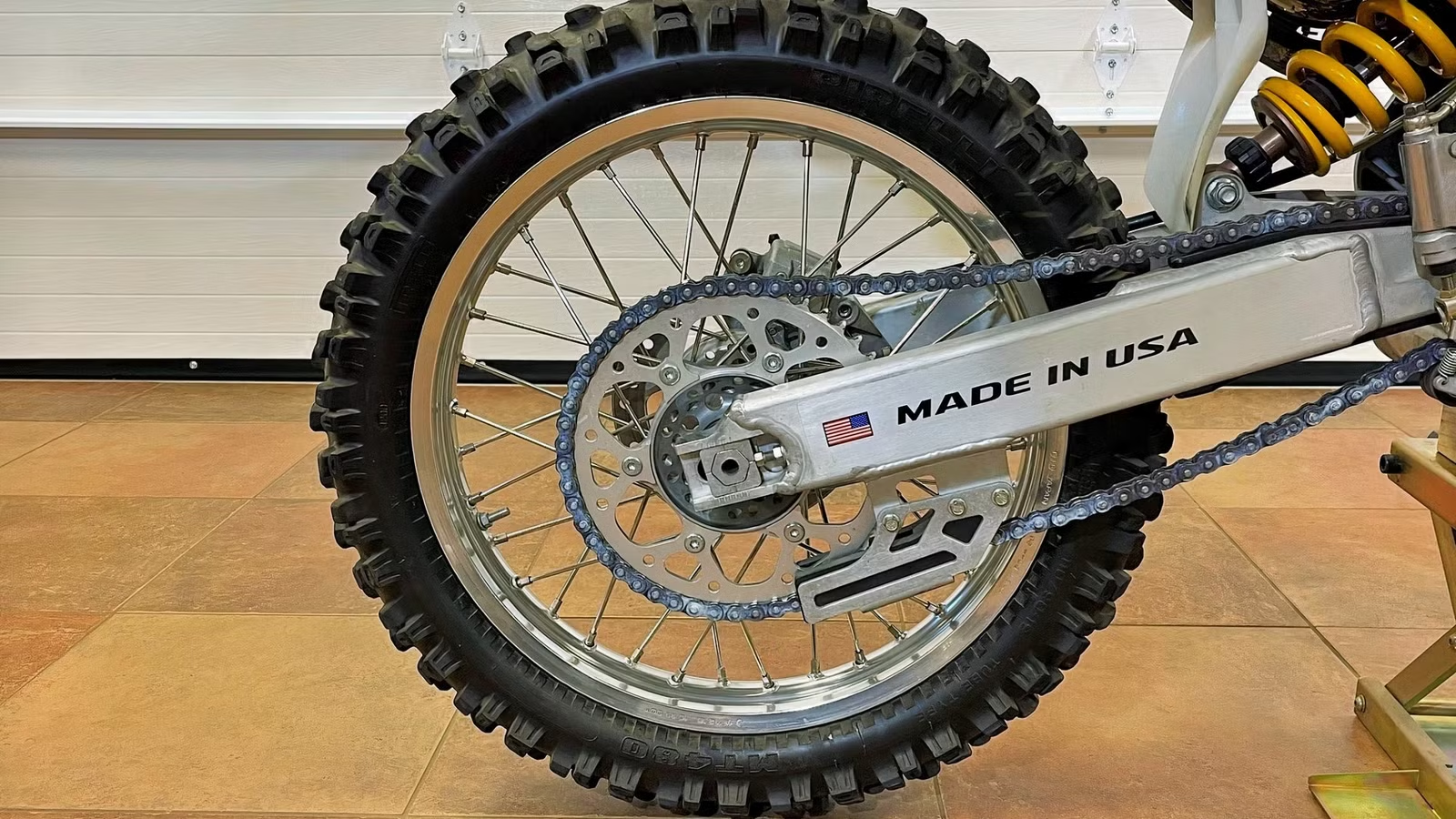
This all led to the 2001 Cannondale MX400. Its name slightly undersold the hardware because the production engine displaced 432cc, up from the 397cc version shown earlier. With an MSRP of about $8,000, it entered the market as a premium motocross bike carrying a specification sheet that sounded as though it had been mailed back from the future.
The liquid-cooled, double-overhead-cam single used electronic fuel injection and a reversed cylinder head. The intake sat at the front, drawing air from behind the number plate through the frame, while the exhaust exited toward the rear. Yamaha would popularize a similar reversed-cylinder idea on the 2010 YZ450F, nine model years after the Cannondale had put the layout into production.
Not The Finished Product

A starter button replaced the traditional kick-start ritual, and the five-speed cassette transmission could be removed without splitting the main engine cases. Cannondale separated the gearbox and crankcase lubrication, while the powertrain sat inside a bolt-together aluminum twin-spar frame. Öhlins suspension and Nissin brakes added expensive credibility.
On paper, this was exactly the kind of leap motocross fans claim to want. It was American-built and technically audacious, aimed directly at the Japanese establishment. Early impressions even found precise steering and strong stability, backed by broad power delivery. The problem was that a motocross race is a merciless product-development meeting, and the MX400 had arrived with far too many agenda items unresolved.
Every Smart Idea Came With An Expensive Catch

The fuel injection provided the clearest example. Early testing exposed a hesitation just off idle, and later production bikes could surge or flame out at low rpm. Adjusting the system required electronic equipment rather than a screwdriver and a box of carburetor jets. Temperature changes could upset the mapping, which wasn’t ideal for a machine expected to race through changing conditions.
Stalling became especially awkward because the electric starter worked best when the engine was cool. Once the 432cc single got hot, the system could struggle to relight it. Riders therefore had a bike prone to dying near tight corners and reluctant to restart after doing so. The magic button occasionally behaved like a decorative suggestion.
Packaging Headache

The reversed cylinder also created a packaging headache. There wasn’t enough room for the long, carefully tuned exhaust path a competitive four-stroke needed, so the header ran almost directly into the muffler. The front intake couldn’t supply enough air by itself, forcing Cannondale to add a second filter under the fuel tank. Reaching it required removing the seat and bodywork before lifting the tank, because one air filter was apparently too convenient.
On top of all that, weight magnified every weakness. Early specifications claimed 242 pounds dry, while real evaluations placed the bike around 250 to 260 pounds without fuel, roughly 20 pounds beyond a Yamaha YZ426F. The front suspension was considered too soft, while the rear could feel harsh in aggressive testing. Maintenance access was equally discouraging, with even routine adjustments sometimes demanding major disassembly.
The MX400 Paid For Motocross’s Next Decade

Cannondale kept developing its Motorcycles and ATVs, but the numbers never gave the division any breathing room. The company reported $46.6 million in motorcycle and ATV losses across 11 consecutive quarters. It filed for Chapter 11 protection on January 30, 2003, after approximately 5,000 powersports machines had been sold in total. That figure includes motorcycles and ATVs, rather than 5,000 MX400 motocross bikes.
The collapse erased the machine faster than its ideas. Cannondale’s bicycle business survived under new ownership, while ATK acquired the motorcycle assets and engine rights. The MX400 itself became a ghost in the collector market. The only notable sale was back in 2021, and for a meager $6,000, a remarkably sad ending for one of America’s most ambitious production motocross projects.
Doing The Homework For Everyone

Its legacy becomes clearer when viewed beside the 2010 Yamaha YZ450F. Yamaha arrived with the resources and development depth to make fuel injection and a reversed-cylinder layout feel purposeful rather than experimental. The concept earned praise because the finished motorcycle worked as a system. Cannondale had already demonstrated what happened when those same ideas were pushed into showrooms before the engineering around them was ready. In essence, Cannondale paid the pioneer tax in full, and everyone else received the engineering notes.
Sources: Motomanuals, Motorcycledaily, BeMoto, Motocrossactionmag, Mecum, Cannondale

Related posts

Latest Post


No Comments