
The Japanese Cruiser That Makes Harley Riders Look Twice
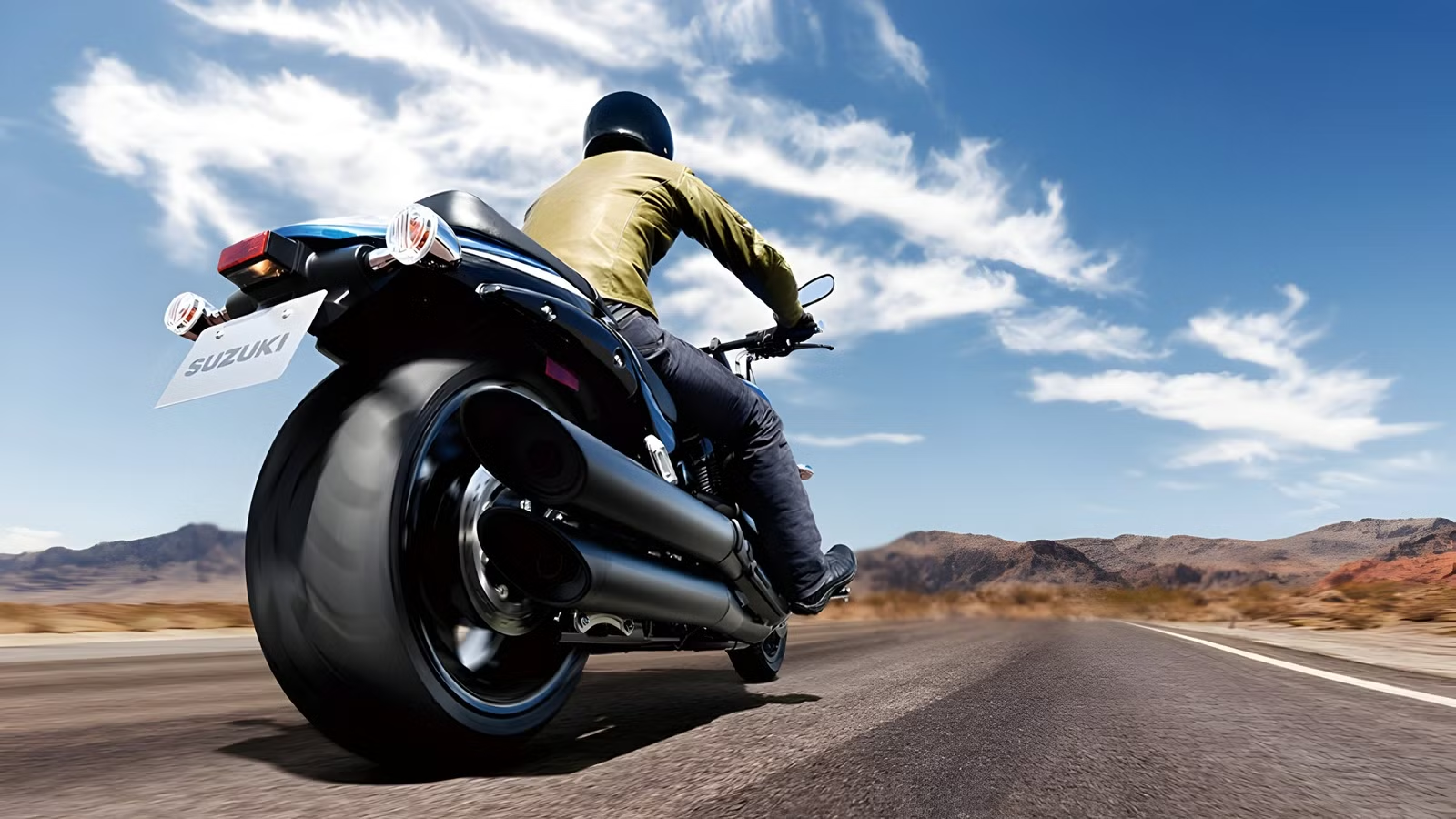
Harley-Davidson riders are a famously devoted bunch. Converting one — even briefly — into someone who cranes their neck at a passing cruiser motorcycle from Japan takes something genuinely special. Road presence is the first hurdle: the bike needs to be large and long in a way that feels distinct, not derivative. The engine should be front and center, ideally in a finish that catches the light. And if the overall design leans aggressive and unconventional rather than retreading the retro playbook, so much the better.

That is a difficult brief for any cruiser to fill, and it gets harder still when you consider how few Japanese manufacturers are even trying in this segment anymore. Most have quietly moved on. But Suzuki never pulled one particular heavyweight from the lineup — and it remains on sale today.
Head-Turning Japanese Cruisers Are A Rare Breed In 2026
Back when Japanese giants were fighting the Speed Wars, Harley-Davidson was quietly building a dominance in the cruiser segment. That dominance grew so large that the Big Four from Japan all realized how much they were leaving on the table by focusing elsewhere. As a result, they all tried to beat Harley at its own game, and we got some excellent Japanese V-twin cruisers over the years. The Kawasaki VN2000 is a great example that still remains iconic because of its massive V-twin engine — the largest displacement engine fitted to a production cruiser even today.


The hype didn’t translate into sustained sales, though. Die-hard Harley fans still wanted Harleys, and Japan’s enthusiasm for V-twin cruisers began to fizzle out. That brings us to today. Japan has largely waved the white flag in the cruiser segment, with barely any effort or innovation in this niche space. Manufacturers are playing to their strengths instead, building cruisers that do things Harleys can’t.

The Rebel 1100 is a perfect example — it carves its own path by prioritizing overall value and everyday usability rather than trying to match its American counterparts. That means if you want your Harley-riding friends to do a double take, you’ll need to seek out one of the original Japanese V-twin cruisers from an earlier era that is still on sale today. Fortunately, Suzuki has kept one of its heavyweights in the lineup, even though the model hasn’t seen a meaningful update in decades.
The Suzuki Boulevard M109R Can Make Harley Riders Look Twice

Case in point: the Suzuki Boulevard M109R. This is one of the most impressive Japanese V-twin cruisers ever built, thanks to its unique combination of performance, road presence, and distinctive details throughout. The performance alone is remarkable — no current Harley cruiser comes close to its output figures. Harley riders will have no choice but to take notice as you pull away.
The pricing makes the proposition even more compelling. The M109R is listed as a current-model motorcycle on the official Suzuki Cycles site, and a search of authorized dealers reveals that new examples are still available — some with substantial discounts off the sticker price. That puts this power cruiser within reach of buyers who might otherwise be cross-shopping entry-level American iron.
The M109R Might Be Old, But The Equipment On Offer Is Still Impressive

How is the price so competitive? Because Suzuki hasn’t updated the M109R in what feels like an eternity, so there are no modern electronics packages inflating production costs. Price increases have also been minimal in recent years — roughly incremental adjustments year over year. That’s not necessarily a drawback, though, because the underlying package remains genuinely impressive. Here’s a closer look.
Powered By Suzuki’s Largest Motorcycle Engine Ever

Suzuki knows a thing or two about motorcycle engines — just look at the game-changing VVT-equipped GSX-R1000 or the legendary Hayabusa, once the world’s fastest production motorcycle. Drawing on that engineering heritage, the company developed a purpose-built V-twin for the M109R. Displacing nearly 1,800cc, it is armed with some of the largest pistons fitted to any production motorcycle engine.
Those pistons measure 4.4 inches in diameter — 0.8 inches larger than those found in the latest Ford Mustang Dark Horse. Combined with full liquid cooling, the engine produces 123 hp and 118 lb-ft of torque. All of that power reaches the rear wheel through a five-speed transmission and a low-maintenance shaft final drive.
|
Engine |
54-degree V-twin |
|---|---|
|
Displacement |
1,786cc |
|
Compression Ratio |
10.5:1 |
|
Power |
123 HP @ 6,200 RPM |
|
Torque |
118 LB-FT @ 3,200 RPM |
|
Transmission |
5 speed |
|
Final Drive |
Shaft drive |
GSX-R-Derived Underpinnings Bring The Sportiness

The M109R’s massive mill sits inside a double-cradle chassis fabricated from steel, paired with a steel swingarm and subframe for added rigidity. Unremarkable so far — but the suspension and braking hardware is where things get interesting. The front end draws heavily from the GSX-R superbike of the era, as evidenced by the beefy inverted forks and radially mounted monobloc calipers. Keep in mind this was 2006, and most Harleys still haven’t adopted comparable suspension hardware two decades on. The rear is handled by a monoshock.
The wheel and tire package tells a similar story. Eighteen-inch alloy wheels are fitted front and rear, wrapped in 130- and 240-section rubber. The 240-section rear tire was the widest fitted to any production motorcycle at the M109R’s launch, and it remains an impressively broad contact patch by any modern measure.
Weighs Well Over 750 Pounds

That massive road presence comes at the cost of weight. The M109R tips the scales at a substantial 764 pounds — considerably more than most Harley cruisers. Even the Fat Boy weighs around 70 pounds less than the Suzuki. The rest of the dimensions follow the same larger-than-life philosophy:
- Wheelbase: 67.3 inches
- Length: 96.5 inches
- Width: 34.4 inches
- Seat height: 27.8 inches
- Tank capacity: 5.2 gallons
As Raw As Power Cruisers Come

While the Boulevard holds its own against modern Harleys in most respects, the feature list is where it unmistakably shows its age. That’s hardly surprising given this is essentially the same motorcycle that launched in 2006. There is no traction control, engine brake control, ride modes, or ABS on offer.
What you get instead is an unfiltered riding experience at all times — your right wrist does the managing, not an ECU or IMU. The cockpit reflects that philosophy, featuring a two-part instrument cluster: the handlebar area houses the tell-tale lights and tachometer, while the tank-mounted pod carries the speedometer and odometer.
Unmistakable Presence On The Road

One of the main reasons the Suzuki Boulevard M109R commands attention from Harley riders is its sheer road presence. It’s a large bike with distinctive styling from front to rear — a clear departure from a typical American big-twin cruiser like the Fat Boy, yet every bit as muscular. And despite being on the market for so long, the design still reads as fresh and purposeful rather than dated.
Up front, the near-rectangular headlights and beefy forks set an aggressive tone, leading into a sweeping profile defined by a long tank that tapers into a sculpted seat. Beneath the tank, the massive V-twin sits prominently behind a neatly packaged radiator. The rear is equally striking, with a sloping tail section perched above that wide rear wheel. On the B.O.S.S. version, a restrained use of chrome sharpens the overall character. The slash-cut dual exhaust ensures the engine’s rumble is never far from anyone’s attention.

The bike’s low-slung stance and well-sorted underpinnings also mean comfort isn’t sacrificed for style or performance. Both the rider and pillion seats are generously padded and shaped for longer stints in the saddle. Forward-set footpegs and drag-style handlebars round out an ergonomic package that should suit a wide range of riders. As muscle cruisers go, the Boulevard M109R ticks every box for style and comfort — and remains one of the most unmistakable bikes you can put on the road today.
Source: Suzuki Cycles

Related posts
Latest Post


No Comments