
Every BMW Model Ranked By Long-Term Owner Satisfaction
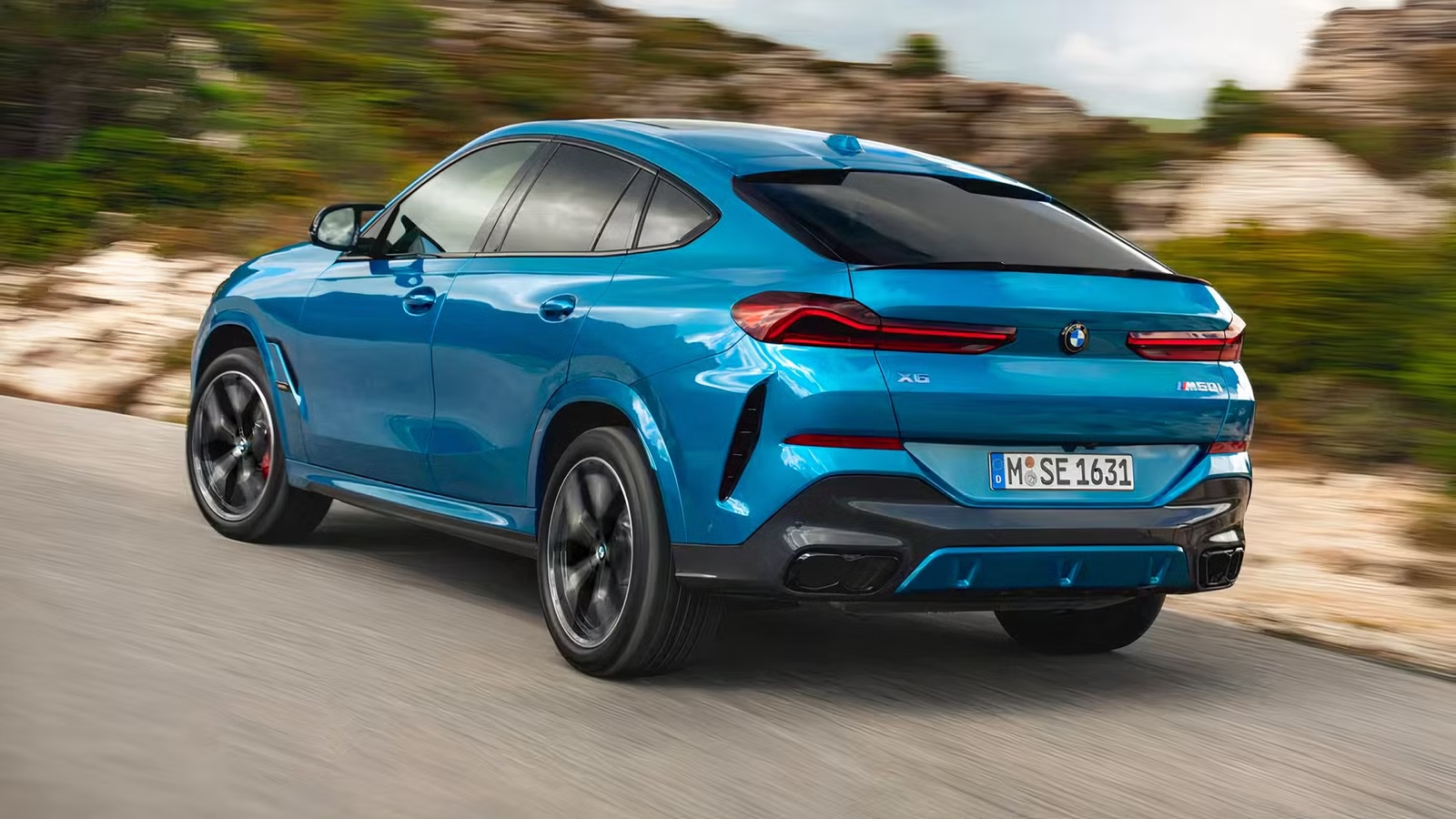
BMW has built a reputation for producing premium vehicles that blend performance, technology, and everyday usability. The brand’s owners reflect a legacy of strong long-term reliability, sometimes counter to what critics suggest, with modern BMW models ranking among the top brands on dependability lists from industry and consumer-trend analysts, such as J.D. Power’s annual Vehicle Dependability Study, where the brand rated 198 problems per 100 vehicles (PP100), well above the luxury brand average of 217 PP100.

That number is attained through J.D. Power’s annual owner surveys, which ask verified owners to rate their vehicles’ quality and reliability, driving experience, resale, and dealership experience, and assign a percentage grade (xx/100). BMWs tend to score around the 80th percentile or higher, but the grades often require interpretation because Power groups multiple variants (sedan, coupe, convertible, and wagon, as well as mild hybrids and PHEVs) under a single model—Series, in BMW’s case. Performance M variants seem to be treated separately but aren’t individually rated, nor are electrified i Series models, which are relatively new.
The models in this list have been extensively researched to ensure the most accurate information possible as of the time of publishing. Models are listed in ascending order based on overall consumer rating, from the lowest to highest.
14
2026 BMW X2
Consumer Rating: 76/100

A while back, BMW assigned coupes and convertibles their own Series designation, usually an even number up from their respective sedan and SUV counterparts. The BMW X2 is the brand’s coupe-styled (sweeping roofline) subcompact crossover. It combines hatchback styling and driving manners with SUV-inspired ride height. The X2 generally earns “Average” ratings for Quality & Reliability, and “Great” Driving Experiences ratings.
BMW X2 Reliability

Owners appreciate the BMW X2’s sporty character and compact dimensions, as well as the upscale cabin that ranks above its niche. Reported complaints include infotainment glitches, electronic issues, and higher-than-expected maintenance and repair costs. Some owners don’t appreciate the firmer ride around town (though they accept it on higher-speed open roads) and live with the tighter rear-seat room. While not one of BMW’s more problematic models, long-term ownership expenses can get significant.
- Average Yearly Maintenance Cost: Insufficient Data (RepairPal)
- Est. Maintenance Cost During The First 5 Years: $3,163 (CarEdge)
- Total Recalls: 10
- Worst Year To Buy Used: 2018
13
2026 BMW iX
Consumer Rating: 77/100

As BMW’s flagship electric SUV, the BMW iX combines long-range (283–364 miles, depending on powertrain), cutting-edge technology, and luxury-car refinement in a dedicated EV package. Despite its relatively low sales volume, the iX has a loyal following, evidenced in reliability ratings from J.D. Power that place it in the “Great” bracket for Driving and Dealership Experiences, and borderline “Great” in Quality & Reliability.
BMW iX Reliability

Owners praise the BMW iX’s quiet cabin and effortless acceleration that come from the EV platform, and appreciate the inherently spacious interior. As expected from a relatively new electric platform, infotainment and software gremlins highlight the list of complaints, with the latter sometimes affecting driver-assistance features, charging, and occasional electrical glitches. Early-production model recalls and reliability concerns were quickly ironed out.
- Average Yearly Maintenance Cost: Insufficient Data (RepairPal)
- Est. Maintenance Cost During The First 5 Years: $5,996 (CarEdge)
- Total Recalls: 28
- Worst Year To Buy Used: 2022
12
2026 BMW 5 Series
Consumer Rating: 77/100

The BMW 5 Series has long been the benchmark for midsize luxury sport sedans, with its meticulous balance of performance, comfort, technology, and refinement. In J.D. Power studies, the 5 Series consistently scores borderline “Great” in Quality & Reliability, Driving Experience and Dealership Experience, with Resale meriting an “Average” rating (though that may be because owners are reticent about giving them up).
BMW 5 Series Reliability

Over the years, BMW 5 Series owners consistently highlight the powerful engines, upscale interiors, composed rides, and advanced technologies, with common complaints leaning toward electronic glitches, infotainment issues, and expensive out-of-warranty repairs. Some past 5 Series models tended toward powertrain issues, but the executive sedan and wagon generally enjoy a strong long-term reputation that outshines luxury competitors, and especially rivals from Audi and Mercedes-Benz.
- Average Yearly Maintenance Cost: $620–$1,123 (RepairPal)
- Est. Maintenance Cost During The First 5 Years: $3,837 (CarEdge)
- Total Recalls: 34
- Worst Year To Buy Used: 2008
11
2026 BMW 8 Series
Consumer Rating: 78/100

The BMW 8 Series slots in as the brand’s flagship grand touring car, historically alternating model cycles with the 6 Series coupes and convertibles, and later grand touring Gran Coupés. The 8 Series’ greatest asset is its owner-rated Quality & Reliability, with its driving experience rating just “Average” in J.D. Power surveys, as are its dealership experience and resale, though the latter could be hampered by the vacillation between 6 Series and 8 Series through the years.
BMW 8 Series Reliability

BMW 8 Series owners frequently praise their cars’ distinctive profile, luxury refinement, long-distance comfort, and strong engines, all of which are traditionally part of the flagship experience. Common complaints include complex electronics, infotainment glitches, expensive maintenance, and the occasional sensor or driver-assistance feature faults. Though the model has generally avoided widespread reliability concerns, repair costs can be substantial out of warranty, projected to triple in its second five years.
- Average Yearly Maintenance Cost: $1,020 (RepairPal)
- Est. Maintenance Cost During The First 10 Years: $5,573 (CarEdge)
- Total Recalls: 6
- Worst Year To Buy Used: 2019
10
2026 BMW X3
Consumer Rating: 78/100

The BMW X3 is one of the luxury compact SUV segment’s best-sellers, on the strength of its practical utility, engaging driving dynamics, and brand prestige. In J.D. Power studies, the X3 has generally posted above-average owner satisfaction, thanks to “Great” driving experience, dealership experience, and resale, with the Quality & Reliability score nearing the “Great” level. The X3 is one of BMW’s most consistently well-regarded vehicles.
BMW X3 Reliability

Owners commonly praise the BMW X3’s balance of ride and handling, interior space and versatility, smooth and powerful engines, and intuitive technology. It isn’t without concerns, typically including electronic gremlins, powertrain issues (mostly on older models) such as cooling-system issues and oil leaks, and costly repairs once warranty coverage expires. Reliability does vary by generation, but the X3 is generally viewed as one of BMW’s stronger long-term assets.
- Average Yearly Maintenance Cost: $1,034 (RepairPal)
- Est. Maintenance Cost During The First 5 Years: $5,912 (CarEdge)
- Total Recalls: 27
- Worst Year To Buy Used: 2013
9
2026 BMW X1
Consumer Rating: 79/100

The BMW X1 is the brand’s smallest SUV (and one of the brand’s entry-level vehicles, once the 1 Series departed North American shores in 2013), offering compact but practical dimensions and a driving experience that is more engaging than many similarly sized crossovers (mainstream or luxury). In J.D. Power ownership surveys, the X1 has generally earned average ratings for Quality & Reliability and Dealership Experience but is bordering on the 85th percentile when it comes to the Driving Experience.
BMW X1 Reliability

Owners praise the BMW X1’s surprisingly roomy and upscale cabin, responsive and efficient engine, and its maneuverability in urban and suburban traffic. Common complaints include infotainment glitches, transmission concerns in some earlier models, suspension issues, and occasional electrical gremlins. While not immune to the maintenance costs associated with BMWs, the X1 is noted as one of the brand’s more value-laden and dependable vehicles.
- Average Yearly Maintenance Cost: $915 (RepairPal)
- Est. Maintenance Cost During The First 5 Years: $5,790 (CarEdge)
- Total Recalls: 15
- Worst Year To Buy Used: 2014
8
2026 BMW X7
Consumer Rating: 80/100

The BMW X7 is the brand’s largest and most luxurious SUV, offering the technology, precision, power, attention to detail and three-row seating that comes with flagship status. In J.D. Power ownership and quality studies, the X7 has generally earned “Great” satisfaction scores across most categories, with owners valuing its blend of premium accommodations, road-trip comfort, and the level of service that comes from owning a prestigious flagship vehicle. The only blip is in Resale satisfaction that may well be due to broad used-market demand for a large luxury SUV.
BMW X7 Reliability

BMW X7 owners generally praise all the attributes that you pay for in a large, luxurious SUV—spacious cabin, meticulous craftsmanship, high-quality materials, smooth ride, and strong acceleration. Reported concerns tend to involve the usual BMW concerns—infotainment glitches and electronic gremlins, but they also flag air-suspension repairs, and the high cost of maintaining a complex luxury SUV.
- Average Yearly Maintenance Cost: Insufficient Data (RepairPal)
- Est. Maintenance Cost During The First 5 Years: $6,597 (CarEdge)
- Total Recalls: 13
- Worst Year To Buy Used: 2019
7
2026 BMW X5
Consumer Rating: 80/100

When you think of BMW SUVs, you are naturally drawn to the midsize luxury X5, even though BMW will point out it’s not an SUV but an SAV (sport activity vehicle), because its SAVs are engineered for sports-car-like on-road performance, not off-road prowess. The X5 was BMW’s first foray into the SUV market, at the turn of the century, and continues its satisfying owner relationship in one of the most competitive industry segments, earning “Great” scores in all facets of J.D. Power quality and reliability ratings, save for Resale, where it rates Average.
BMW X5 Reliability

Owners frequently praise the BMW X5’s blend of ride, handling solidity, powerful engines, upscale but not overwrought interior, and advanced technology. The latter is also the source of most complaints, with other concerns including air-suspension issues and cooling-system failures in early generations, all of which result in expensive repairs once the X5 is outside warranty coverage. Perhaps the reason for “Average” Resale scores is that owners consider it a satisfying long-term vehicle, so are less likely to turn it over.
- Average Yearly Maintenance Cost: $1,166 (RepairPal)
- Est. Maintenance Cost During The First 5 Years: $6,116 (CarEdge)
- Total Recalls: 28
- Worst Year To Buy Used: 2011
6
2026 BMW 7 Series
Consumer Rating: 81/100

For as long as the industry can remember, the BMW 7 Series has been the brand’s flagship luxury car (although the more recent 8 Series may take exception to that), showcasing the brand’s latest technology. The 7 is well known for its combination of comfort and performance and generally earns strong ratings in J.D. Power owner surveys. The only blemish is a “Fair” rating in Resale (scoring 66/100), but that may be because few 7 Series owners attempt to resell their sedans, most likely turning them in on a brand new 7.
BMW 7 Series Reliability

The BMW 7 Series’ selling points for owners are what you’d expect from a flagship vehicle—spacious cabin, premium materials, smooth ride, and powerful engine—but owners are also impressed by the level of handling for a large, heavy sedan. Common complaints involve BMW’s typically sophisticated electronics and technology, such as infotainment glitches, and high maintenance costs that come with the sedan’s complex engineering, notably the active air suspension, making out-of-warranty repairs some of the most expensive in the industry.
- Average Yearly Maintenance Cost: $847 (RepairPal)
- Est. Maintenance Cost During The First 5 Years: $4,926 (CarEdge)
- Total Recalls: 46
- Worst Year To Buy Used: 2012
5
2026 BMW Z4
Consumer Rating: 82/100

The BMW Z4 traces its modern-day roots to the Z3 of 1996, and its heritage to the 3/15 of the 1930s. Today, it’s the only roadster in BMW’s stable and one of the better two-seat sports cars on the market. In J.D. Power studies, the Z4 has generally earned strong quality and satisfaction ratings, with owners particularly pleased with the sporty character, appropriate engines, and impressive balance between daily usability and weekend fun. Owners rate Resale average, but we think that’s likely because they don’t consistently part with it.
BMW Z4 Reliability

Owners clearly love the BMW Z4’s sharp handling and quick acceleration (which isn’t surprising given its stance, weight, and footprint) and cozy cabin. The 10-second retracting roof (operable at up to 30 mph) is a noteworthy feature for owners, who do have concerns with occasional infotainment glitches and electronic gremlins. The limited cargo space is not considered a deal-breaker for the mostly-dependable sports car, but owners are wary of maintenance costs.
- Average Yearly Maintenance Cost: $895 (RepairPal)
- Est. Maintenance Cost During The First 5 Years: $4,695 (CarEdge)
- Total Recalls: 15
- Worst Year To Buy Used: 2003

Related posts




Latest Post


No Comments