
The Biggest Yamaha Motorcycle Engine In 2026
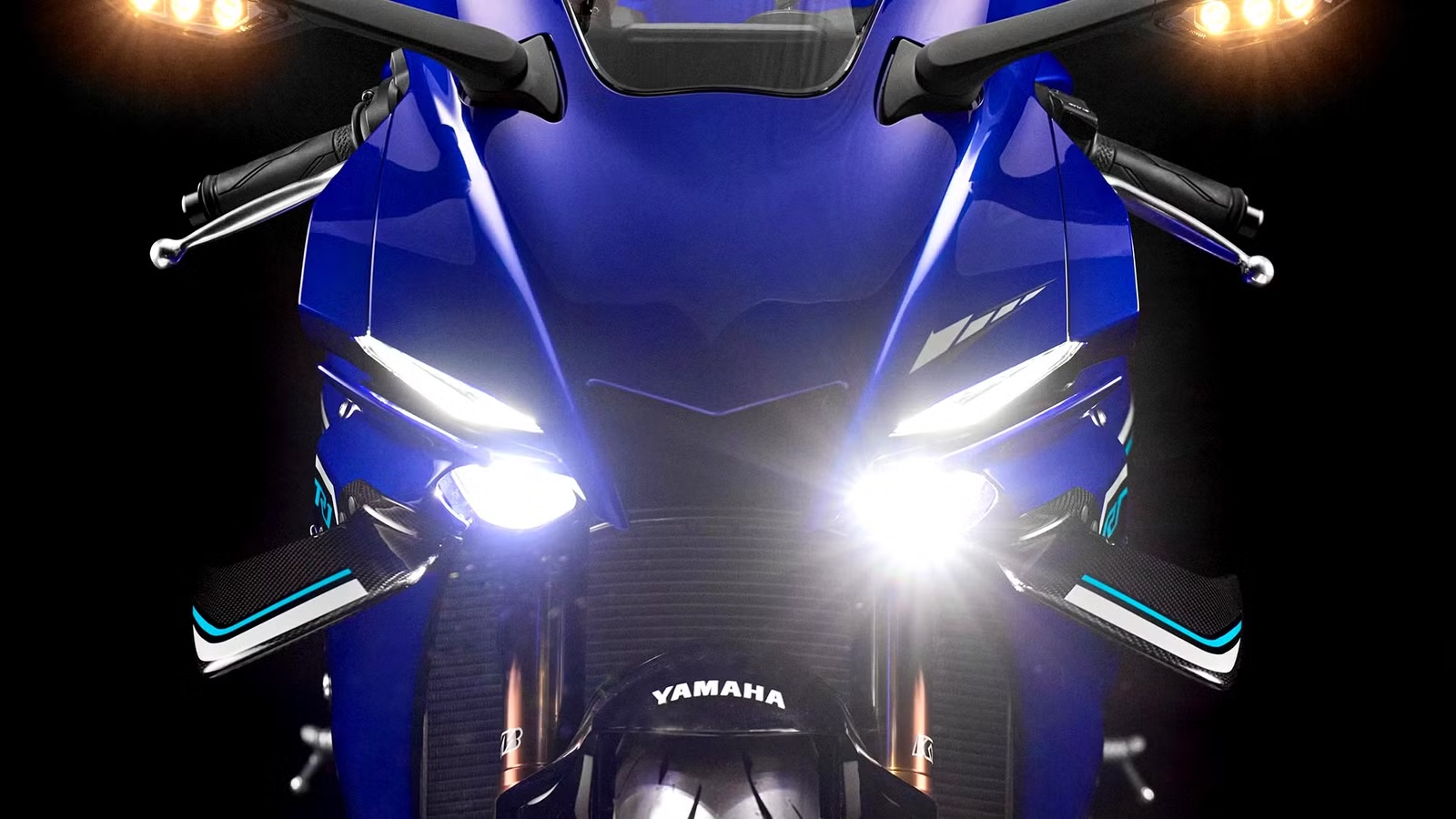
Big engines have traditionally occupied the expensive end of a motorcycle showroom. Cruisers relied on displacement for effortless torque, tourers used it to haul riders and luggage without breaking a sweat, and sport bikes squeezed increasingly serious performance from roughly liter-sized four-pot motors. Yamaha has played in all three camps over the years, which makes its 2026 lineup particularly interesting.

Most of its current range now revolves around compact shared platforms, with the 689cc CP2 and 890cc CP3 powering everything from affordable roadsters to adventure bikes and sport-tourers. That leaves Yamaha’s biggest current engine at under 1,000cc. Yet, capacity only tells half the story here. The engine sitting at the top of Yamaha’s 2026 range is also one of its most distinctive.
Yamaha Used To Have An Arsenal Of Much Bigger Motorcycle Engines
A liter cubic capacity ceiling would have sounded unlikely looking through the Yamaha catalog not too long ago. The company previously offered several motorcycles comfortably beyond the liter mark, particularly when heavyweight cruisers and traditional sport-tourers occupied a larger chunk of its U.S. lineup that, of late, seems to have diminished, getting rid of cruisers and sport-tourers altogether despite its rivals still offering a plethora of options in these segments.

The Star Roadliner is one such example. It used a 1,854cc air-cooled, 48-degree V-twin in 2006, and that basic capacity subsequently appeared across several large Star-series cruisers. Yamaha returned to it with the Star Venture in 2017, building a luxury tourer around another 1,854cc air-cooled V-twin designed around low-rpm torque, highway comfort, and luggage plus passenger carrying ability.

Then there was the FJR1300, or technically, still is, as it’s listed on the website. Its 1,298cc liquid-cooled inline-four became one of Yamaha’s longest-serving large-displacement road engines and remained in the American lineup through the 2024 FJR1300ES. Yamaha is still clearing those motorcycles in 2026, but the model itself remains a 2024. It therefore doesn’t count when discussing Yamaha’s biggest engine for the current model year.
That leaves Yamaha’s current road-bike lineup looking very different from not too long ago. The Tracer 9 family now handles sport-touring duties with an 890cc CP3 triple, while Yamaha no longer sells a current heavyweight cruiser remotely close to the old Star Venture’s capacity. There was also the 1,679cc V4-powered VMAX bruiser that the company has pulled the curtains on. In other words, the company’s biggest engines didn’t shrink because performance disappeared. Yamaha simply changed how it goes looking for it in 2026.
The 998cc CP4 Is Now Yamaha’s Biggest Powerhouse

The flagship engine crown now belongs to Yamaha’s 998cc CP4 inline-four cylinder motor. Given Yamaha’s current strategy of sharing engines, it powers four 2026 motorcycles: the YZF-R1, YZF-R1M, MT-10, and MT-10 SP. All four use the same fundamental 79.0mm bore and 50.9mm stroke dimensions, making the engine decidedly oversquare. The short-stroke nature helps it cope with the high rpm demands of this performance line of bikes, while keeping the assembly relatively compact. Liquid cooling, dual overhead camshafts, four valves per cylinder, fuel injection, and a six-speed transmission complete the basic layout.

The superbike and naked-bike versions aren’t identical, though. The R1 and R1M run a 13.0:1 compression ratio, while the MT-10 and MT-10 SP use 12.0:1 compression alongside intake, exhaust, and fuel-injection tuning aimed at stronger everyday low- and midrange response. So, although Yamaha describes the MT-10 engine as R1-derived, this isn’t simply a like-for-like superbike motor wearing less bodywork. The applications share their core internal architecture but are calibrated around very different jobs.
The Crossplane Crank Is What Makes The Experience Different

The important part of the CP4 name isn’t the number of cylinders. It is the crankshaft design. A conventional inline-four typically uses crankpins arranged 180 degrees apart. Yamaha’s CP4 places them at 90-degree intervals, producing uneven firing intervals of 270, 180, 90, and 180 degrees. That arrangement gives the engine its throaty exhaust note much like a V4, but the sound alone was never the main objective. Yamaha developed the crossplane layout to reduce fluctuations caused by inertial torque as the pistons accelerated and decelerated.

Separating those forces more clearly from combustion torque gives the rider a more direct relationship between throttle input and the drive reaching the rear tire. And this behavior is what matters when opening the throttle while the motorcycle is leaned over, or while accelerating out of a corner, which explains the architecture’s roots in Yamaha’s YZR-M1 MotoGP program. The crossplane design reached production with the R1 in 2009, and a heavily redesigned CP4 followed with the 2015-generation R1. More than a decade later, Yamaha still considers that design and character worth keeping, and we’d agree wholeheartedly.
One Engine, Two Very Different Personalities

The 2026 MT-10 is the least expensive route into the 998cc CP4 at $14,999. Here, the engine is tuned for street use rather than lap times, which suits a 467-pound hyper naked equipped with cruise control, a six-axis IMU, fully adjustable KYB suspension, and a 4.5-gallon fuel tank. Spend $17,499 and the MT-10 SP retains the same 998cc engine but adds electronically controlled Öhlins suspension at both ends.
The other side of the family starts with the $19,199 YZF-R1. Its higher-compression version of the CP4 works inside a 448-pound superbike equipped with a Deltabox aluminum frame, IMU-based rider aids, Brembo front brakes, and aerodynamic winglets. This is where the engine’s high-rpm ability and crossplane delivery are exploited most aggressively.

At $27,899, the YZF-R1M sits at the top of the CP4 range. The engine capacity remains unchanged, while carbon-fiber bodywork, magnesium wheels, data-logging capability, and electronically controlled Öhlins racing suspension account for much of the difference. Even at this level, Yamaha’s flagship treatment isn’t about making the engine bigger.
That makes the CP4 unusually versatile and explains the company’s decision to use it in different applications. It has to provide tractable, road-friendly performance in the MT-10 while also forming the basis of Yamaha’s flagship production superbike to set a track day on fire with blistering lap times. The common factor remains its bulletproof reliability and ease of maintenance.
Yamaha’s Biggest Engine Is Small By Modern Flagship Standards

What really stands out in 2026 is how restrained the 998cc looks beside some rival flagships. Kawasaki’s Ninja 1100SX and Z1100 use 1,099cc inline-fours, while large adventure bikes, cruisers, and touring motorcycles routinely push well beyond 1,000cc. Even among performance motorcycles, the R1’s arch nemesis, the BMW’s S 1000 RR, uses a 999cc inline-four, effectively matching Yamaha for capacity. BMW broadens its power delivery with ShiftCam variable intake valve timing, while Yamaha’s CP4 relies on its crossplane crankshaft and, in the R1 and R1M, variable-length YCC-I intake funnels.

So it seems that Yamaha’s current approach with its biggest motorcycle engine in 2026 isn’t about trying to win a displacement contest. The company has already demonstrated that it knows how to build engines approaching twice the CP4’s capacity. Instead, Yamaha’s largest current engine sits at a shade under a liter because that is enough for the motorcycles using it, which are also the company’s flagships. More importantly, the CP4 has something much harder to replace than another hundred cubic centimeters, which is a mechanical identity that remains recognizable whether it is buried inside an R1’s fairing or sitting exposed in an MT-10.
Source: Yamaha

Related posts

Latest Post


No Comments