
Behind The Manual BRZ Trim Enthusiasts Guard Like A GT3
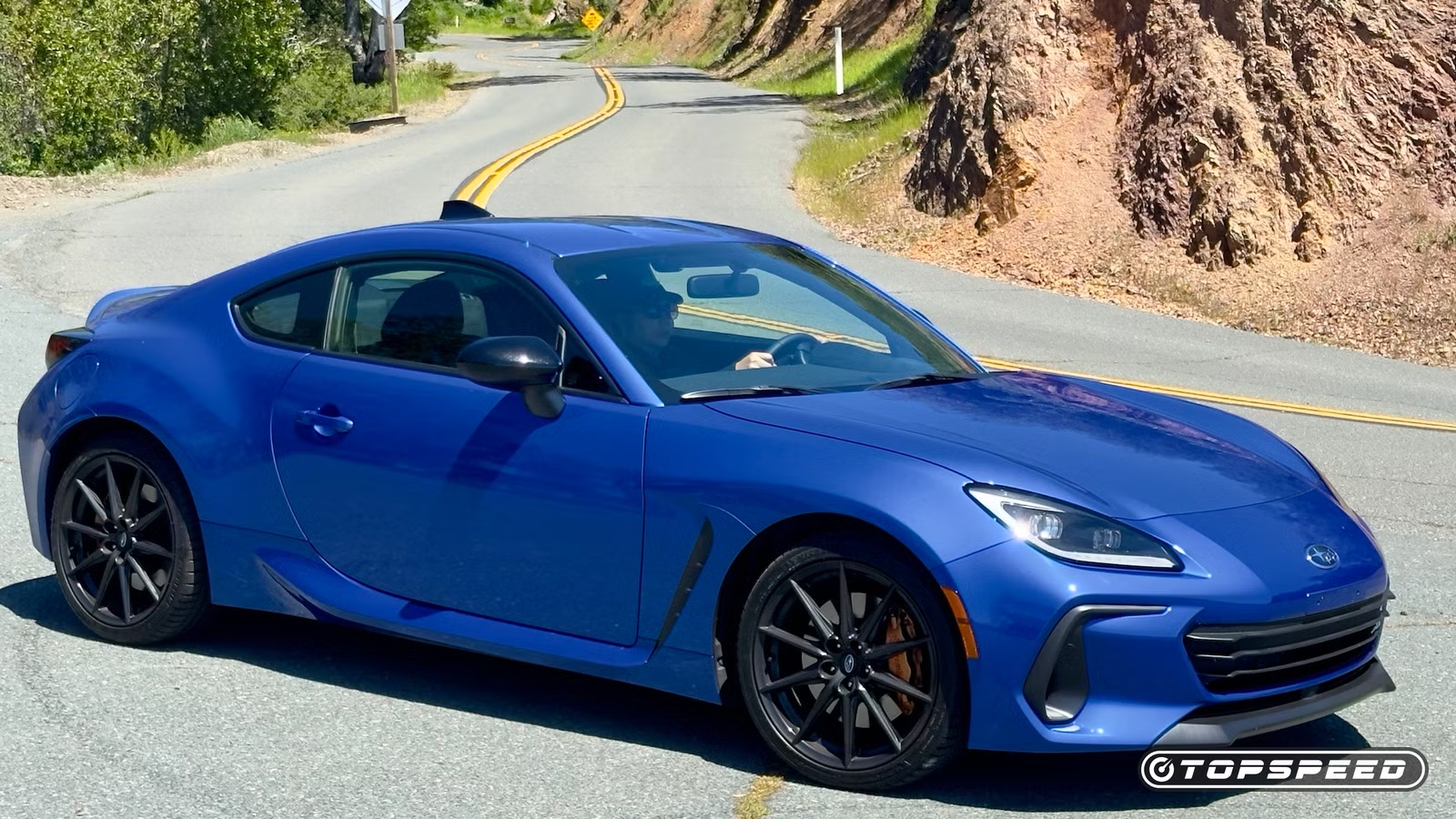
A six-figure Porsche 911 GT3 and an affordable Japanese sports coupe should have almost nothing in common. One is a coveted collector car with supercar performance, while the other makes 228 horsepower and costs less than many luxury crossovers. Yet, owners of one particular manual-only trim can be nearly as reluctant to hand over their keys. It is not exceptionally powerful, individually numbered, or guaranteed to appreciate, but it combines three pedals, RWD, and factory-developed chassis upgrades in a package that may become increasingly difficult to replace. The question is whether its used-market performance justifies that protectiveness, or whether enthusiasts simply love it too much to let it go.
The Manual Sports Car Drought Has Changed What Feels Special
Affordable RWD Manuals Are Becoming The Exception

Affordable performance has not disappeared, but its character has changed. Hot hatchbacks lean heavily on turbocharging and all-wheel drive, while increasingly powerful muscle cars have pushed well beyond the traditional affordable-car price range. Electrification is adding speed, but usually with more weight and no manual transmission.
That leaves the Subaru BRZ, Toyota GR86, and Mazda MX-5 Miata holding onto a remarkably specific formula. Each combines RWD, a naturally aspirated engine, and an available manual transmission without demanding luxury-car money.
Scarcity alone does not make any of them collectible. However, it changes how owners think about replacement. Selling an ordinary commuter means finding another appliance. Selling a lightweight, naturally aspirated manual coupe means betting that manufacturers will continue building one, which is becoming rarer than ever.
The BRZ Prioritizes Involvement Over Outright Speed


The BRZ has never won arguments by dominating a spec sheet. Its 2.4-liter flat-four engine produces 228 horsepower and 184 lb-ft of torque, numbers that look modest compared to modern turbocharged performance cars. That is also part of its appeal.
With RWD, a Torsen limited-slip differential, a low seating position, and curb weight below 2,900 pounds in most configurations, the BRZ lets you use more of what it offers. Its limits are approachable enough to explore without requiring a racetrack or reckless speeds.
The tS follows the same philosophy. Subaru did not add forced induction or chase a dramatic acceleration improvement. Instead, it sharpened the chassis, brakes, and body control — the qualities that already made drivers become attached to the BRZ.
The Second-Generation BRZ Gave The tS A Better Foundation
The 2022 Redesign Addressed The Original Car’s Weakness

The first Subaru BRZ earned praise for its handling but faced years of criticism over its 2.0-liter engine and uneven torque delivery. Subaru answered with the second-generation model for 2022, adding a naturally aspirated 2.4-liter flat-four engine that increased output to 228 horsepower and 184 lb-ft, but the more important improvement was the broader, more accessible torque curve. Subaru also claimed a roughly 50 percent increase in torsional rigidity and a 60 percent improvement in front lateral bending rigidity. An aluminum roof and front fenders helped control weight.
The result retained the original BRZ’s character while removing one of the largest barriers to loving it. It was still not brutally fast, but it no longer felt as though the engine and chassis belonged to different cars.
The tS Returned To Refine The Chassis, Not The Engine

Subaru waited until the 2024 model year to bring the tS badge back. Short for “tuned by STI,” the designation does not transform the BRZ into a full STI model. It creates a factory-developed version for drivers who value consistency and feedback.
The tS received STI-tuned Hitachi dampers, four-piston front and two-piston rear Brembo brake calipers, 18-inch wheels, and Michelin Pilot Sport 4 tires, while the engine output remained unchanged.
That decision defines the car. A tS buyer pays for better body control, stronger braking performance, and factory integration rather than additional horsepower. It is less impressive in sprint racing but potentially more satisfying when the road starts to turn.
The tS Turns Its Constraints Into Part Of The Appeal
Every 2024–2026 BRZ tS Comes With Three Pedals

Subaru’s official 2026 specifications confirm that the tS remains exclusively paired with a six-speed manual transmission. That continues the approach used for the 2024 and 2025 models, even though other BRZ trims have offered an automatic.
That restriction matters because it makes the tS a self-selecting car. Nobody ends up with one simply because it was the most expensive BRZ on the dealer’s lot. Every owner chooses the same basic experience: three pedals, RWD, and chassis upgrades that make more sense to an enthusiast than a horsepower shopper.
The manual does not make the tS rare on its own. You can still order a regular BRZ or GR86 with one. What it does is give the trim a clearer identity and make an unmodified, well-documented example easier for another enthusiast to understand later.
Its Price Has Climbed Close To $40,000

The argument becomes more difficult when price enters the conversation. The tS started at $35,345 before destination for 2024, rose to $36,245 for 2025, and reached $38,360 for 2026. That represents a $3,015 increase, or roughly 8.5 percent, in only three model years. Once the destination is added, the 2026 car enters $40,000 territory.
A less expensive BRZ or GR86 delivers the same engine and fundamental layout. You could use the savings for aftermarket suspension and brake components, potentially creating a faster track car.
However, modifications do not necessarily reproduce the tS ownership proposition. The Subaru sports car offers a complete factory package with warranty coverage, predictable calibration, STI association, and equipment that future buyers can identify from the VIN. You are paying partly for the capability and partly for the confidence that nobody assembled the package in a garage.
The Used Market Tells A More Complicated Story
Resale Studies Disagree On What The BRZ Retains

This is where any clean future-classic narrative begins to fall apart. iSeeCars estimates that the BRZ depreciates by 23.9 percent over five years, resulting in 76.1 percent retention and an estimated $27,280 resale value. Its calculation statistically compares MSRP with the values of five-year-old vehicles.
CarEdge reaches a similar result, forecasting 24-percent depreciation and a $27,508 value after five years. However, its estimate assumes a vehicle in good condition, driven 13,500 miles annually, and an original purchase price of $36,015.
Those estimates concern the BRZ range, not the 2024-and-newer tS specifically. They are also forecasts or model-wide analyses rather than a five-year transaction record for a trim that has existed in its present form for only a few years.
Kelley Blue Book presents a less flattering short-term picture. Its current national valuation page places a used 2024 BRZ tS at around $27,200, against an original price of $36,465, including destination. Different ages, mileage assumptions, valuation dates, and methodologies explain why these figures should not be blended into one convenient retention claim.
Used Listings Show A Premium, Not Immunity From Depreciation

According to Cars.com, the nationwide average asking price for a used 2024 BRZ tS is approximately $28,350, with listings beginning around $27,100. That suggests demand, but it also confirms that early cars have depreciated from their original sticker prices.
Completed sales provide a more useful reality check than dealer asks. A clean, unmodified 2025 tS with approximately 1,600 miles sold on Cars & Bids for $31,500 in January 2026. It attracted 19 bids, 575 watchers, and more than 10,000 views — strong evidence of enthusiast interest, although not evidence of appreciation.
Public listing tools did not provide a consistent nationwide count or verifiable average days-on-market figure for manual 2024-and-newer tS models. Therefore, the market cannot prove that owners statistically refuse to sell. It only shows that clean examples attract attention and maintain an asking-price advantage over many ordinary BRZs.
The BRZ tS Captures More Than Its Specs Suggest
Its Rivals Appeal To Different Kinds Of Enthusiasts

The Mazda MX-5 Miata is lighter and offers open-top driving, but it has less cargo space and produces 181 horsepower. The mechanically related Toyota GR86 generally offers the same fundamental experience for less money, though it lacks the tS model’s specific combination of STI-tuned dampers and Brembo brakes.
A used Porsche Cayman adds a mid-engine layout, prestige, and a more exotic ownership experience. It also introduces higher purchase prices and the potential for considerably more expensive maintenance and repairs.
The tS sits between those worlds. It is more specialized than a standard affordable coupe but less intimidating than an aging European sports car. Its advantage is not that it defeats every rival. It is that the entire package arrives from the factory and asks relatively little from its owner beyond accepting the manual transmission.
The tS Makes More Sense As A Keeper Than An Investment
Enthusiast discussions and auction comments reveal real attachment. One Cars & Bids commenter even claimed to love a BRZ tS enough to consider buying a second. That captures the culture better than it predicts future value.
You should not buy a tS because appreciation seems inevitable. Public resale studies do not isolate the trim; current examples have depreciated, and condition may eventually matter more than the badge. Accident history, track use, modifications, mileage, and maintenance records can quickly erase any factory-specification premium.
Buy one because you want the most focused factory BRZ and intend to keep it. If price matters more, a BRZ Limited or GR86 is easier to justify. If you plan to replace the suspension immediately, paying extra for the tS hardware makes even less sense.
Enthusiasts do not guard the BRZ tS like a GT3 because the Subaru matches its performance or investment potential. They guard it because both cars represent configurations their owners fear manufacturers may not build forever. The tS is not yet a collectible model. It may be something more useful: an attainable sports car compelling enough to make selling feel like a mistake.
Sources: Subaru, Mazda, Porsche, iSeeCars, CarEdge, Kelley Blue Book, Cars.com, Cars & Bids, Car and Driver

Related posts


Latest Post


No Comments