
Honda’s CB350 Has Been Quietly Dominating India — Now a Production Expansion Could Finally Bring It West
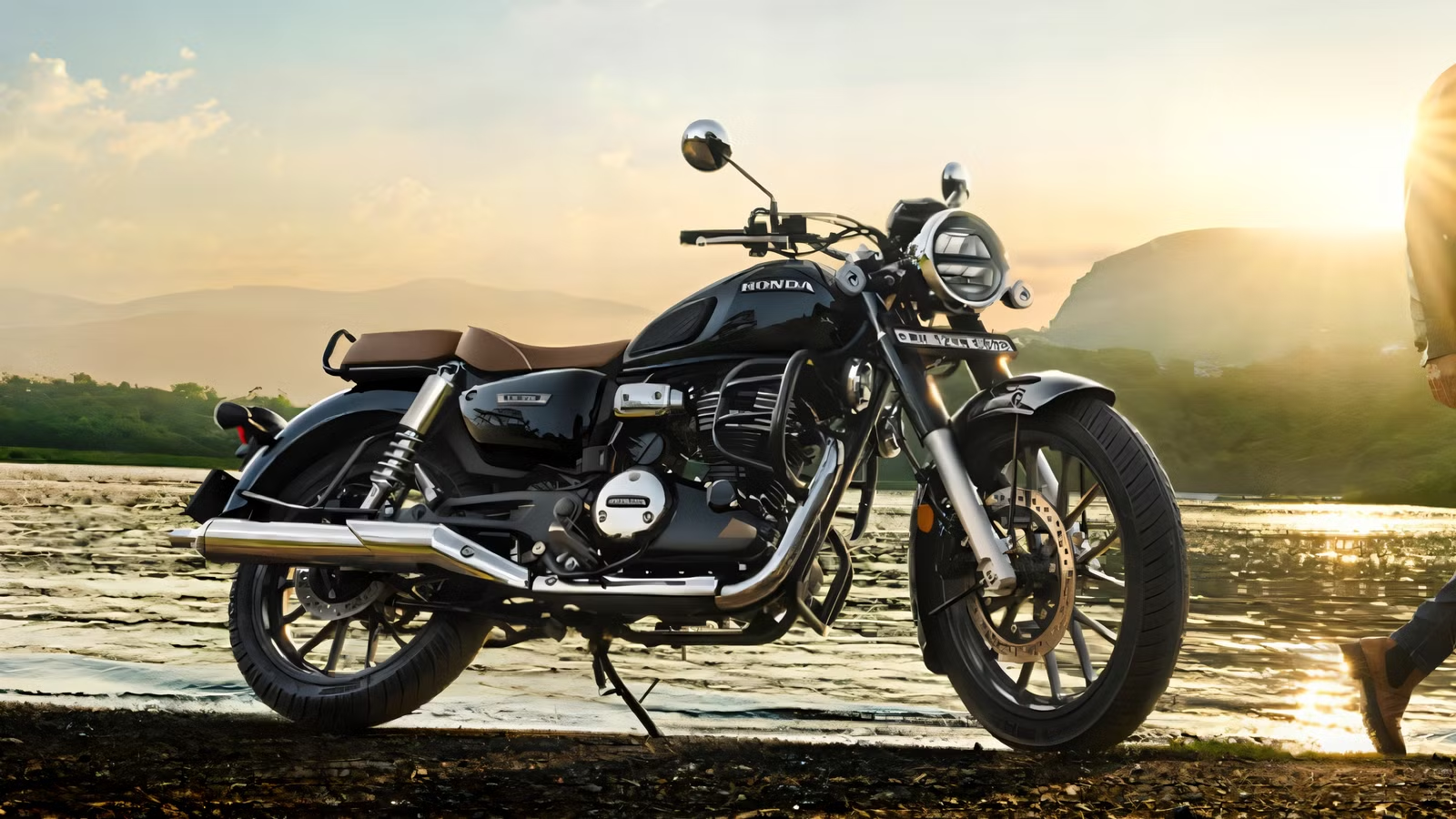
Honda built a Royal Enfield fighter, sold it in enormous numbers across India, and then kept it entirely to itself. The CB350 — a 350cc air-cooled retro middleweight with classic styling and a price point well under $3,000 in its home market — has been one of Honda’s quiet success stories since its 2021 launch, consistently challenging Royal Enfield’s grip on India’s booming neo-classic segment. Western riders have never had access to it.

That could be changing. Honda’s announcement this week of a significant production scale-up at its Indian manufacturing operations signals a broader strategic shift: India is becoming a global export hub, not just a domestic production line. Whether the CB350 rides that wave into North American and European dealerships is still an open question — but the conditions for it have never looked more favorable.
What the CB350 Actually Is
The Honda CB350 — sold in India under the H’ness CB350 and CB350RS nameplates — runs a 348.36cc single-cylinder air-cooled engine producing around 21 horsepower and 30 Nm of torque. Those numbers won’t win drag races, but they’re not supposed to. The bike is tuned for relaxed urban and highway cruising, with a torque curve that delivers accessible, low-rev pull — exactly what the retro segment rewards.

Styling draws directly from Honda’s classic CB lineage: round headlight, chrome accents, a teardrop tank, and spoke wheels on the standard trim. The CB350RS adds a slightly more scrambler-influenced stance with blacked-out components and a high-mount exhaust. Both variants sit on a steel double-cradle frame with telescopic forks up front and twin rear shocks. In India, pricing starts around 2.0–2.2 lakh rupees — roughly $2,400 to $2,650 USD at current exchange rates — making it one of the most affordable new retro middleweights on the planet.
Outselling Expectations in Royal Enfield Territory

Royal Enfield has owned the Indian middleweight retro segment for decades. The Meteor 350, Classic 350, and Bullet 350 collectively represent a massive installed base and fierce brand loyalty. Honda entering that space with the CB350 was a genuine gamble — and it paid off. The bike consistently ranks among Honda’s top-selling models in India, moving tens of thousands of units annually and earning a reputation for reliability and refinement that resonates with buyers who want the retro aesthetic without the Enfield ownership experience.
The CB350 also benefits from Honda’s dealer network in India, which is extensive and well-supported. That infrastructure advantage, combined with competitive pricing and Honda’s brand trust, gave the CB350 traction that a lesser-known manufacturer couldn’t have achieved in the same timeframe.
Why Western Riders Have Been Locked Out — Until Now

The CB350 was engineered specifically for Indian market conditions and regulatory requirements. It doesn’t meet Euro 5 emissions standards in its current form, and it hasn’t been homologated for North American or European sale. Honda has shown no urgency to change that — until the production expansion announcement shifted the calculus.
Scaling India as a global manufacturing hub implies Honda is rethinking which models get exported and from where. If the CB350 were to receive Euro 5 or EPA-compliant tuning — a meaningful but not insurmountable engineering task for a platform Honda already knows well — the export economics start to make sense at scale. A bike that costs Honda relatively little to produce, commands strong margins in India, and could land in Western markets at a sub-$5,000 MSRP would occupy a segment that currently has very few credible options.
The Western Market Gap the CB350 Could Fill
In North America and Europe, the affordable retro middleweight segment is genuinely underserved. Royal Enfield’s Meteor 350 retails around $4,799 in the US — a strong value proposition, but one that Honda could undercut or match while offering its own brand cachet. The Triumph Street Twin starts above $9,000. The Kawasaki W800 sits even higher. Below $5,000, the retro options thin out quickly.
A CB350 landing at, say, $4,500 to $5,000 in the US would compete directly with the Meteor 350 while carrying Honda’s reliability reputation and dealer network. For new riders, returning riders, or commuters who want the neo-classic look without the premium price, that’s a compelling package. The segment has been waiting for exactly this kind of entry.
Honda hasn’t confirmed CB350 exports, and regulatory hurdles are real. But the production expansion announcement makes this a live conversation in a way it wasn’t six months ago. For riders who’ve been watching the CB350 from a distance — admiring the specs, the price, and the styling — the wait may finally be getting shorter.

Related posts





Latest Post


No Comments