
The Corvette’s Iconic T-Top Was Stolen From A Forgotten 1948 Prototype
Imagine you are a design student at ArtCenter College in Pasadena, California, in the 1970s. Campus is full of rumors about your automotive design professor: He’s a college dropout, designed Le Mans race cars, the Lincoln Continental, and the first ever FWD car.

A classmate asks about the teacher’s custom green Chevrolet Corvette, vanity plate: “My Top.”
The old man explains, “I invented the T-top.”
So GM gave him the Corvette as a “thank you?”

He laughs. “No, I had to sue the jerks.”
Gordon Buehrig Shaped Automotive History
Gordon Buehrig’s life story is also the story of the early automobile industry. He was born in Illinois in 1904. His earliest memories were of pre-Model T America, and he witnessed the revolutionary spread of the automobile. He eventually dropped out of University in Illinois to travel to the Motor City instead. In 1924, he began his apprenticeship at a body shop just outside of Dearborn, Michigan.
He worked on vehicle designs for Packard and General Motors. By 1929, he was responsible for designing the Stutz Black Hawks that Stutz sent to the 24 Hours of Le Mans to challenge Bentley.

Buehrig’s early work earned him recognition. At 25, he became Duesenberg’s chief body engineer. There, he designed the Model J.
In 1934, Buehrig decided to move to Auburn, Indiana, to sign on to the Auburn Automobile Company. His first project there was the instantly recognizable 1935 851 Boattail Speedster. Then he began to experiment. His next project was the shockingly original 1936 Cord 810/1937 812. It was an airplane-inspired Art Deco car and the world’s first mass-produced FWD.
By the end of WWII, Buehrig was at Studebaker. In 1949, he signed on at Ford. His Blue Oval projects included the 1951 Victoria Coupe and the 1956 Continental Mark II. He finally retired from Ford to begin teaching in 1965. But not until he’d completed another unique project.
TASCO: The American Sports Car Co

Gordon Buehrig was the designer and one of the investors of a historic project. The American Sports Car Co (TASCO) spent $57,000 developing an unprecedented concept car. The design brief was simple enough: build an American sports car that could go wheel-to-wheel in European-style racing events at Watkins Glen racetrack.
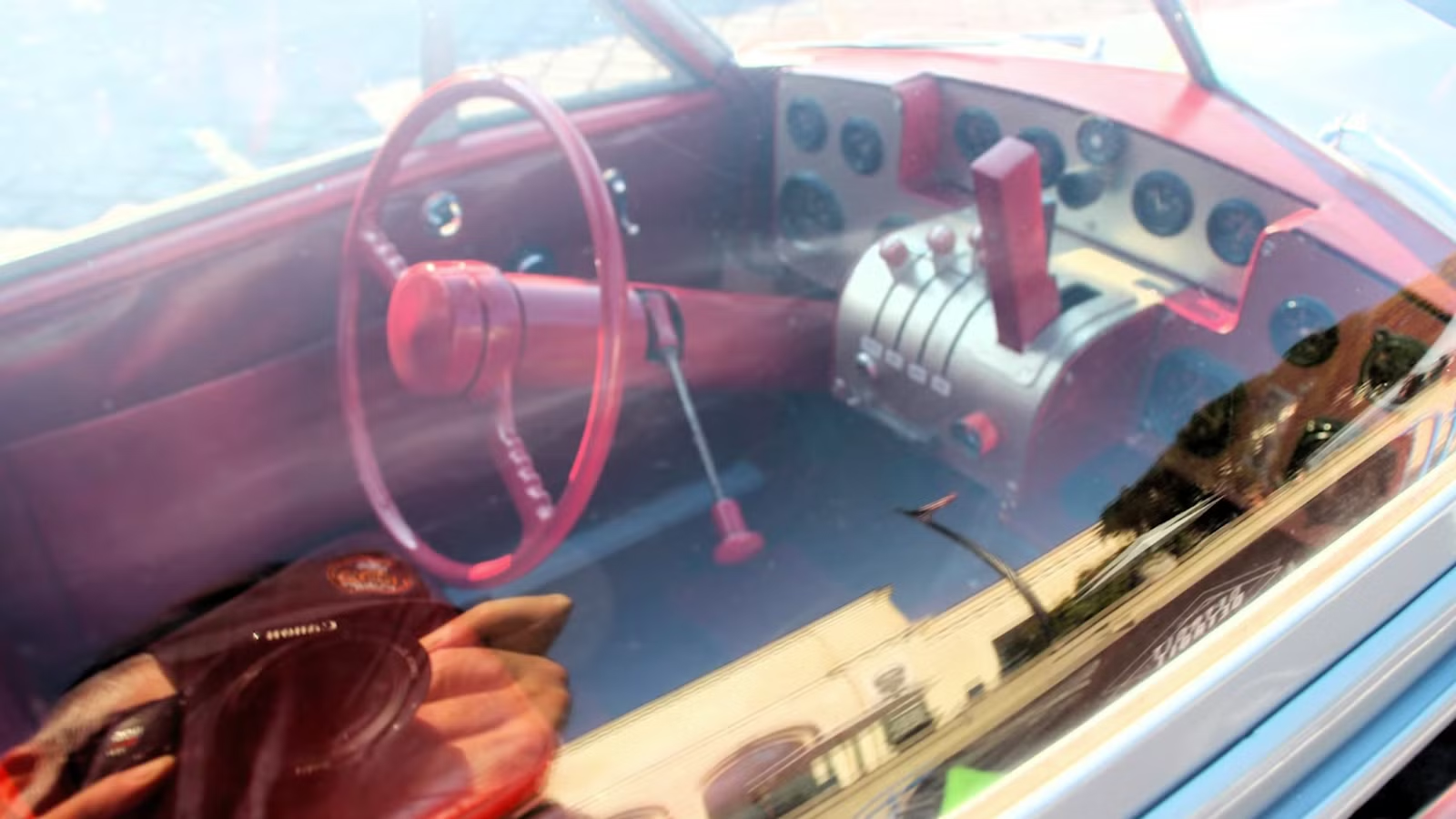
Buehrig’s concept started life as a 1947 Mercury, but it got a V8 tuned for 150 hp and an entirely new body. One of its most eye-catching features was its thin wheel pods. These fiberglass “fenders” were a sort of futuristic take on the design of open-wheeled European Grand Prix cars. The TASCO had a long, aluminum, fuselage-shaped body and aviation-style side vents. Its cockpit was a closed but very aerodynamic bubble for two passengers.

One of its signature features was its roof. It didn’t have a convertible top. But it did have a plexiglass panel above the driver and another one above the passenger. If you removed both, you had an open-air vehicle. But a support bar remained overhead, to keep the sports car’s body stiff for cornering.
The 1968 Chevrolet Corvette Blatantly Stole Buehrig’s Idea

For nearly two decades, no car attempted anything like Buehrig’s pair of lift-off roof panels. Then the C3 Corvette debuted with its “T-top” configuration.
There are several reasons General Motors chose this configuration for the “C3” generation of America’s sports car. First and foremost, convertibles were a huge market segment. But enthusiast drivers were demanding better handling dynamics, and it’s difficult to build a convertible with a stiff body. A stiff overhead brace that remains up when the roof is down solves this problem. Finally, there were rumors that the federal government was considering banning convertibles based on poor crash test results. The company likely hoped a T-top would have snuck by.
The C3 Corvette wasn’t shy about its T-top roof. In fact, Chevy ran a “10 seconds to lift off” advertisement to illustrate the removable panels. But Chevy hadn’t just been inspired by the TASCO prototype. It had steamrolled Buehrig’s intellectual property.

The truth is that Buehrig had actually patented the T-top. He was finally awarded patent number US2556062A for a “roof with movable parts” in 1951. Instead of giving credit where credit was due, General Motors blatantly ignored Buehrig’s pioneering design. Perhaps its lawyers felt his patent was too vague. Perhaps they hoped he’d forgotten about his patent—which expired in June 1968. But no such luck for GM. When it launched the C3 in September 1967, Buehrig sued the company.
All the details of the lawsuit aren’t public. What we do know is that General Motors either wasn’t confident in its chances of winning or didn’t want the bad press, because it settled with Buehrig outside of court. We also know that Buehrig originally asked for $100,000, hoping to recoup some of his investment in TASCO, but was only granted a fraction of this. So back into the classroom went (Professor) Buehrig.
Buehrig’s Greatest Unsung Contribution To Automotive Design

While Buehrig taught automotive design to college students, one of his greatest accomplishments exploded in popularity.
The T-Top design spread from the Corvette to the Pontiac Firebird Trans Am, the Chevrolet Camaro, and even the “fox body” generation of the Ford Mustang. Even Buehrig’s recent employer (Ford) didn’t see a reason to give him so much as a penny of royalties.
The T-top might have hit its pop culture peak during 1977’s Smokey and the Bandit. Burt Reynolds’ hero car was a 1977 Pontiac Firebird Trans Am that has its T-top panels off for much of the film. But the film was far from the end of the road for the configuration.

The 1980s continued to see T-Tops used in several legendary cars. This includes the Datsun/Nissan 300ZX, Ford Mustang, Buick Grand National, and Toyota MR2.
Buehrig, meanwhile, was having problems in his personal life. And they were on par with the financial disaster that had been TASCO and his invention of the T-top.
One Person Never Forgot Buehrig’s “Golden” Brilliance

Gordon Buehrig married Elizabeth “Betty” Whitten the day before Christmas Eve in 1934. The moment kicked off one of the most creative periods in his career, when he left Detroit, joined Auburn, and designed the Cord. Gordon and Betty even had a daughter, Barbara. Gordon’s wife, Betty, died on August 28th, 1970.
Kathryn “Kay” Lundell had long been a friend of Gordon and Betty. Like Gordon, she had been born in Illinois, but had moved to the Detroit area early because her father worked in the industry. Kay also had two daughters, Carol and Joanne, whom she raised on her own because her husband had died at just 37.

Kay obviously had a deep respect for Gordon’s work—and a sense of humor. She bought him a 1971 Chevrolet Corvette C3, with T-tops. Then she had the body painted bright green, to represent the money GM owed him. Finally, she had the roof painted gold to represent the “golden Gordon Buehrig idea.”
Gordon and Kay eventually married. When Gordon died in 1990, Kay bought an Auburn Roadster replica to remember him by. For the next 20 years, Kay and the black car were an icon of Detroit’s annual Woodward Dream Cruise.
Source: The Automobile Museum

Related posts



Latest Post


No Comments