
The Four-Door 1JZ Sleeper Drift Culture Turned Into A Global Icon
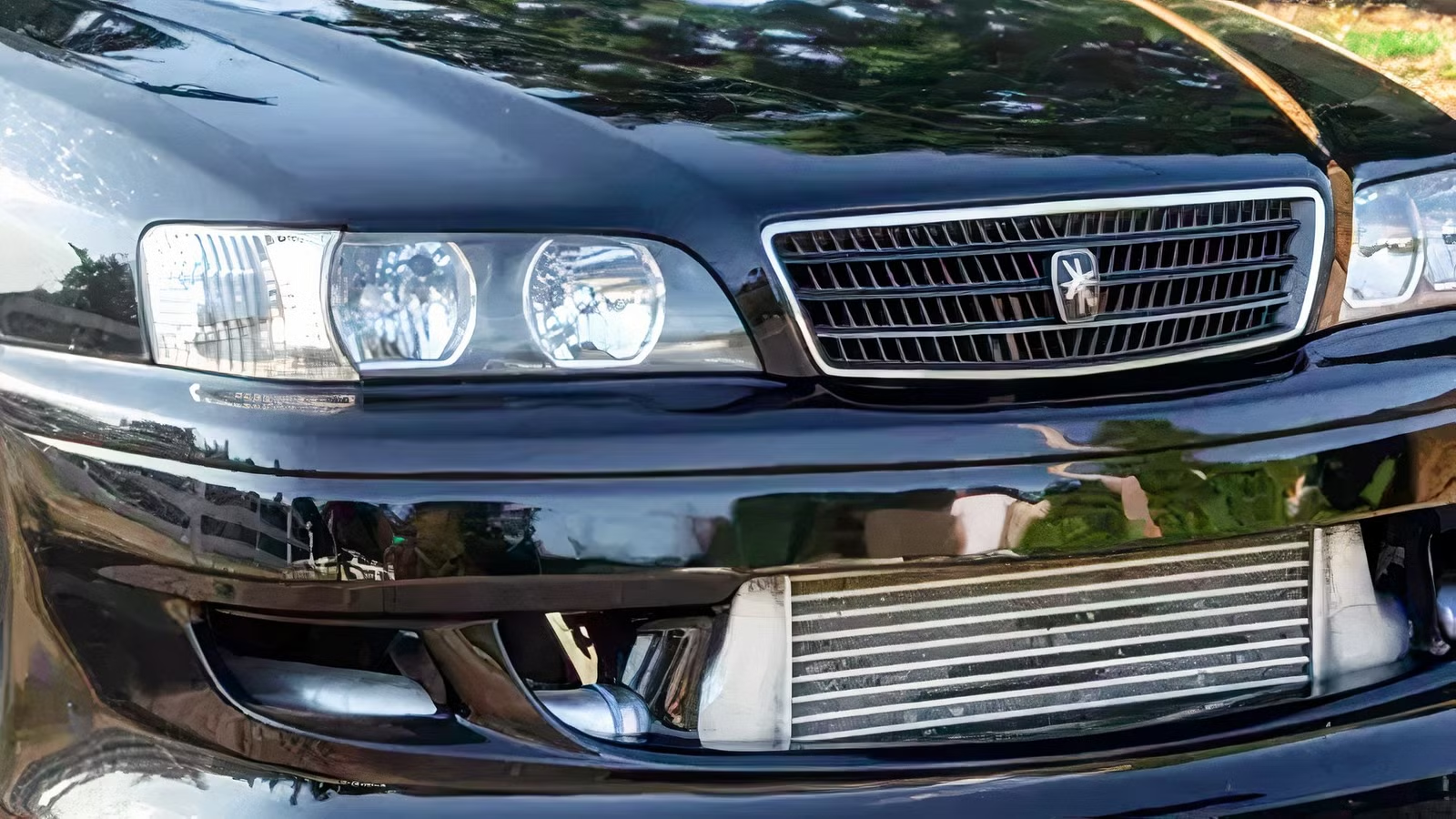
The title of JDM drift king is a title only a handful of cars can truly claim. Most of them are purpose-built sports coupes, icons like the Mazda RX-7, the Nissan S15, and the Toyota Supra Turbo, machines built practically begging for extra boost and stickier tires from the factory. On the face of it, it’s not hard to see why. A rear-drive, front-engine small coupe is practically tailor-made for drifting. But it’s not an ironclad rule. Some were what are classified as mid-size sedans in Japan, the kind of cars you could carry a family of five around in. Only when the wrenches came out did the beast emerge.
The Chaser: Toyota’s Trusty Mid-Size Platform

Americans associate Toyota in the late 1970s as only selling small, affordable cars at bargain-basement prices. In the US, and elsewhere in North America, that was certainly the case. But in parts of Europe and most of Asia, Toyota sold a whole range of cars to an audience not beholden at all to the Big 3 of Detroit. The first-generation Chaser was born into this very environment, shaped in no small part by emissions requirements put in place by Japan’s government that mirrored America’s EPA.
Based heavily on Toyota’s Corona Mark II, the Gen-I Chaser used liberal cosmetic mods to differentiate itself in the lineup. Under the hood was a choice of several four-cylinder engines ranging from 1.8 to 2.0 liters, and a single overhead-cam straight-six in upmarket trim packages. This became something of a theme for the Chaser line going forward, with a flagship straight-six coming to define later variants beloved by the drift community. Early Chasers could be had as a two-door hardtop coupe, but as time passed, the model gained street-cred as a reliable pillared hardtop sedan.
Inside, Chasers were notorious for being roomy without breaking the bank dimensions-wise. Oftentimes, leather seats and real polished wood-grain trim pieces brought an air of luxury to the Chaser line that’d soon be mirrored stateside with Lexus. It was as traditional as a cushy Japanese sedan could possibly be. That didn’t mean the aftermarket, and even Toyota themselves at times, didn’t see the potential latent within the platform.

5 Forbidden JDM Cars Americans Can Finally Import and Drive
These Japanese legends are now legal for import to the US
From Family Hauler to Drift Master: A Step-by-Step Guide

The point of differentiation between the Chaser as a four-door grocery getter to under-the-radar drift missile occurred roughly at the same time as two important events in Toyota’s history. The first was Toyota’s herculean performance in engine R&D in the late ‘80s, and the resulting thunder culture that formed around it. The fourth-generation X80-series Chaser started the process in 1988—still very much a cushy sedan, but packing more and more heat under the hood with each successive trim package.
Offerings included the legendary 2.5-liter 1JZ-GTE twin-turbo straight-six from 1990 to 1992. Ostensibly, these were tuned and sold not as race engines, but as smooth, seamless deliverers of high-end horsepower while being docile enough at the low end to be comfortable. Still, like the 2JZs that came later, these earlier engines had an enormous capacity for more boost, higher compression, and whatever else a Japanese tuning house was willing to throw at it. All these factors helped the Chaser mature into the X90, packing everything from a 2.4-liter diesel engine at the low end, and an N/A variant of the beloved 2JZ at the high-end. Permanent all-wheel drive was introduced as an option in 1993, much like the Nissan Skyline GTS’s ATTESA system, competent in the snow and the rain. Knowing this, rear-wheel drive remained the Chaser’s bread and butter through the mid-’90s.
It stayed that way long enough for the Chaser to unlock its true potential in its fateful sixth generation. When it did, it did so quietly, and in the shadow of flashier sports coupes, some of which had the very same drivetrain underneath. It wasn’t a household name in the west, but it was every bit the drift icon its two-door competitors were.
The Inline-Six Engine That Became A Global Legend
From the big screen to the drag strip, this over-engineered masterpiece still rules the tuning world.
JZX100 Toyota Chaser: Big Car, Equal Drift Prowess

September 1996 turned out to be a pivotal time for Toyota. It was the period where they launched the updated X100 Chaser to the Japanese market, and fully embraced its role as a four-door drift taxi. The soft, rounded styling lines of models gone by were replaced by angular, sharp curves and muscular bodywork. Its factory trunk spoiler came to define Toyota’s presence in the performance sedan segment, and its three-slit front grille was instantly recognizable.
The X100 retained the optional full-time AWD from the X90, but in one of the only cases you’ll see of this, the rear-drive example was much preferred by people who drove them. Gone was the lag-laden twin-turbo straight-six setup from the X90. Instead, the updated 1JZ-GTE sported a single CT15B turbocharger and Toyota’s VVT-i variable valve timing system. These seemingly inconsequential upgrades combined to make an engine as eager to rev as your right foot was willing to make it happen. Officially, the updated 1JZ-GTE made 276 hp.
|
Displacement |
Horsepower |
Torque |
|
2.5 Liters |
276 HP |
268 LB-FT |
The figure put the engine within the limit of an informal gentleman’s agreement between Japanese automakers regarding domestic market engine power. Much like the muscle car wars of the late ‘60s in America, people in the know understood that figure was a significant understatement. The real figure was somewhere closer to 300 hp, possibly even as much as 310 hp on high-octane Japanese pump gas. Dubbed the JZX100 in this configuration, even this niche in the lineup had its own hierarchy.
The Gen-VI Tourer V: The Original Drift-Happy JDM Sedan

At the very top? That’d be the Chaser Tourer V, complete with a beefed-up R154 five-speed short-throw manual gearbox, plus a Torsen limited-slip differential. With double-wishbone suspension and disc brakes at all four corners, the Tourer V waslike an M5 with a Toyota badge. Frankly, it could’ve competed with anything in the segment from the Germans at the time.
As docile and well-mannered as it was from the factory, you didn’t even need to mod the daylights out of a Tourer V to make it fun to drive. 300-plus hp was plenty for Japanese roads, and the canyons and cliffsides around Japan’s main islands were like a safe haven where these cars could unleash their potential. That didn’t mean no one ever tried to tune a JZX100 to the hilt. In the Japanese Touring Car Championship, the Chaser won the 1998 title with Le Mans and Formula 3000 veteran Masanori Sekiya at the wheel. At sanctioned D1 GP drifting events at prestigious circuits like Ebisu, Tsukuba, and Nikko, the Tourer V could whip around corners with every bit the prowess of a Supra or RX-7.
It was uncanny in its ability to drift, its 3,200-lb curb weight and 107-inch wheelbase fighting against body roll. Every time, it’d be kept in line with great suspension geometry and furious tire grip despite the wheelspin. Even with heavyweights of the day hogging the limelight, the Tourer V in particular etched its place into the history books. Now, all that was left to do was wait for them to be import ready to the US.
10 Legendary ’90s Japanese Cars That Still Crush Modern Sports Cars
Now bona fide classics, these Japanese cars remain faster than most modern sports cars.
Import Embargo Gone, So What Are They Worth?

Twenty-five years, a full quarter-century. That’s how long Americans have been denied the right to drift to the local burger joint in the greatest drifting sedan that ever existed. Such were the strict rules around registering imported vehicles not approved for use on American streets. No non-approved import gets around this, but it only made the Tourer V’s legacy grow more tantalizing as we waited.
Now? They’re all fair game in the US, and specialized auction houses like Cars & Bids have seen Gen-VI Tourer Vs sell for as low as $7,890. Up the range, automatic-equipped Tourer Vs hover around $30,000, depending on import taxes and fees. The most prestigious categories are numbers-matching, pristine JZX100 Tourer Vs with the five-speed manual, and turn-key drift racers modified by reputable shops, capping off at $65,000.
But remember, the JZX100 is distinct from its JZX90 twin-turbo cousin, so keep an eye out for the generations while browsing the web, as they’re often for sale on the same websites. Simply put, the real money is in the Supra Twin Turbo and all its rivals. What that means for the rest of us is simple: a real JDM drift missile doesn’t have to be a six-figure show car. There are ways around it, ones with two extra doors.
Source: Bring a Trailer, Cars & Bids, JDM Buy Sell

Related posts




Latest Post


No Comments