
Why Mazda’s Inline-Six SUV Makes German Luxury Rivals Look Overpriced
Luxury SUVs have become rolling status symbols with heated steering wheels, stitched dashboards, and price sheets that read like ransom notes. A buyer can walk into a German showroom thinking about one number, then leave staring at another after adding the gear most people expect in a premium family hauler.

That sets up a very awkward question. When a non-German brand offers the same rich layout, smooth six-cylinder power, upscale shape, and real SUV usefulness for far less money, how much of the German price buys engineering, and how much buys the crest on the hood? Let’s follow that money trail through the midsize luxury SUV class.

The German midsize luxury SUV class has trained buyers to accept big numbers early. For 2026, the BMW X5 xDrive40i starts at $70,600 and brings 375 horsepower. Mercedes-Benz asks $72,250 for the GLE 450 4MATIC SUV, which also makes 375 horsepower from a 3.0-liter turbo inline-six with mild-hybrid help. Audi plays the value card better at first, since the 2026 Q7 starts at $62,000, but that entry version uses a 261-hp four-cylinder. The stronger Q7 55 TFSI brings a 335-hp V6.
Those base prices do not tell the full story, though. German luxury shoppers rarely stop at the first line on the menu. They add bigger wheels, richer leather, driver-assist systems, upgraded audio, lighting packages, sport trim, tow gear, and the kind of comfort features that make a family SUV feel like a proper reward. BMW even shows a configured X5 sDrive40i at $73,500, while Audi lists a 2026 Q7 55 TFSI Prestige with major packages at $90,095. Mercedes pushes the GLE ladder to $90,000 before buyers even reach the AMG GLE 63 S.
That creates a strange new normal. A buyer can spend more than $70,000 and still feel as if the dealer has barely started circling the good stuff with a pen. The segment has not lost its engineering talent. The X5, GLE, and Q7 still carry serious hardware and strong road manners. The problem sits in the value math – these SUVs make buyers pay luxury money before they even finish building the version most people actually want.
The Sweet Spot Is No Longer Just About The Badge

Most buyers want a smooth engine, a quiet cabin, smart tech, good seats, and a body that can handle kids, luggage, weather, and a weekend trip without turning every merge lane into a group project. Enthusiasts also want a chassis that does not feel like a rolling sectional sofa. A luxury SUV should feel expensive from the driver’s seat, not only from the monthly payment.
That desirable German formula has become surprisingly specific. It usually starts with a six-cylinder engine because smooth power still matters in a heavy SUV. Then it needs all-wheel drive, balanced steering, confident brake feel, a cabin with real materials, and enough towing and cargo usefulness to justify buying something taller than a sedan. Nobody needs a 4,800-pound family hauler that drives like a track toy. But it should not feel like a refrigerator with lane centering, either.
That opens the door for a big twist. One SUV from outside the usual luxury clubhouse follows the same recipe more closely than expected. It does not start above $70,000, does not rely only on screens and shiny trim to make its case, and goes after the mechanical pieces enthusiasts care about first: engine layout, platform balance, traction, towing, and cabin polish. In a market where the badge often sits first and the value comes later, that order matters.
The SUV That Breaks The German Pricing Logic: 2026 Mazda CX-90

|
Engine |
Power |
Torque |
0-60 MPH |
Top Speed |
|
3.3-liter turbocharged inline-six |
340 hp |
369 lb-ft |
6.4 seconds |
132 mph |
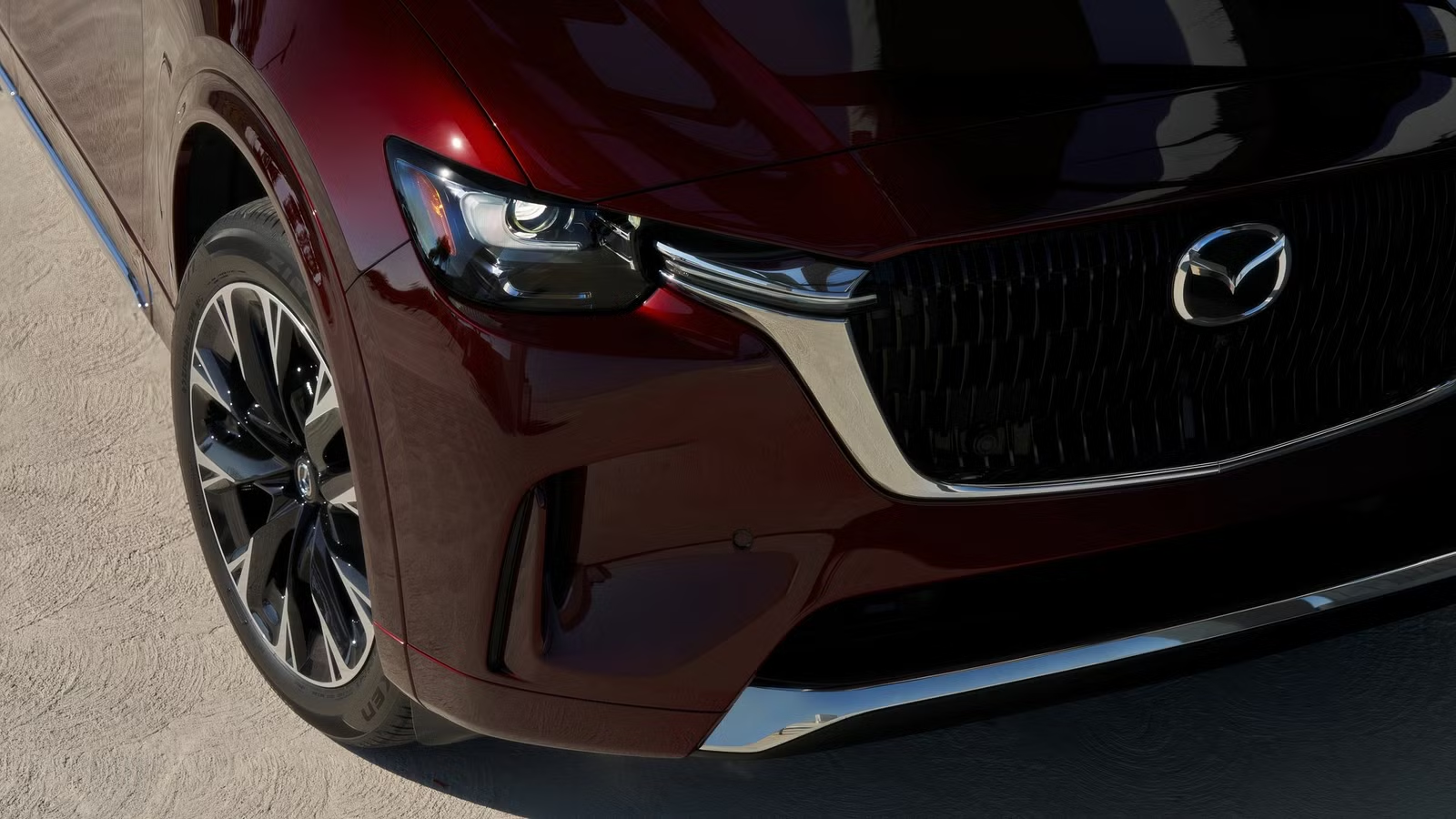
That SUV is the 2026 Mazda CX-90. It sounds odd at first because Mazda does not sit in the same mental parking lot as BMW, Mercedes-Benz, or Audi. Yet the CX-90 does not need to copy German luxury cues to make its point. It aims at the same fundamentals – a premium-leaning platform, smooth six-cylinder power, standard all-wheel drive, sharp design, and three-row family use.
Mazda built the CX-90 around its electrified Large Platform and gave it hardware that reads more enthusiast than appliance – double-wishbone front suspension, multilink rear suspension, Kinematic Posture Control, and standard i-Activ AWD. Mazda has also described the CX-90’s setup as a rear-biased AWD architecture, which helps explain why the SUV feels more serious than the average front-drive-based three-row crossover.

The engine matters even more here. The regular 3.3 Turbo models use a turbocharged 3.3-liter inline-six with 280 horsepower and 332 lb-ft of torque on regular fuel. The 3.3 Turbo S version turns that same basic layout into 340 horsepower and 369 lb-ft on premium fuel, or 319 horsepower on regular. Every inline-six CX-90 uses an eight-speed automatic and standard i-Activ AWD. That is a real premium powertrain layout, not a four-cylinder doing its best impression of one.
Then the price lands like a dropped wrench. The 2026 CX-90 3.3 Turbo Select starts at $39,300. The top inline-six 3.3 Turbo S Premium Plus starts at $57,570, both prices are before the $1,530 destination charge. In comparison, the richest gas CX-90 starts below the base BMW X5 xDrive40i and Mercedes-Benz GLE 450 4MATIC. A fully loaded Mazda undercuts the German starting line. That is “new wheels, family vacation, and still money left for snacks” territory.
The CX-90’s Value Goes Beyond The Engine

The best thing is that the CX-90’s case does not rest only on horsepower or sticker shock. Mazda gives it actual family muscle – the SUV offers seating for up to eight passengers, and higher trims can swap in captain’s chairs for a more premium second-row setup. The 3.3 Turbo and Turbo S models return an EPA-estimated 25 mpg combined, which looks strong for a large three-row SUV with a turbo inline-six. Properly equipped inline-six models can tow up to 5,000 pounds.
Inside, Mazda leans on restraint instead of overload. The brand’s Kodo design language gives the CX-90 a long-hood, clean-body look, and the cabin follows that same idea. Higher trims bring Nappa leather, premium lighting details, available Bose audio, a 12.3-inch display, wireless phone features, a 360-degree monitor with Trailer Hitch View, and a deep list of i-Activsense safety tech. The top 3.3 Turbo S Premium Plus adds second-row captain’s chairs with a center console, ventilated front and second-row seats, and Japanese Premium Nappa leather choices.

There’s an important nuance here, too – the CX-90 does not erase BMW, Mercedes-Benz, or Audi. It obviously does not carry the same badge prestige and does not promise the same dealership theater, the same brand cachet, or the same last five percent of polish that long-time luxury buyers may still notice. German SUVs still offer higher towing limits in some cases, more available performance variants, and brand histories that matter to people who want the full luxury ritual.
The Real Threat Is Not That Mazda Beats Germany

But the CX-90 does not really need to beat an X5, GLE, or Q7 in every category. That would turn the argument into a spec-sheet food fight, and nobody wins those except forum users with suspiciously free afternoons. The CX-90’s real threat comes from how much it gets right for the money. It gives buyers inline-six smoothness, standard all-wheel drive, upscale design, real three-row use, strong fuel economy, and a cabin that feels more expensive than the badge on the steering wheel suggests.
That puts pressure on the German value story. A buyer can still choose the X5 for its sharper luxury identity, the GLE for its comfort and presence, or the Q7 for its tech-rich Audi feel. Those choices make sense, but the CX-90 forces a cleaner question: how much extra does the buyer want to pay for the badge after the Mazda has already covered the basics with style, power, and a surprisingly premium backbone?

That question makes the CX-90 interesting, and not only to bargain hunters. Enthusiasts should care because Mazda spent money on the stuff that changes how a vehicle feels: engine layout, chassis tuning, AWD behavior, steering character, and interior focus. It did not just add chrome and call it a day. Thanks for that, Mazda.
The result is a three-row SUV that sneaks into a very expensive conversation wearing a much cheaper name tag. The 2026 Mazda CX-90 may not give buyers the full German luxury fantasy. It does something more annoying for those brands by giving people enough of that fantasy to ask why the cover charge got so high in the first place.
Source: Mazda, BMW, Mercedes-Benz, Audi

Related posts



Latest Post


No Comments