
The Forgotten Chrysler Wagon That Beat AMG To The Fast-Luxury Formula By 40 Years
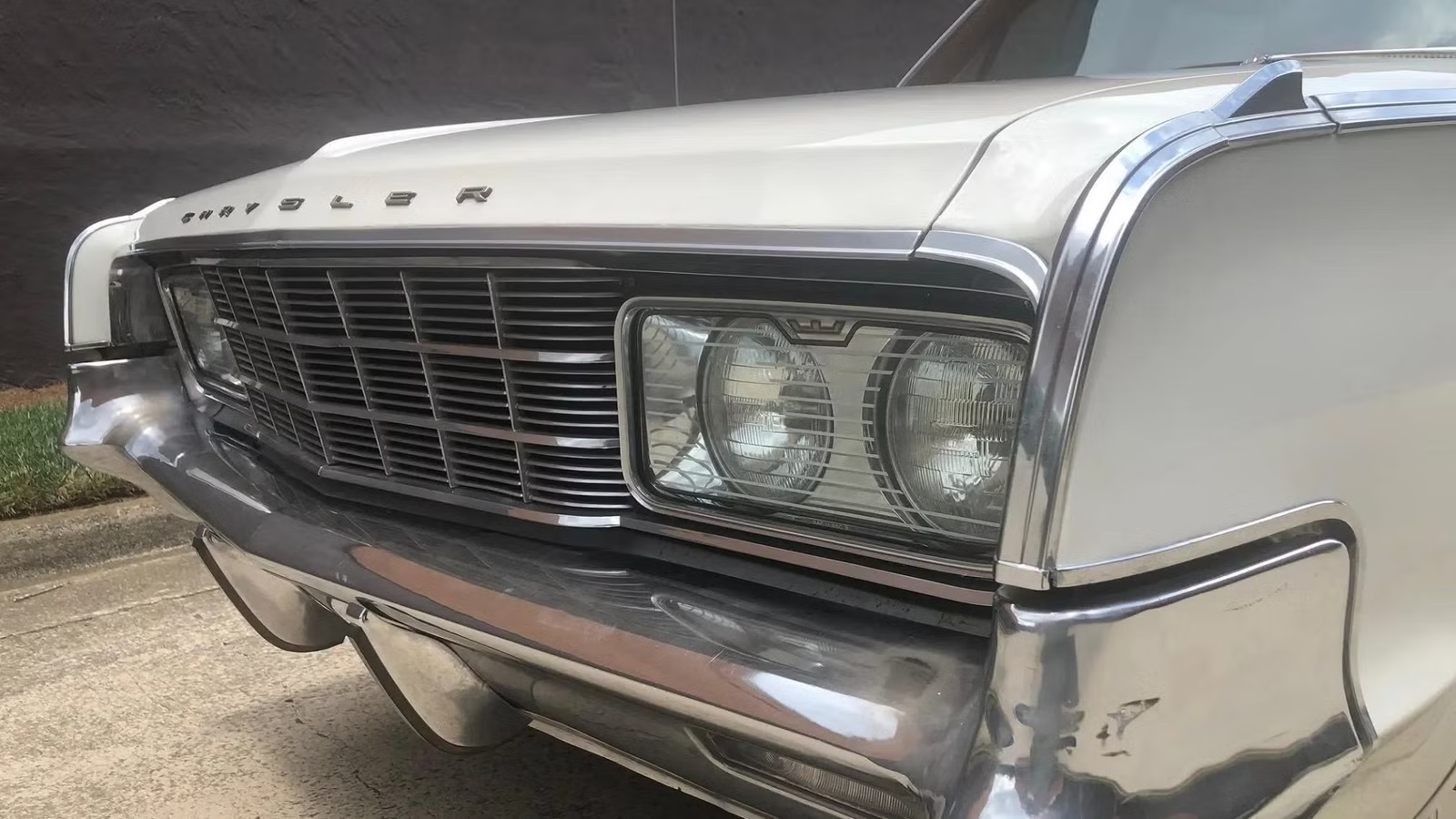
In the 1960s, station wagons carried children, groceries, camping gear, and all the visual excitement of a beige refrigerator. Most buyers valued space over speed, and enthusiasts rarely gave them a second glance. Yet one American wagon broke that rule decades before European brands turned fast estates into cult cars.
Performance Wagons Were Supposed To Be A European Invention

The familiar history of the performance wagon usually starts in Europe. Audi’s RS2 Avant arrived in 1994 with Porsche development work, all-wheel drive, and sports-car pace wrapped in a practical five-door body. Audi now calls it the founding model of the RS line and a car that helped create a new class. Mercedes-AMG later pushed the same concept toward absurdity with V8 estate cars that could haul furniture on Saturday and humble sports cars on Sunday.
The basic formula involves more than dropping a large engine into a wagon, however. Detroit did plenty of that, especially once muscle-car engines started appearing in almost everything with wheels and a warranty. A real fast-luxury wagon needs several talents at once: it must produce strong power without demanding constant effort, and it must remain settled during long, fast trips. Its cabin must feel expensive rather than merely large, and it also needs usable rear seats and a cargo area that does not exist only to satisfy a brochure writer.
By that measure, Audi and AMG built some of the clearest modern examples. They did not invent every ingredient, however – American automakers had explored luxury, torque, and long-distance speed long before the RS badge existed. One car combined those traits in a station wagon while John F. Kennedy occupied the White House.

America’s New Interstates Created A Different Kind Of Family Car

The early 1960s gave American carmakers a new kind of road to design around. Interstate construction accelerated after additional funding arrived in 1961. By the end of 1962, drivers could use roughly 14,300 miles of the system, with thousands more under construction. These roads used controlled access, divided lanes, gentle curves, and standards intended for sustained travel. A family car no longer had to crawl through every town on a cross-country trip.
Around that time, large families still wanted wide seats, luggage room, and a soft ride, but the Interstate added another demand: effortless speed. Chrysler already had the right parts on the shelf – its premium cars used large RB-series V8s, three-speed TorqueFlite automatics, power steering, power brakes, and available air conditioning. The firm also advertised unit-body construction, torsion-bar front suspension, improved shock absorbers, and transmissions designed to handle substantial torque.
That philosophy created a wonderful contradiction. Chrysler offered a wagon that weighed about 4,455 pounds in nine-passenger form. It stretched roughly 18 feet long and could seat three rows of people, including children on a rear-facing third seat. That last row gave young passengers a fine view of the cars behind them and, during hard acceleration, a live demonstration of Newton’s laws.
The Chrysler New Yorker Town & Country Had The Formula By 1961

The mystery wagon was the Chrysler New Yorker Town & Country, particularly the closely related 413-powered models sold from 1961 through 1965. It sat at the expensive end of Chrysler’s wagon range and combined New Yorker trim with genuine full-size utility. In 1961, the nine-passenger version weighed around 4,455 pounds and rode on a 126-inch wheelbase. Chrysler built it when most performance cars still wore two doors and when the word “wagon” suggested wood paneling, paper grocery bags, and a father who refused to stop until the fuel gauge reached the letter E.
Its specifications changed from year to year, which matters. The 1961 New Yorker used a single four-barrel 413-cubic-inch Golden Lion V8 rated at 350 horsepower and 470 lb-ft of torque. Chrysler listed 340 hp for the New Yorker’s 413 in 1962 and continued with roughly that output through the middle of the decade; the 1964 version also carried a published 470 lb-ft torque figure. Bear in mind that period ratings used the old SAE gross method, so direct comparisons with modern net horsepower require caution. Even so, the numbers placed the wagon among Chrysler’s strongest regular-production cars.

The rest of the car completed the performance wagon formula. Buyers received New Yorker-level materials and trim, a smooth push-button TorqueFlite automatic, power steering, power brakes, and six- or nine-passenger seating. Air conditioning appeared on the options list, along with power windows, power seats, door locks, cruise control, and other costly conveniences. Early models through 1964 also used rare pillarless hardtop wagon styling, with frameless side glass and no fixed center post interrupting the view when the windows came down. A 120-mph factory speedometer faced the driver on relevant early cars.
The cargo volume mattered just as much. Chrysler offered a rear-facing third row or a flat load floor with as much as 95 cubic feet of advertised cargo volume in the closely related 1962 wagons. The third seat folded away when the family needed space for luggage, tools, or the era’s heaviest possible picnic cooler. Unlike many later performance cars, the Town & Country did not sacrifice its practical purpose to prove a point. It remained a proper wagon.
Chrysler Engineered The Weight To Disappear At Speed

Of course, the Town & Country could not cheat physics. More than two tons of steel still needed time and road to change direction. Chrysler did, however, give that mass a better foundation than many buyers might expect. The company had moved its Chrysler-branded cars to unitized construction for 1960. Instead of placing a separate body on a conventional full frame, engineers welded the body structure into an integrated load-bearing unit. The company claimed greater strength and rigidity, and the design helped the car behave as one complete structure rather than a body loosely negotiating terms with the chassis beneath it.
That construction also made the wagon unusual. Large American station wagons often relied on traditional body-on-frame layouts, which worked well for durability and easy model sharing but could allow more flex and secondary motion. Chrysler’s unit body could not make an 18-foot wagon feel small, yet it gave the suspension a firmer platform from which to work. The 1965 redesign advanced the idea with a new unitized C-body and a rubber-isolated front section.

Torsion-Aire front suspension supplied another important piece. Chrysler used longitudinal torsion bars instead of conventional front coil springs, with an anti-roll bar and hydraulic shock absorbers controlling movement. The company even specified unique torsion bars and rear springs for Town & Country wagons to account for their weight and load capacity. That tuning helped the car combine a compliant ride with the stability needed for fast highway travel.
The 413 V8 made the wagon’s mass feel less important whenever the road straightened. Its great advantage came from torque, not high engine speed. The 1961 engine produced its 470 lb-ft at only 2,800 rpm, while the later 340-hp versions delivered similar low-speed force. That output allowed the engine to move the car, passengers, and luggage without a dramatic downshift or a frantic rush toward redline. A modern turbo wagon builds speed with a hard, rising surge, but the Chrysler likely felt more like a large hand pushing firmly against the seatback and refusing to let go.
AMG Perfected A Formula Chrysler Had Already Discovered

The Chrysler cannot match a modern performance wagon in every measurable sense. It lacked anti-lock brakes, stability control, adaptive dampers, high-grip radial tires, and computer-managed traction. Its steering favored ease over detailed feedback, and its suspension prioritized broad highways rather than hairpin corners. It also carried no dedicated performance badge. Chrysler sold it as an expensive, powerful family car, not as a track-bred machine with a cargo cover. AMG and Audi later added the missing pieces: stronger brakes, sports suspension, advanced tires, deliberate performance tuning, and branding that taught buyers to view the wagon itself as an enthusiast object.

Still, the essential concept had arrived by 1961. The New Yorker Town & Country used a luxury-car base, one of Chrysler’s largest and most powerful engines, a refined automatic transmission, serious highway hardware, three-row seating, and restrained performance credentials. Forty-two years later, the 2003 Mercedes-Benz E55 AMG Estate combined a 476-hp supercharged V8 with an automatic transmission, upgraded brakes, luxury equipment, and full wagon utility. Mercedes perfected the modern version and pushed it far beyond the Chrysler’s limits.
There is no evidence that AMG copied Chrysler, and the New Yorker Town & Country did not directly father the European performance-estate line. However, it deserves recognition as a spiritual ancestor: Detroit solved the same problem independently, decades earlier and for different roads. Chrysler built a wagon that could cross states at speed, keep a large family comfortable, and summon 470 lb-ft with one push of the accelerator.
Source: Chrysler, Audi, Mercedes-AMG

Related posts



Latest Post


No Comments