
7 Coolest Classic Compact Muscle Cars
The definition of a muscle car, and we have no idea who came up with it, is an American-made intermediate two-door with a back seat and a big honking V8. Even so, some of the coolest cars of the Golden Age of American Muscle were actually compacts, not intermediates, proving that impressive things sometimes do come in small packages. A compact car is defined as one having a wheelbase less than 110 inches, and as hard to believe as it is, many favorite classic-era muscle cars fell below that threshold. Another big shocker is that cars like the Dodge Dart and Chevy Nova actually weren’t compacts, with both having at least 111 inches of wheelbase. A shorter wheelbase car has quicker handling and responsiveness, as well as better weight transfer, which gives them a distinct advantage on the streets. Here are the classic compact muscle cars that first demonstrated that it is not the size that matters, but what you do with it that counts.
7
1971 AMC Hornet SC/360
Wheelbase: 108 Inches

We’re honestly shocked that a 1971 AMC Hornet SC/360 has a 108-inch wheelbase because it looks like it’s about the same size as a Geo Metro. Produced for one year only, the Hornet SC/360 lived up to its name as a supercar with a 360 V8 that, with the Go package, produced 285 hp and 390 lb-ft of torque. Weighing just over 3,000 pounds, the compact muscle car had an impressive power-to-weight ratio and could run a quarter-mile in the mid-14s. AMC only built 784 of these and not because it was some kind of limited-edition car, but rather because people simply didn’t want them. This seems insane to us today because it had a cool design, great performance, and came in under $3,000, but for whatever reason, didn’t resonate with speed freaks back then. Nowadays, Hornet SC/360s are even more affordable, if you can find them, with only one example ever closing at auction that sold for just $55,000 at Mecum Indy 2022.
6
1969 Chevrolet Camaro SS
Wheelbase: 108 Inches

The first-gen Chevy Camaro, like many of the cars on this list, is a pony car, but that’s a class distinction like muscle car or sports car and not an indication of size. With 108 inches of wheelbase, the 1969 Camaro SS was most certainly a compact, and with a 375 hp, 415 lb-ft of torque 396 L78 V8, it was also, without question, a muscle car. As one of the most formidable cars of the Golden Age, a bone-stock ’69 Camaro SS 396 L78 could run a quarter-mile in 14.2 seconds, which was blistering, considering that all GM muscle cars at the time were restricted to sub-400 cubic inch engines as well as being banned from using multi-carb setups. Originally costing just over $3,000 new, a 1969 Camaro SS with the top 396 option has a Hagerty excellent condition value of nearly $100,000. Chevy moved a ton of first-gen Camaros, so they are actually pretty affordable on the collector’s scene, but with the ’69 SS 396 L78, there were only 4,889 made, which makes them semi-rare and highly desirable.

5
1971 Dodge Demon
Wheelbase: 108 Inches

When Dodge was gifted their own version of the highly successful Plymouth Duster, they toyed with the idea of calling it the “Beaver” until they discovered that was naughty slang for a female body part, so they went with “Demon” instead, which ultimately proved even more offensive to fundamentalist Christians. For those unfazed by the name, this was an impressive lightweight compact that was wallet-friendly, with a $2,721 MSRP for the top performance 340. The 1971 Demon’s 340 V8 produced 275 hp and 340 lb-ft of torque, good enough for a 14.5-second ET. Then there was the Grand Spaulding Dodge dealer-built Demon GSS (pictured above) that had a 340 Six Pack with a trio of two-barrel carbs and was reported to produce over 400 hp and run a 12-second quarter-mile. A ’71 Demon 340 has a relatively modest Hagerty excellent condition value of $71,200, but on the auction scene they can go into six figures.
4
1969 Ford Mustang Boss 429
Wheelbase: 108 Inches

The Ford Mustang kicked off the pony car craze in 1964½ alongside the 1964 Pontiac GTO, which launched muscle car mania, but it was never really all that muscular until the late ’60s, when it finally had access to some big-block power. The 1969 Boss 429 is the first real Mustang muscle car, with a 375 hp, 490 lb-ft of torque 429 Cobra Jet V8. The ’69 Boss 429 could run a quarter-mile in 14.09 seconds, which was impressive for a ‘Stang, but not mind-blowing for the era when Hemi-equipped Mopars were in the low 13s. Apparently, Ford purposefully detuned the engine for street use, which is remarkable in and of itself. In any case, this is one of the most collectible Mustangs and muscle cars from the Golden Age, with documented survivor cars selling for over a half-million dollars. With only 857 Boss 429s being built in ’69, this is a legitimately rare car, but nearly every single one is still in play on auction sites, so it actually seems kind of common.
3
1970 Pontiac Firebird Trans Am
Wheelbase: 108 Inches

With seemingly miles of hood, the second-gen Pontiac Firebird almost comes across like a full-size ride, but those 108 inches of wheelbase make it solidly a compact. Taking pony car design to the extreme, with a long hood and short decklid, the second-gen Firebird has one of the most stunning body styles of the Golden Age and, in fact, was so striking that Pontiac carried it all the way into the 1980s. In 1970, the Trans Am was the most formidable Firebird to date, especially with a 370 hp, 445 lb-ft of torque 400cRam Air IV V8. Running a quarter-mile in 13.9 seconds, this was a car that defied GM’s 400 cubic-inch limit. GM lifted its big engine ban in 1970 and a 455 V8 became available for some Pontiac models, but the 400 Ram Air IV was significantly more potent. Only 88 Trans Am Ram Air IVs were built in 1970, so this is a true Golden Age rarity that regularly sells for well over $100,000, but even the Ram Air IIIs can reach those heights.
2
1971 Plymouth Hemi ‘Cuda
Wheelbase: 108 Inches

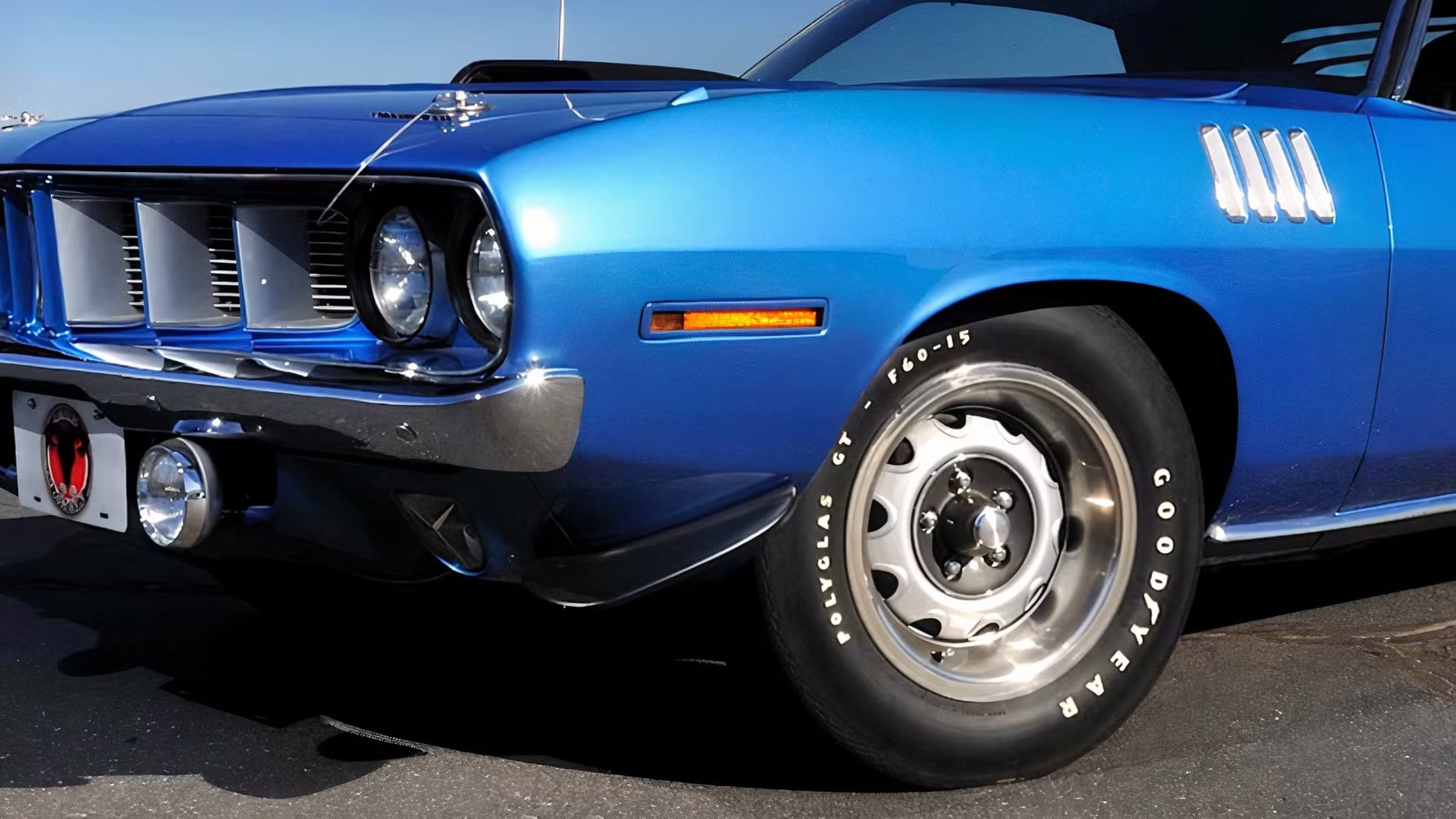
The third-gen Plymouth Barracuda along with the first-gen Dodge Challenger were introduced in 1970 on Chrysler’s E-body platform, and while both share a similar profile, they are very different cars. With unique sheet metal and grilles, the Barracuda and Challenger were not twinsies, and the Dodge was an intermediate with a 110-inch wheelbase, while at two inches shorter, the Plymouth was a compact. We chose the 1971 Hemi ‘Cuda for this entry because it was just a little bit more distinctive than the ’70, with faux quad fender vents that look like gills and a sawtooth grille mimicking the razor-sharp teeth of an actual barracuda. Equipped with a 425 hp, 490 lb-ft of torque 426 Hemi V8, the ’71 ‘Cuda was the dominant force on the streets with a 13.1-second quarter-mile straight from the factory. This was the most formidable street machine of the Golden Age, with no intermediates coming close.
1
1969 AMC AMX
Wheelbase: 97 Inches

As a compact two-seater, the AMC AMX probably should have been classified as a sports car, but it is widely known as a muscle car. What is not in dispute is the AMX’s compact credibility with just 97 inches of wheelbase, making it positively tiny. AMC wanted in on the pony car trend, but because it was a smaller company with fewer resources, it couldn’t design both a notchback and fastback as the Mustang had, so it combined both styles into one model. The 1969 AMX with a 315 hp, 425 lb-ft of torque 390 V8 didn’t intimidate Mopar owners, but at just around 3,000 pounds it was quick enough for a 14.2-second quarter-mile time that could beat most Ford and GM muscle cars. Like all AMC classics, the ’69 AMX is extremely affordable, with pristine examples selling for under $70,000, which is genuinely a good thing. No one would use a half-million-dollar Boss 429 as a daily driver, but a $65,000 AMX can be driven and enjoyed all week long.

Related posts



Latest Post


No Comments