
The Motorcycle That Could Be The Most Complete All-Rounder In Its Class
Buying a motorcycle is great until you realize that the cruiser you love isn’t exactly at home in the city, the sport bike you bought isn’t much use once the pavement runs out, or the enduro that thrives off-road isn’t exactly built for mile-munching. Every type of motorcycle has its strengths, but those strengths usually come with compromises.

Then there’s the adventure motorcycle, promising to be the jack of all trades and master of none. But that opens another Pandora’s box: do you go for a sub-500cc ADV and sacrifice some highway ability, jump into the liter class and accept more weight and a higher price, or find the sweet spot somewhere in between?
What Smaller And Larger ADVs Compromise
Go too small, and something like the Royal Enfield Himalayan 450 gives you the simplicity and character of a 452cc thumper, but it can feel less effortless when you’re spending hours on the highway with luggage. Go the other way with something like the BMW R 1300 GS, and you get 145 horsepower and serious long-distance ability, but you’re also dealing with more weight, bulk, and a much higher price when the trail gets tight or the terrain gets loose.
Why Middleweight ADVs Are The Ultimate All-Rounders


That sweet spot in between could be the middleweight category. But even after settling on a middleweight ADV, there’s still plenty of choosing to do. You could go for something like the Yamaha Ténéré 700 if you want your adventure motorcycle to lean heavily toward off-road riding, or pick the Suzuki V-Strom 800 if most of your adventures are going to happen on asphalt.
Or, perhaps, yet again, something in the middle could work. But which middleweight actually walks that line between asphalt and dirt without compromising either — and without the price of a liter-class bike?
The Honda Transalp Hits The Sweet Spot

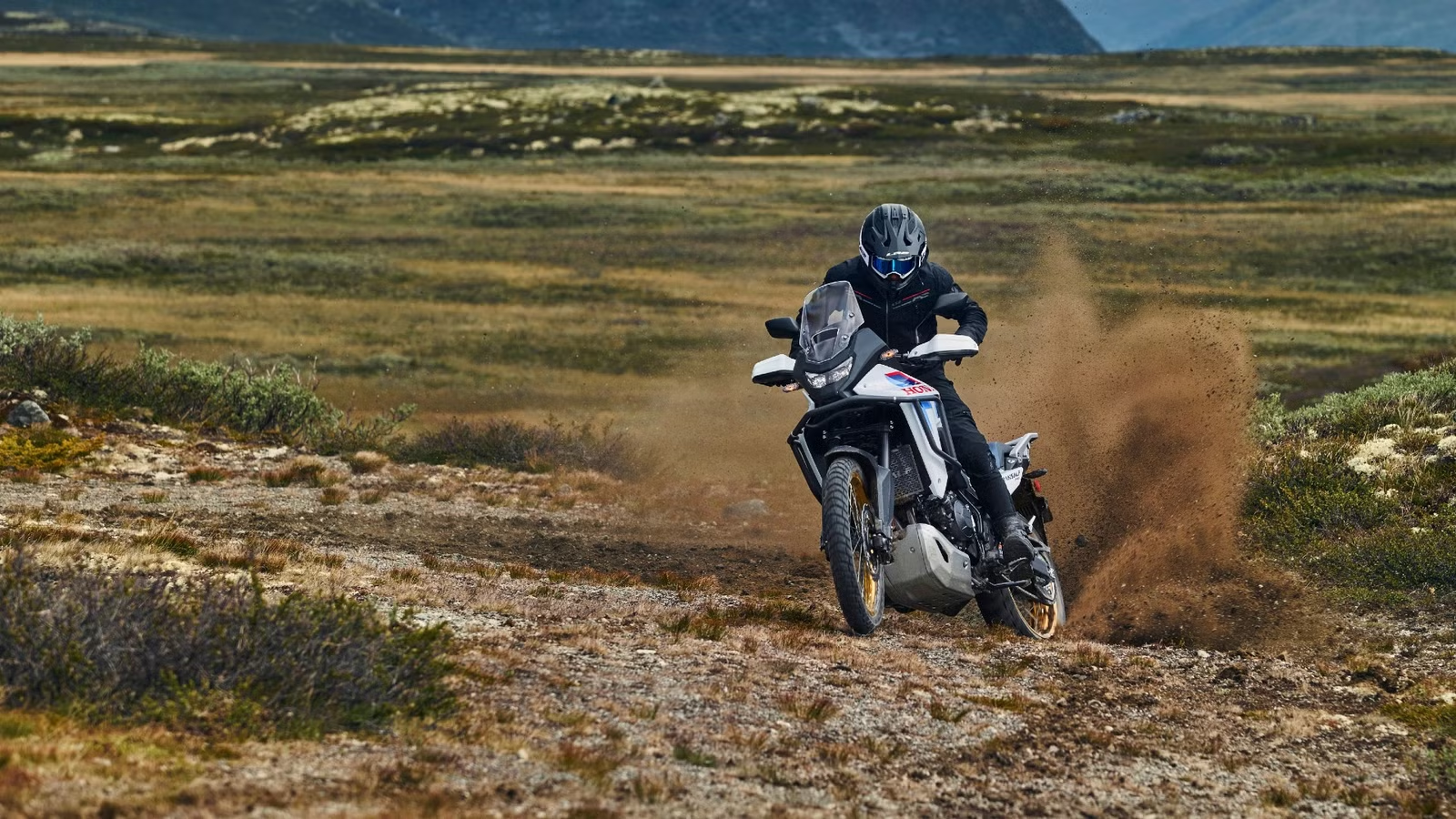
This is exactly where the Honda XL750 Transalp E-Clutch comes in. If you’re already looking at the middleweight segment and want a motorcycle that can eat up highway miles before taking you down a gravel road or trail, without pretending you’re about to enter the Dakar Rally, the Transalp makes a pretty strong case for itself.
755cc Parallel-Twin With 91 Horsepower And 55.3 Pound-Feet

The Transalp’s 755cc parallel-twin is based on the engine used in the CB750 Hornet, and it’s a pretty versatile motor. The commonly cited 90.5-horsepower and 55.3-pound-feet figures come from Honda’s global specifications, while Honda U.S. doesn’t officially publish horsepower and torque figures for the North American model. Honda describes the engine as delivering strong performance across the revrange, and there is enough higher-rev punch when you want to have some fun with it. A six-speed gearbox puts that power to the rear wheel.
It Can Handle The Dirt Without Becoming A Dirt Bike

The Transalp doesn’t go quite as far down the off-road rabbit hole as something like the V-Strom 800DE, and that’s partly the point. Suzuki gives the DE more suspension travel and ground clearance, but it also weighs nearly 40 pounds more, while the Honda takes a slightly more measured approach to off-road hardware. That makes the Transalp less intimidating when the trail gets tight without taking away its ability to deal with the kind of dirt riding most owners are likely to encounter.
21-Inch Front Wheel, 18-Inch Rear And Long-Travel Suspension

The Transalp gets the classic 21-inch front and 18-inch rear ADV setup, which helps it roll over rough surfaces while still behaving predictably on the road. Its 7.9 inches of front and 7.5 inches of rear suspension travel are enough for the kind of off-road riding most owners are likely to encounter, although the Yamaha Ténéré 700 offers 8.3 and 7.9 inches respectively. That difference is small, but it shows where the Transalp sits in the middleweight ADV spectrum.
Ground Clearance And Off-Road Riding Modes

The Transalp has around 8.2 inches of ground clearance, while the Yamaha Ténéré 700 gets 9.4 inches, giving the Yamaha an advantage when the terrain gets properly rough. The 8.2-inch figure is independently reported rather than explicitly listed by Honda U.S. The Honda also gets five riding modes—Sport, Standard, Rain, Gravel, and User—which let riders adjust engine power, engine braking, torque control, and ABS intervention depending on the surface.
A Manageable Curb Weight For An Adventure Bike

At 468 pounds ready to ride, the Transalp E-Clutch isn’t the lightest middleweight ADV out there, but it remains reasonably manageable for a motorcycle of this size. The Ténéré 700, for example, comes in at 459 pounds wet, while the Suzuki V-Strom 800DE is around 507 pounds.
So, even if you tip it over, your deadlift PR doesn’thave to be anything spectacular to get it back on its feet. That weight figure also has an unexpected benefit on pavement — which is where the Transalp arguably shows its most surprising side.
The Transalp Is Built For Touring

The Transalp is perhaps more biased toward time on asphalt, and that’s not necessarily a bad thing for an adventure tourer. The standard windscreen isn’t adjustable, which is a little disappointing for longer highway runs, but the 4.4-gallon tank is well suited to covering serious distances. The standard seat gives you a 33.7-inch perch, while Honda’s Low Seat provides a lower option for riders who want easier footing.
And Still Works As An Everyday Motorcycle

Honda’s Low Seat drops the Transalp’s seat height to 32.6 inches. That makes a meaningful difference when you’re dealing with traffic, parking lots, or just trying to get both feet down at a stop. The upright riding position, manageable dimensions, and two-up seat also make it easy to live with when you’re in between adventures and just going about your business in the city.
Technology Makes The Transalp Even More Adaptable

The Transalp gets a five-inch full-color TFT display, and it is about as straightforward as displays come. There’s no huge visual wow factor here, but it gives you the information you actually need, including speed, fuel level, gear position, trip information, ride mode, and rider-aid settings. Then there’s the E-Clutch, which can handle clutch operation for you while still letting you use the conventional clutch lever whenever you want. The system can also be switched off through the TFT menu if you prefer to operate the motorcycle like a conventional manual.
The Competitive Price Makes It More Attractive

At $10,199 before Honda’s $600 destination charge, the 2026 Transalp E-Clutch undercuts the Yamaha Ténéré 700’s $10,999 MSRP by $800. It also undercuts the Suzuki V-Strom 800DE by $1,600 based on its $11,799 MSRP. That becomes even more interesting when you consider the Transalp gets Honda’s E-Clutch system as standard in North America.
In summary, it might not be the motorcycle you buy with your heart, but the Transalp makes a pretty strong case for being the one you buy with your brain: friendly, capable, and able to do just about everything without making a big deal out of it.
Sources: Honda

Related posts



Latest Post


No Comments