
1972 Ford Gran Torino 351 Cobra Jet: The Muscle Car Nobody Noticed
Many believe the golden era of the muscle car ended in 1970. The insurance crackdown, the emissions rules, and a wave of engines that looked gutted on paper led historians to close the book and move on.

That version of the story of the muscle car misses a Ford that hit 60 mph in 6.8 seconds in 1972, wearing a Cobra Jet badge years after most enthusiasts assume the name had been retired. It hid inside a body-on-frame luxury coupe that insurance companies and enthusiasts both dismissed at the time. Barely 2,000 buyers checked the right boxes on the order sheet.
Why The Muscle Story Stops Short Of 1972
Insurance companies spent the early 1970s making performance cars expensive to own. Surcharges on high-powered intermediates climbed fast, and buyers who wanted a big engine increasingly found the annual premium cost more than the option itself. Emissions rules tightened at the same time, forcing compression ratios down across every American engine lineup.

The industry switched to SAE net ratings for 1972, measuring output with the exhaust, alternator, water pump, and air cleaner all bolted on. Gross ratings had measured a bare engine on a stand, so identical hardware suddenly read far weaker on paper without losing a single part.
Ford’s 460 dropped to 8.5:1 compression for 1972 and a 212 hp rating, then fell again to 200 hp the following year. The engine’s basic design never changed through any of it, which made the paper decline look far steeper than the mechanical one.
Ford’s 429 Cobra Jet had carried 370 hp in 1971, and the Super Cobra Jet 375 hp, and both vanished for 1972. They went out alongside the Cobra model itself, which had been the company’s intermediate performance halo since 1969. The whole mid-size line got repositioned toward luxury, with plusher trim and quieter rides replacing stripes and scoops.
Historians looked at the collapsed numbers and the missing nameplates and wrote 1972 off as the year Detroit gave up. Ford had not stopped building a fast intermediate that year. The company had just stopped putting the fast part where anyone expected to find it.
The Luxury Coupe That Kept The Cobra Jet Badge Alive

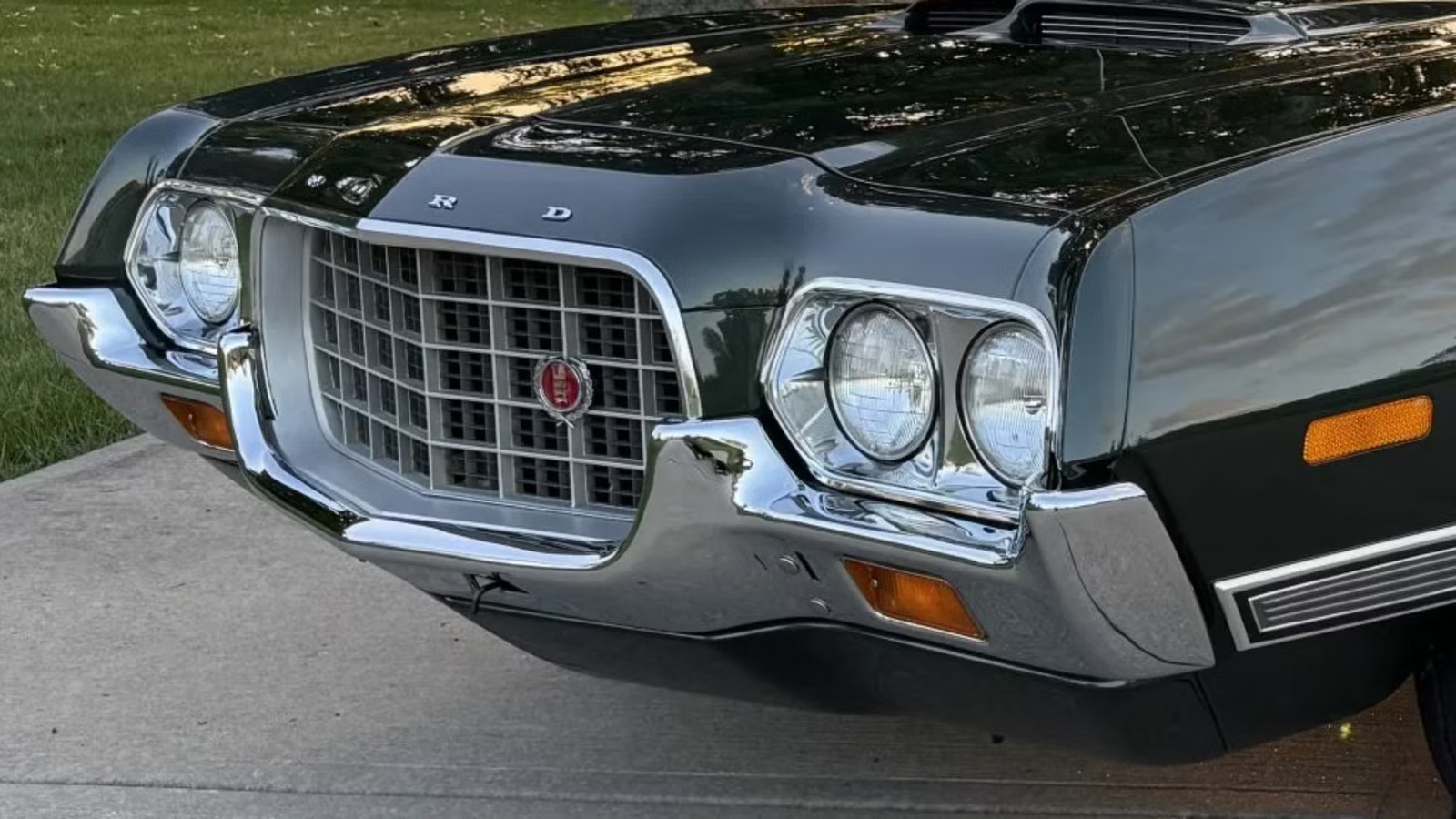
The 1972 Ford Gran Torino Sport took over from the Torino GT that year, arriving as part of a full redesign of Ford’s mid-size line. It grew longer, wider, and heavier, and it wore an egg crate grille so large that one period road tester likened its face to a killer whale. Nothing about it looked like a follow-up to a muscle car.

Underneath, Ford threw out the old Falcon-derived unibody and switched to body-on-frame construction. The new perimeter frame was essentially a scaled-down version of the full-size Ford chassis, and it added roughly 300 lbs. Five cross members, 14 rubber body mounts, and an energy-absorbing S-shaped front section were all aimed at isolating the cabin from the road.
The track was at least 2 inches wider than the 1971 car, with unequal-length control arms up front and a four-link coil-spring setup at the rear. All of it pointed toward comfort rather than lap times.

Top of the engine list was the Q-code 351 Cobra Jet, a Cleveland-block V8 rated at 248 hp and 299 lb-ft. The hardware was serious for the era: four-bolt main bearings, a performance intake manifold, a high-lift camshaft with hydraulic lifters, and a four-barrel Motorcraft carburetor. It continued the line that ran through the 1971 Boss 351 and shared its architecture with the 1972 351 HO.
Period testing put a four-speed SportsRoof running 3.50:1 gears at 60 mph in 6.8 seconds, with quarter-mile times in the mid-15s. Reviewers praised the ride even on cars ordered with the competition suspension, which was not something anyone said about a 1970 Chevelle.
The 429 Was The Wrong Engine To Order

A 429 sat on the 1972 order sheet, which is where most of the confusion about this car starts. It was not a Cobra Jet, because both the 429 Cobra Jet and the Super Cobra Jet ended production after 1971. What buyers actually got was a plain 429-4V rated at 205 hp and 322 lb-ft.
That torque figure is higher than the Cobra Jet’s 299 lb-ft, and it is the detail that trips people up. The 429 still needed about 9.2 seconds to reach 60 mph, roughly two and a half seconds behind the smaller engine. Peak torque arrived early in the rev range and there was very little above it.

Low compression, a mild camshaft, hydraulic lifters, and small-port heads made the 429 a relaxed highway engine rather than a performance one, which is exactly what Ford intended. Buyers who wanted effortless torque for towing and cruising got it, and buyers who wanted acceleration were better served by the smaller block.
Often, the 1972 car is credited with a 455 and 510 lb-ft that never existed on any Ford that year. The real flagship engine was the 351 Cobra Jet at 248 hp and 299 lb-ft.

Surviving 429 cars keep the story alive because the badging and valve-cover callouts read as Cobra Jet to anyone not checking the paperwork. Ford’s engine code sits in the fifth character of the VIN, and a genuine Cobra Jet car reads Q. The performance crown had moved to the smaller block, and almost nobody noticed.
Only 2,091 Buyers Ordered The Right Combination

Ford built 60,794 Gran Torino Sport SportsRoofs and 31,239 Sport hardtops for 1972, roughly 92,000 cars between them. The plain Gran Torino two-door hardtop, with no Sport package at all, sold 132,284 units in the same year. Buyers wanted the comfortable version of this car by a wide margin.
Marti Auto Works production records show that just 2,091 SportsRoofs left the factory with the 351 Cobra Jet and the four-speed manual. That works out to roughly one in every 29 SportsRoofs built. Hardtop coupes with the same combination are counted separately, so the true performance build was scarce even inside an already narrow slice of the lineup.

The Cobra Jet was the only 1972 Torino engine offered with dual exhaust, and the only one that could be paired with the four-speed. Every other engine in the range, including the 429, forced a three-speed automatic. A buyer who wanted to shift gears had no choice but to order the Cobra Jet.
Ram Air was available on the Cobra Jet and the 429, and it turned the hood scoop from decoration into a working intake. Very few buyers checked that box either, and fewer still checked it alongside the manual gearbox.
None of this changed how the car looked from the curb. A Cobra Jet four-speed SportsRoof parked next to a 302-powered automatic showed almost nothing to separate them. That is exactly why insurance companies never singled it out, and why enthusiasts filed the whole model year under luxury coupe.
Four-Speed Cars Are Clearing Concours Book Value Estimates

Hagerty values a 1972 Gran Torino Sport with the 351 Cobra Jet at $43,700 in concours condition, $32,500 in excellent, $23,500 in good, and $15,100 in fair, with a 10 percent bump for the Rallye package.
A four-speed car showing 10,000 miles sold for $61,000 on Bring a Trailer in June 2026 carrying upgraded Ford Racing parts for the engine, and another four-speed with 85,000 miles brought $50,500 in March. Both cleared the concours figure, one by about 16 percent and the other by roughly 40 percent.

One four-speed had covered 10,000 miles and the other 85,000, and both still beat the automatic by a comfortable margin. Three sales point in the same direction as the production records do. The engine paired with the correct gearbox is what really determines its value. Anyone shopping should check the fifth VIN character for the Q code and ask for a Marti Report before committing.
Sources: Bring A Trailer, Hagerty, Mecum Auctions

Related posts



Latest Post


No Comments