
The Analog Superbike That Still Feels Insane Today
The nineties were a very exciting time to be alive as a sport bike rider, with technologies advancing fast and highly anticipated launches happening at a rapid pace. Ducati debuted the beloved 916 in 1993 and was killing the WSBK game with its subsequent homologation variants, while Honda raised the production sport bike standard in ‘92 with the CBR900RR Fireblade. Meanwhile, Japanese manufacturers together with Honda were engaged in something of an arms race, constantly trying to outdo one another in terms of outright speed and all-round performance. In 1996, the CBR1100XX Super Blackbird became the world’s fastest production motorcycle with a top speed of just under 180 mph.


Japan’s Speed Wars Rewrote The Definition Of “Fast”

The Super Blackbird’s dominance only lasted about three years, though, before making way for the legendary Suzuki GSX1300R Hayabusa to take the crown. It came with a top speed of 194 mph, which ultimately led to the informal gentlemen’s agreement to cap speeds at 186 mph before regulatory bodies stepped in. But speed wasn’t the only thing that mattered, of course, and Suzuki had also been continuously building its superbike cred with the GSX-R750 and its bigger GSX-R1100 sibling. Honda had the Fireblade, Kawasaki brought us models the Ninja ZX-7R and ZX-9R, and Ducati’s 916 remained popular until it was replaced by the 996 and the later 998. What was Yamaha up to, though?
10 Big-Bore Vintage Superbikes Real Riders Worship Forever
These legendary machines from motorcycling’s golden era continue to command massive respect and serious auction money decades later.
The Bar Was About To Be Raised Yet Again

Introduced in 1996, the YZF1000R Thunderace became Yamaha’s flagship sport bike complete with a liquid-cooled 1,002cc inline-four engine. The powerplant made a very healthy 145 ponies at 10,000 rpm, thus enabling the Thunderace to hit speeds of up to 164 mph. And the chassis was pretty sweet, as well, but nothing about the YZF1000R was particularly groundbreaking. Yamaha knew it needed to dial things up a notch in order to get ahead of its competition, so it went back to the drawing board and began planning a huge technological leap for 1998. This came to represent one of the biggest milestones in superbike development, and now it’s time for us to dive straight into the deep end.
The First American Bike To Hit 150 MPH From The Factory
This pioneering American sportbike broke barriers in 2007 when mass production bikes from the US lagged behind the world.
The Yamaha YZF-R1 Sent Shockwaves Through The Industry

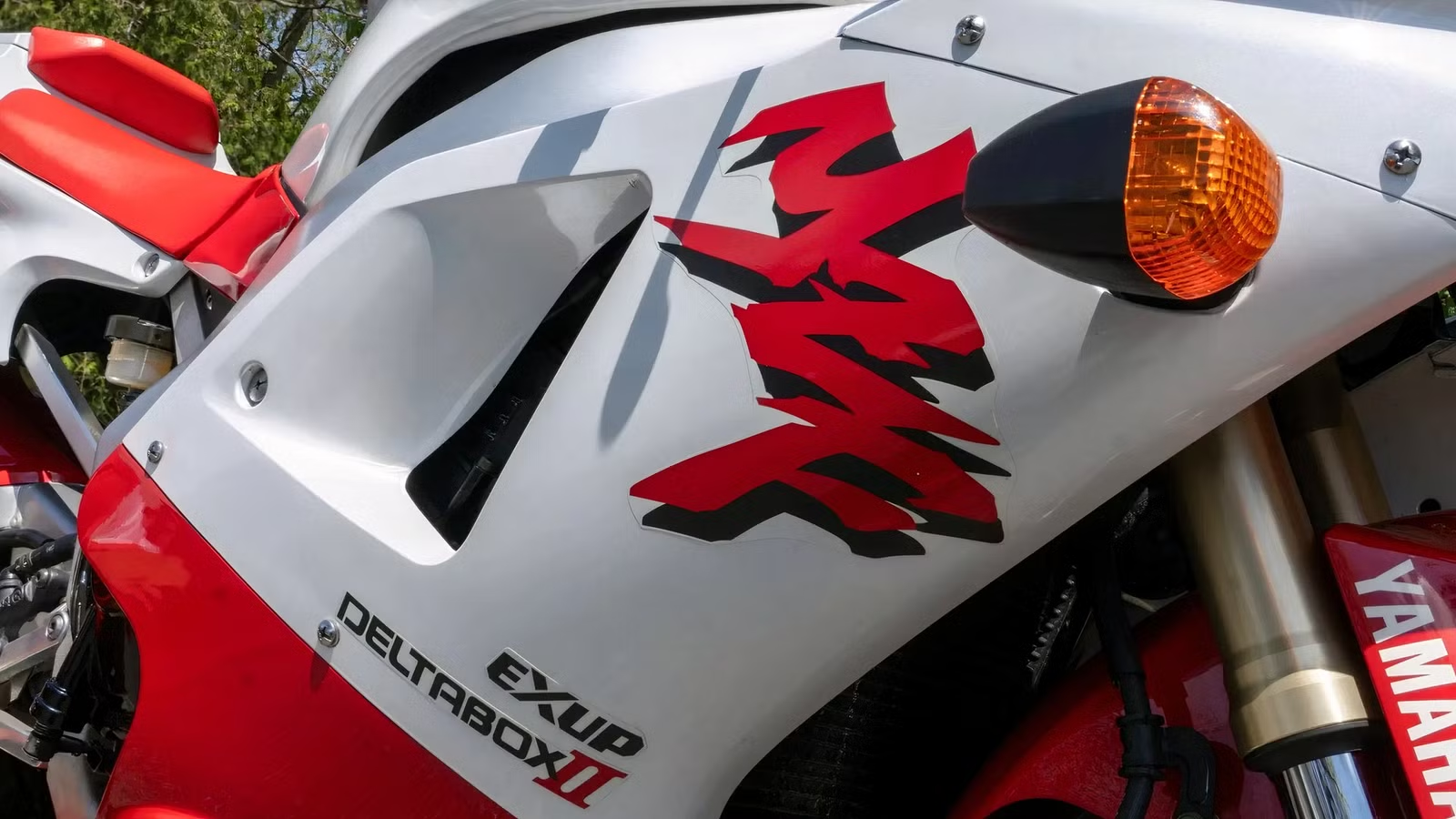
The coveted YZF-R1 came in swinging when it was unleashed by Yamaha in ‘98, prepared to redefine people’s expectations of a top-tier liter-bike. Packaging efficiency was one of the main objectives during its development, so as to make the R1 more compact than just about anything else in its class. The bike’s short wheelbase made it incredibly agile and nimble around corners, but it also brought about wheelie-prone behavior as a side effect. It was a demanding ride, for sure, yet one that could also be highly rewarding once you knew what to expect. The bike’s tight proportions were in part made possible by Yamaha’s stacked gearbox design.
Technical Specifications
|
Engine |
Liquid-Cooled 998cc Inline-Four |
|
Valvetrain |
DOHC, 5 Valves Per Cylinder |
|
Compression Ratio |
11.8:1 |
|
Horsepower |
150 HP @ 10,000 RPM |
|
Torque |
80 LB-FT @ 8,500 RPM |
|
Transmission |
6-Speed |
|
0-60 MPH |
2.8 Seconds |
|
Quarter-Mile |
10.32 Seconds |
|
Top Speed |
172 MPH |
Said arrangement places the transmission shafts on top of one another instead of the conventional setup where one sits behind the other. The design is much more compact and effective at mass centralization, which explains why you’ll find it on most modern motorcycles. Then there was the R1’s beastly powerplant – a liquid-cooled 998cc four-banger with five valves per cylinder, dual overhead camshafts and a compression ratio of 11.8:1. The engine could muster up to 150 horsepower at 10,000 rpm and about 80 pound-feet of torque at 8,500 revs, all sent to the rear wheel via a six-speed transmission.
According to period testing performed by Cycle World, the Yammie could accelerate from zero to 60 mph in a mere 2.8 seconds. In addition, its quarter-mile time was rated at 10.32 ticks of the stopwatch, and top speed sat at 172 mph. This outstanding performance was in no small part a product of the R1’s power-to-weight ratio, the best of any liter-bike at the time of its release. Yamaha’s crotch rocket tipped the scales at just 390 pounds without fluids, while also benefiting from a robust chassis to tame all its power. The bike’s anatomy featured a light Deltabox II aluminum frame, resting on 41-millimeter (1.6-inch) inverted forks at the front and a fully-adjustable monoshock at the rear. For ample stopping power, the R1 used dual 298-millimeter (11.7-inch) brake discs and four-piston calipers up north, along with a single 256-millimeter (10.1-inch) rotor and a two-piston caliper down south.
Yamaha Built A V4 Two-Stroke That Shook The World To Its Core
This Yamaha exploded onto the motorcycling scene and changed bikes forever
Analog Superbike DNA At Its Very Best

In hindsight, another striking characteristic of the original R1 is the complete lack of electronic interference. There were no fancy ride assists like ABS or traction control to hold one’s hand; only the bike’s visceral character demanding skill and precision from those who took it for a spin. And for riders who crave that raw analog experience today, the YZF-R1 is the ultimate expression of it in superbike form. Upon its arrival, Yamaha’s icon became the new benchmark for all other liter-bikes to aspire to, but it still made use of some old-school tech like carburetors and a cable-operated throttle. That minimal use of electronics places it in an interesting sweet spot, where its blistering performance still feels insane by today’s standards without all the digital fuss getting in the way. But be sure to treat these early R1s with respect if you ever get the chance to ride one, because it won’t hesitate to bite back when it feels that your confidence outmatches your ability.
The Yamaha R7 Homologation Bike Collectors Quietly Hunt Now
Aside from the name, it has nothing to do with the twin-cylinder R7 currently in production, instead tracing its origin back to WorldSBK racing.
A Lasting Legacy Whose Impact We Still Feel Today

It’s difficult to overstate how much of a game-changer Yamaha’s flagship was all these years ago, having ushered in a new chapter of sport bike evolution. The nameplate remains in production to this day, with the current 2026 model extracting nearly 200 horsepower from its 998cc crossplane four-cylinder. Gone is the analog personality of its beloved forefather, though, as we’re now living in the age of ride-by-wire throttles, different ride modes and cornering ABS. Older R1s still hold a special place in many people’s hearts, so it’s no wonder that pristine examples with low mileage tend to fetch a pretty penny at auction.
For instance, a 1999 model with 591 miles on the odo went under the hammer for nearly $18,000 in 2024. Another was sold for $17k on Bring a Trailer earlier that year – a mint-condition 1998 example with 927 miles. Clearly, people have a lot of love for these old-school performance icons, and you should be prepared to spend a decent bit of cash if you’re looking to get one in good shape. For comparison, the 2026 YZF-R1 has an MSRP of $19,199, so we wouldn’t be surprised if these old models from the late nineties will eventually surpass the value of a brand-new machine. They certainly have the cult classic aura to do so, but we’ll have to wait and see what the future brings.
Sources: Yamaha, Cycle World, Bennetts, Motorcycle News, Classic Two Wheels, Bring a Trailer

Related posts

Latest Post


No Comments